
Pinoy-Hapon United Foundation (PHUF), a non-profit organization, Honorary Chairman Takeshi Asanuma
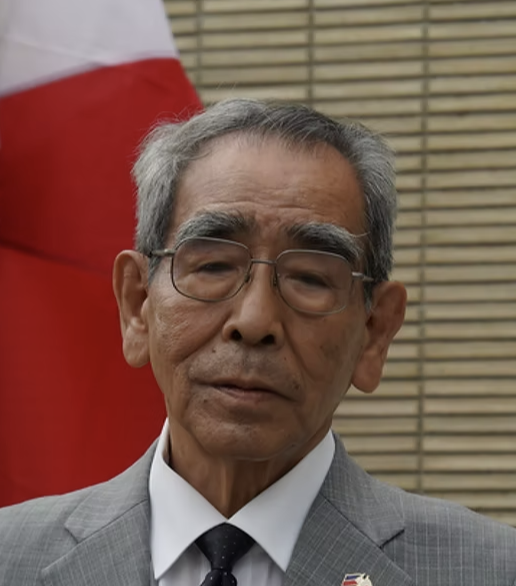
Those who served in the previous war, the Greater East Asia War, who actually took part in combat, survived, and returned home, must by now be well past the age of 100, and opportunities to hear their experiences directly are fast disappearing. Even those who fought as boy soldiers at the age of 17 or 18 at the time are already well into their nineties. The chance to hear firsthand accounts of that horrific wartime experience is steadily slipping away.
I was born in Shōwa 13 (1938), and by the time I became aware of the world around me, the country was already in the midst of war. When Japan surrendered unconditionally in August of Shōwa 20 (1945), I was on summer vacation as a first-grader at national school. The wartime experiences I underwent just as my sense of self was awakening burned themselves into my mind as a kind of PTSD, a formative experience I have never been able to forget, and I have carried that harrowing memory in a corner of my heart all the way to this, my eighty-eighth year.
It is my earnest wish to pass on even a small part of the “war” I experienced to younger generations, and to have them keep the Greater East Asia War — now a matter of history — in their memory. In Shōwa 19 (1944), my father went off to war, to Aomori; my great-grandmother and grandparents moved outside Nara City; and the six or seven household staff we had were each taken off for military service or labor conscription. My father’s youngest brother (26 years old, exempted from military service due to poor health) and his wife (with a one-year-old son) lived nearby and helped with the family business, but my mother looked after them as well.
From around the end of Shōwa 19, B-29s began coming to bomb the skies over Osaka with some frequency. From time to time, I was able to witness what looked like aerial combat with intercepting fighter planes. Anti-aircraft guns on the ground also opened fire, and B-29s were shot down over the city of Osaka as well; the adults in our neighborhood would go to see the wreckage and come back with accounts of the gruesome scenes. It seems that large crowds subjected the American airmen killed there to public humiliation.
Once the new year came, the air raids centered mainly on nighttime, and an air-raid warning was issued almost every night. Nighttime air raids are truly terrifying.
My younger sister and I would be carried by our mother as we fled into the air-raid shelter. Formations of B-29s, illuminated by searchlights from the ground, scattered one-ton bombs across the city of Osaka, destroying every kind of structure and gouging craters some seven or eight meters across into the roads.
I would shiver inside the air-raid shelter, listening to the whistling sound of falling bombs — from the pitch of the sound, you could guess how close it would land. When I thought, “this one’s close,” a tremendous BOOM would echo nearby and the shelter itself would shake. This kind of terror would go on for more than an hour at a stretch. NHK kept broadcasting the air-raid warning throughout, and once it was lifted, it would air the Central Military District’s report: “Enemy aircraft have withdrawn to the west of the Kii Peninsula.”
The day after an air raid, I went to see the bombed site in our neighborhood. Four or five wooden houses had been blown apart, and a large crater had opened in the nearby road. The civil defense corps was clearing the site, and I was told that in the courtyard of one of the bombed houses there had been an air-raid shelter, inside which two people had died. There was no telling when or where death by bombing might strike.
To prevent fires from spreading during bombing raids, the forced clearance and demolition of densely packed wooden housing began in various parts of the city. In my own neighborhood, too, the densely built wooden housing near Kintetsu Uehonmachi Station was forcibly torn down, creating an open plaza in front of the station — but after the war ended, a black market sprang up there, lined with restaurants and food stalls. It was redeveloped in Shōwa 54 (1979), and that redevelopment became what is known as “Uehonmachi Hai Hai Town.”
Next after the B-29 bombing raids, the most terrifying thing was strafing by carrier-based aircraft and fighter planes.
These began appearing all across Japan from around the time Japan’s control of the air had weakened, in Shōwa 20 (1945). There were the square-winged Grummans and the twin-boomed Lockheed P-38s. They attacked indiscriminately — not only military targets but civilian trains, vehicles, buildings, and people alike — strafing at such low altitude that you could make out the pilots’ faces.
I will talk about the strafing attacks in the next installment.
コメント