
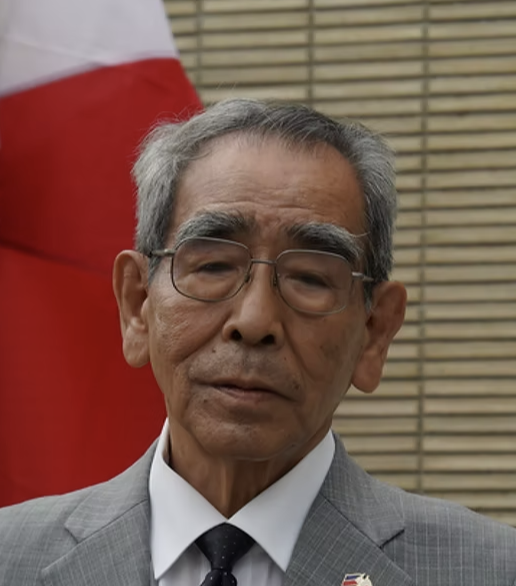
Pinoy-Hapon United Foundation (PHUF), a non-profit organization, Honorary Chairman Takeshi Asanuma
When speaking of the relationship between Japan and the Philippines before, during, and after the war, there is one man who absolutely cannot be left out: Mr. Osawa Kiyoshi. Born in Gunma Prefecture in 1903 (Meiji 36), he conceived the idea of “making his fortune overseas” at the age of 19 in 1925, went to Yokohama to gather information, and decided to head for “Luzon.” He sailed to Manila on an emigrant ship, went south as far as Zamboanga in Mindanao, where he had heard “there was work,” but found nothing suitable there either, and so crossed by local boat to Basilan Island to the southwest.
There he met an American named Robinson who ran an orchard and other ventures, and found work under him. Osawa worked diligently, overcame hardship after hardship, earned his employer’s trust, and eventually was entrusted with the whole of his business.
In 1929 (Showa 4), Osawa left the orchard on Basilan Island and planned to go into business for himself. After some years away, he returned briefly to Japan to raise capital, signed agency agreements with the Mizuno sporting-goods company and the Club cosmetics company, and went back to Manila to begin importing and selling sporting goods and cosmetics, branching out into trading. Through his experience and drive, he swiftly rose to a leading position among the Japanese companies and the Japanese community on Luzon at the time, took an active part in local community affairs, deepened his ties with local notables, and secured a firm standing in Manila’s business circles.
On December 8, 1941 (Showa 16), the “Greater East Asia War” broke out, and Japan advanced rapidly. On January 2, 1942, the “14th Army” under Lieutenant General Masaharu Homma made a “bloodless entry” into Manila. Murata Shozo, a former Minister of Railways and president of Osaka Shosen, came to the islands as an administrative advisor to the Japanese military, assisting the Japanese military headquarters, and made contact with Osawa. Osawa was given the status of a staff officer-equivalent civilian employee of the Japanese military and pledged his full cooperation with the occupation policy.
Under Japanese military occupation, the nationalist, pro-Japanese politician José P. Laurel was elected “President” by the National Assembly, and moves were made to declare the territory’s “separation from the United States.” Murata and Osawa supported and cooperated in this, and with the agreement of the Japanese military as well, the founding of the “Republic of the Philippines (the Second Republic)” was proclaimed on October 14, 1943, positioned as a continuation of the “Malolos Republic (the First Republic)” established in 1898 by the revolutionary nationalist politician Emilio Aguinaldo, inheriting part of its flag and constitution. From that point on, this territory came to be called “the Philippines.”
Murata Shozo became the first Ambassador Extraordinary and Plenipotentiary to the Republic of the Philippines.
Yet the “Rising Sun” flag would not fly over the skies of the “Republic of the Philippines” for long. American forces steadily pressed up from the south. In late October 1944, Supreme Commander of the Allied Forces Douglas MacArthur landed at Leyte with a great army, defeated the Japanese forces, and pushed north toward “Manila.” In early January 1945, a total of some 200,000 American “mechanized forces” landed at Lingayen Gulf and began their advance southward. American aircraft also began appearing frequently over Manila, strafing Manila’s port and Japanese military facilities, while in the harbor lay the grounded hulks of numerous Japanese naval vessels that had been rendered unable to sail.
In January 1945, General Yamashita abandoned the idea of a decisive battle in the densely populated city of Manila, and led a force of some 100,000 men in a withdrawal to the Baguio mountain region about 200 kilometers north of Manila, taking up positions in several locations. The defense of Manila was left to the “Naval Landing Force,” which was annihilated in the ferocious “Battle of Manila” fought from February 3 to March 3, 1945 (the “Manila Naval Defense Force,” some 26,000 men in all).
In early January 1945, at the request of the military headquarters, Osawa gathered up the heavy oil, gasoline, light oil, and other fuel stores scattered around the Manila area, organized a convoy of tanker trucks, and took charge of transporting them north to the “Yamashita Group,” setting off toward the north. (To be continued)
コメント