
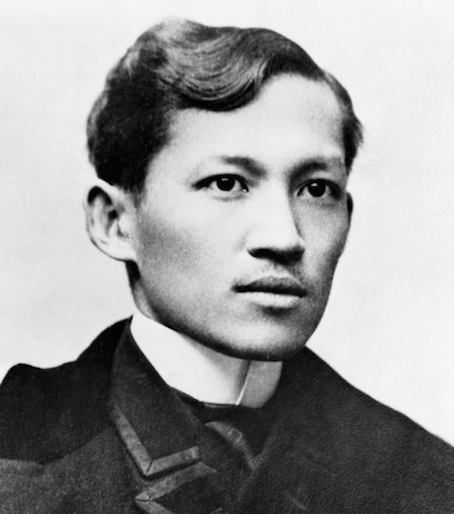
By Yasotarō Mōri
▲ Shadow the First
It was while he was preparing to enter the Ateneo Municipal that his beloved mother was suddenly arrested on suspicion of being an accomplice to attempted murder and held in the prison at Santa Cruz, the capital of Laguna Province. His uncle Alberto of Biñan was his mother’s brother; some years before, Alberto had separated from his wife. The accusation was that his mother had conspired with Alberto to kill this wife. That the charge was a ridiculous fabrication was known better than anyone by the judicial authorities themselves — it was an abuse of power carried out expressly to torment the Rizal family. In sending his mother to Santa Cruz, they went so far as the cruelty of forcing her to walk the full fifty kilometers on foot, permitting her no conveyance.
Some time before this, a Spanish officer had once led a detachment of guards onto the Rizal family’s farmland. Rizal’s strong-willed father, unwilling to let his fields be trampled, demanded that the officer withdraw. The officer, taking this as a grave insult, left in fury, openly declaring that he would make the family pay for it one day.
Around the same time, a Spanish judge also paid a visit to the Rizal household one day. Rizal’s father believed he had received the man with considerable hospitality, but the judge grew angry that he had been treated no differently from an ordinary Filipino, and he too left feeling deeply insulted.
As it happened, this officer and this judge were friends, and the two of them conspired to torment Rizal’s mother in what amounted to revenge for their supposed insults. Since the charge was fabricated, and the presiding judge in the case was this very same man, his mother stood no chance of winning — however reasonably she argued her case, it was of no use, and she was ultimately found guilty. She appealed at once, and won. But the judge then sued her on the bizarre grounds that “the act of appealing was itself contempt of court.” The case was carried up to a higher court, where this same strange charge of contempt was upheld all over again — a pattern repeated until his mother had been in and out of prison six times in all. Everyone around her grieved, believing she would probably never see the light of day again.
After two and a half years in prison, his mother was suddenly released. Around that time, the Governor-General of the Philippines was making a tour of inspection and visited the town of Calamba. The town welcomed him in various ways, including a dance performed by several young girls. One of the girls danced so beautifully that the Governor-General called her over and asked what reward he might give her. Without hesitation, the girl replied, “As my reward, please pardon my mother.” The girl was Rizal’s youngest sister. The Governor-General readily agreed, and on the spot ordered that her mother be released at once. That an educated woman, the mother of ten children, could be held in prison for two and a half years on a completely trumped-up charge, only to be suddenly freed as a reward for a young girl’s skillful dancing, shows just how lawless Spanish colonial rule over the Philippines was at the time — and yet the Filipino people, however indignant they felt about it, were powerless to do anything at all.
▲ Shadow the Second
José’s elder brother, Basio, was at that time studying at San José College in Manila, and had come to deeply respect and study under Dr. José Burgos, a Filipino. It happened that, in Cavite near Manila, Filipino priests had been removed from a church in order to install Spanish priests in their place. Dr. Burgos openly denounced this practice as unjust. Not long afterward, a small band of soldiers and laborers in Cavite banded together in a mutiny. The authorities declared that Dr. Burgos had incited it, and along with two other Filipino priests he was brought before a military tribunal, found guilty, and the three were executed in the most brutal manner. (One of the three, Father Zamora, had sent a friend an invitation to a game of chance, writing — as was customary — not “money” but “ammunition” to bring along. The Spanish authorities seized on this word “ammunition” and read a deliberately sinister meaning into it to secure the men’s conviction.)
Just before his death, Dr. Burgos advised the Filipino people to “seek an education outside the Philippines — if possible, outside Spain as well,” saying that the Philippines could advance only through the enlightenment of its people. (It is easy to imagine that opinions of this kind left a deep impression on Rizal’s mind.) Dr. Burgos further warned that “if the Spanish government does not swiftly reform its misrule in the Philippines, it will lose the trust of the Filipino people, and they will come to long to be the subjects of some other, more benevolent government.” (This “more benevolent government” is understood to have meant Britain — it is worth noting that the English-language newspapers of Hong Kong consistently sympathized with the islanders and criticized the Spanish authorities.) Rizal, as if carrying on Dr. Burgos’s very intent, seemed to spend his entire life striving for justice.
Because of this, Basio, in his bitter outrage, became half-deranged, and would not stop denouncing the lawlessness and injustice of the authorities — so much so that he ultimately lost his eligibility to sit for the next advancement examination. This happened almost immediately before Rizal left for Manila.
These two incidents cast a deep shadow over the young Rizal’s heart, and it can even be said that they had a profound effect on his outlook for the rest of his life, becoming a distant cause that would govern his conduct to the very end. He felt, with piercing conviction, that “the Filipino people must be saved.” He had, of course, no idea at the time how this might be achieved, but he resolved firmly that, whatever means it took, save them he must.

コメント