
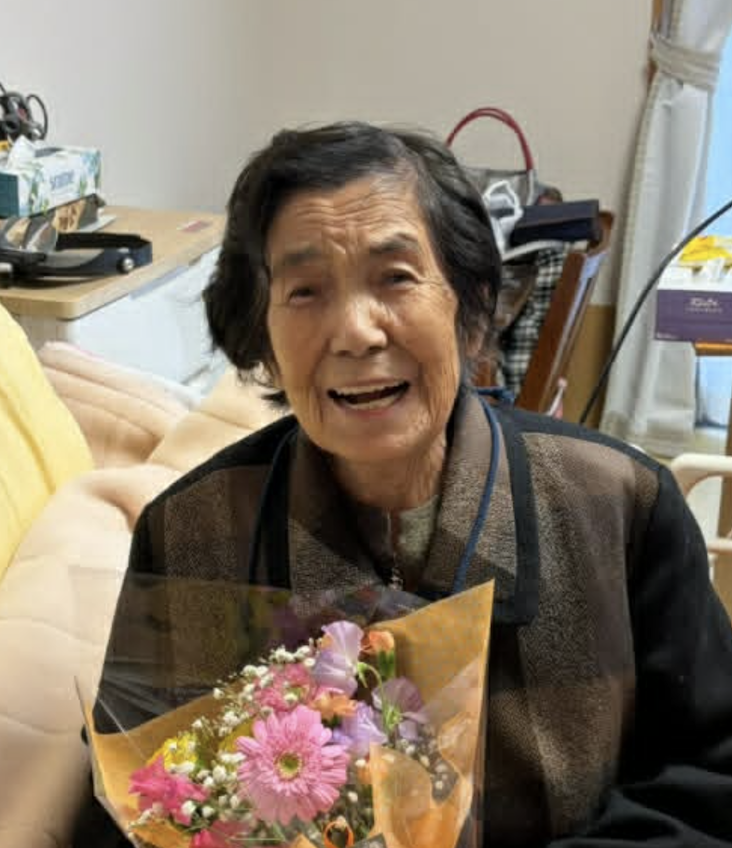
Hisako Kamikita (maiden name: Kimura), born January 8, Shōwa 9 (1934), in Arakawa Ward, Tokyo — a repatriate from Korea. Mother of two daughters and one son. Her father was a craftsman specializing in special glassware. She now leads a two-residence life, dividing her time between her home in Takayama, Gifu Prefecture, and “Pension Krone,” a guesthouse she runs in the town of Samboan, Cebu Province, in the Republic of the Philippines.
Reunited as a Family in Osaka
Three years after repatriating to Japan, her father and stepmother finally found stable work in Osaka, set up a new home in Ōyodo Ward, and sent for Hisako and her two brothers, whom they had left behind in Nagasaki.
Looking Back on Life in the Bombed City of Nagasaki
Even so, Hisako often wonders. It was said that in areas contaminated by radiation from the atomic bomb, no plants would grow and no crops could be raised for decades. And yet her family lived in Nagasaki for three years — so why, she wonders, did none of them suffer any ill health effects at all?
As it happens, her stepmother’s family home was in Nishiyama-machi, near Suwa Shrine, while the atomic bomb detonated over Matsuyama-machi, about three kilometers north of central Nagasaki City. The area around Suwa Shrine, to the south, lay in the shadow of Mount Kompira — a mountain of less than 400 meters — and was spared the bomb’s direct effects.
The Good Fortune That Let All Five Family Members Come Home Alive
Even so, it took a measure of good fortune for all five members of Hisako’s family to make it safely back to Japan without losing a single member, and without any serious mishap along the way. It was fortunate that her father, Suezō, had not been a soldier, and that they had not been residents of Manchuria or northern Korea, far from Busan, the port from which the repatriation ships departed.
Among those repatriating from Manchuria and northern Korea, no small number suffered sexual violence or were killed. In addition, some 575,000 former Japanese soldiers who had the misfortune of being captured by Soviet forces were interned in Siberia, and of these, 58,000 died of hunger and cold, never again to set foot on their native soil.
Marriage, and Life in Takayama
Some time later, Hisako met an electrician named Iwao Kamikita, who had come to Osaka from Takayama, Gifu Prefecture, to study motor repair, and the two married in Shōwa 30 (1955). Iwao owned an electrical contracting company in Takayama called Takara Denki, and before long he and a friend founded a construction company, Takara Kōken Construction, of which he later became president. Riding the wave of Japan’s period of rapid economic growth, Takara Kōken Construction expanded its business, and Iwao also served two terms as a village councilman, but died at the age of 75, partway through his second term.
Hisako became the mother of two daughters and a son, and three years after Iwao’s death, their son, Kazuhisa, took over Takara Kōken Construction, with their second daughter, Naomi, supporting him in running it. A few years ago, Hisako handed the company — by then one of the leading construction firms in the area — over to the two of them, declared to her children that she intended to spend her remaining years doing as she pleased, and traveled the country in search of a place where she might live alone in her old age. She even traveled through Okinawa, from Ishigaki Island to Yonaguni Island, but found that, as a woman living alone in her old age, she was met with wariness by the locals, and that the remote islands turned out to have an unexpectedly high cost of living — making them, in the end, less than ideal places to settle.
Discovering Samboan, Cebu
Then, about five years ago, when Hisako visited Samboan, in Cebu Province — the hometown of a Filipina named Irene, an acquaintance of her son’s classmate — together with her eldest daughter, Yukiko, she fell in love with the place at first sight, and immediately decided to buy a house that happened to be for sale there.
Moved by Hisako’s decision to move, all on her own, to Samboan — a rural corner of Cebu Province that even most Filipinos have scarcely heard of — her eldest daughter Yukiko and her husband, Gen Kuroyanagi, gave up their life in Japan and joined her there. Now the three of them divide their time between the five months from November to March in the Philippines, and the remaining seven months in Takayama. In Samboan, moreover, the daughter and her husband have opened a small guesthouse called “Pension Krone,” where, surrounded by ten mixed-breed dogs (askal), they welcome the occasional guest who comes to stay.
“They Should Try Living Through That Hell Themselves”
“When the local women in Takayama, who never suffered any hardship in the war, see me living this leisurely life and say, ‘Oh, how nice, I’m so envious’ — half admiring, half jealous — I want to tell them: then you should try living through that hell yourselves.”
Having survived the brutal ordeal of repatriation from Korea, there is nothing left in this world that frightens Hisako. We salute her remarkable life. (End)
コメント