
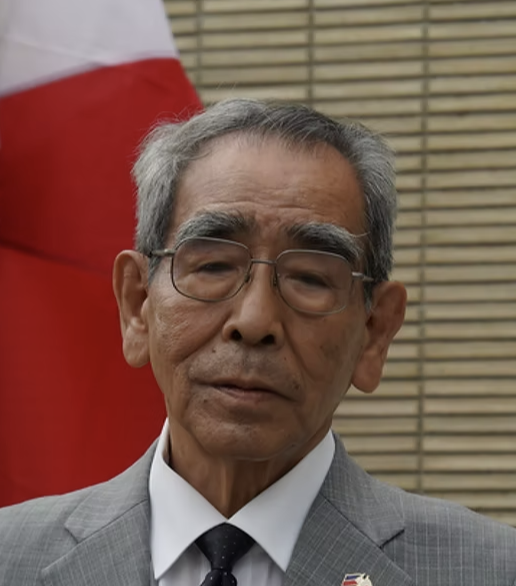
Pinoy-Hapon United Foundation (PHUF), a non-profit organization, Honorary Chairman Takeshi Asanuma
On March 13, Shōwa 20 (1945), we were burned out of our home!
From around the end of Shōwa 19, B-29 night attacks on the city of Osaka were repeated almost daily, but most of them were bombing raids. This particular night, March 13, was different. This was the Great Osaka Air Raid — a series of successive waves of attack using napalm incendiary bombs.
Around ten o’clock at night, the air-raid warning rang out, and a massive formation of B-29s struck Osaka in successive waves. Napalm bombs were dropped in bundles of eight to ten, scattering apart in midair. Each individual bomb was hexagonal in shape, about sixty to seventy centimeters long, and they came raining down separately. They punched straight through tiled roofs as they fell, and immediately burst apart, spraying intensely hot napalm in every direction.
Beating at them with the government-recommended “fire-beating poles” did nothing to put them out, and even water had no effect — they were a nasty thing, continuing to blaze at high temperature wherever they landed. The raid continued until nearly dawn. I heard that many people suffered severe burns trying to fight the fires.
Napalm bombs began falling scattered around our own neighborhood as well, and fires broke out here and there. My father’s youngest brother — my uncle — and his family, who lived nearby, fled into our air-raid shelter. My mother judged that both our house and this shelter were now in danger, grabbed our cash and valuables, and led me, my sister, and my uncle’s family of three out of the shelter, determined that we simply had to flee — but by then the entire area was already a sea of fire.
Before we even reached the main avenue where the streetcars ran, the houses on either side were ablaze, sparks rained down, and our neighbors, too, were fleeing in confusion all around us. Houses were collapsing in flames. The entire sky was a deep red. Even though it was still cold season, hot, spark-laden winds howled around us, and my mother, carrying my sister on her back and gripping my hand tightly, shouted to my uncle, “Let’s flee to the Kintetsu line! Let’s flee to Grandfather and Grandmother’s house in Nara!”
We somehow managed to make it to Kintetsu Uehonmachi Station, but it was already overflowing with disaster victims. The injured were being carried in and laid out on the floor to receive treatment. Many people were silent, still in shock.
Even so, we were told that Kintetsu would run its first train of the day as far as Ikoma. My mother negotiated with a station attendant to let us ride one stop further, to Tobinomura (Tomio) Station, and thanks to that we were able to escape all the way to our grandparents’ house.
Most of urban Osaka was reduced to scorched earth in a single night. Including this First Great Osaka Air Raid, the total number of Osaka residents killed or injured during the war is said to have reached 15,000.
Two other relatives’ households, likewise burned out of their homes in Osaka, also fled to our grandparents’ house, so it ended up holding some twenty people, children included, without nearly enough bedding to go around — everyone simply slept crowded together on the floor.
Even so, I entered the village’s Tobinomura National School on April 1. “♬ Studying together, how happy we are, first-graders at national school” was the first school song I ever learned.
In mid-May, my family and my uncle’s family found a room to rent in Yata Village, at the southernmost tip of Higashisumiyoshi Ward, Osaka City, and moved there; my brother and I transferred to the village’s national school, which had not been evacuated.
However, about twelve kilometers to the west of here lay the city of Sakai, where a naval base was located, and around this time American fighter planes began attacking it frequently — attacks I would come to witness up close.
The American fighters that attacked the base at Sakai would circle around directly over our house before heading back toward Osaka Bay. They were P-38s and Grummans.
I believe it was about three days after we moved. The air-raid warning rang out from the morning, school was called off, and from far to the west came sounds like an exchange of gunfire.
Suddenly, American fighter planes appeared flying low overhead, banked around, and I heard the rat-a-tat-tat of gunfire. It wasn’t even that close, and yet I instinctively threw myself to the ground. My whole body was shaking.
The next day at school, I heard that a train had been strafed near Sugimotocho Station on the national railway. I don’t know the extent of the damage. It was a location about five or six kilometers from where we lived. That was strafing.
*The large-scale air raid that struck Osaka from late on the night of March 13, 1945, into the early morning hours of the 14th, is known as the First Great Osaka Air Raid. The principal weapon dropped by the U.S. Army Air Forces’ B-29 bombers was the M69 incendiary bomb, a type of napalm bomb developed to burn down Japan’s wooden houses, using napalm — a jellied petroleum substance — as its main component.
コメント