
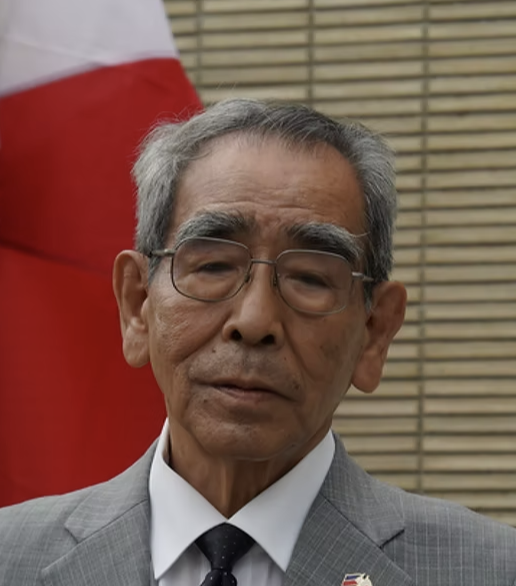
Pinoy-Hapon United Foundation (PHUF), a non-profit organization, Honorary Chairman Takeshi Asanuma
On New Year’s morning of Shōwa 18, we hung the national flag in front of our entrance, and the family, dressed in formal attire, exchanged New Year’s greetings. Ours was a four-generation household — my great-grandmother (88), grandparents (59?), parents (32), older brother (7), myself (5), and younger sister (1) — and it seems this was a ceremony carried on from our samurai-family tradition, though my own memory of it is not entirely certain.
My family line descends from the Kantō warrior clans tracing their ancestry to the Seiwa Genji, and bore the surname Yamana. In the Keichō era, an ancestor from Asanuma District in Musashi Province fought alongside Tokugawa Ieyasu in the Summer Siege of Osaka, distinguished himself, and was granted the fiefs of four villages, including Imago Village, within the Yamato-Kōriyama Domain — territory under the direct control of the Tokugawa shogunate. He thereby became a gōshi (rural samurai), took the family name Asanuma from his home region, and was permitted to bear a sword, carrying on our line as a samurai house.
In Imago Village, the family kept a large moated residence; just inside the main gate, to the right, stood a stable where several riding horses were always kept, and a family temple had also been built on the grounds — but in the end, with the Meiji Restoration, we lost all our land and fortune, becoming a fallen samurai house. My grandmother would always tell me, “We’re a samurai family, you know,” and she herself was the daughter of a samurai house from the Kishū Domain. My great-grandfather, who passed away in Shōwa 9, is said to have resented, for the whole of his life, that the Meiji Restoration had denied him his coming-of-age ceremony and the right to bear a sword.
On the afternoon of New Year’s Day and the morning of January 2 in Shōwa 18, relatives, household staff, and tradespeople who did business with us came, dressed in their finest, to pay their respects — and I believe this was the last of our family’s traditional New Year celebrations. By this time, the war front against the United States seems to have been turning against our country, and the war was drawing closer to Osaka as well. My grandparents said, “Osaka isn’t safe anymore,” bought a house on the outskirts of Nara City, and left Osaka, taking my great-grandmother with them.
The collection of copper and iron began — a government order that every household surrender all unneeded metal for weapons manufacturing. Each household turned in nearly all its iron goods, keeping only the bare minimum of pots and kettles, and even the metal security bars on windows were replaced with wooden ones. Even the gold buttons on our school uniforms were taken away, and we were issued cheap replacement buttons made of Bakelite, a kind of hard cardboard-like material.
In September of Shōwa 18, the first bomb fell on the city of Osaka — a one-ton bomb. My brother had entered national school that April, but around summer vacation it was decided that the city’s national schools would be evacuated: third-graders and above were sent, as a group, to a temple in Nukata, on the slopes of Mount Ikoma, while the schools in the city itself were closed. My brother, however, went through what was called “evacuation to relatives,” moving to our grandparents’ home on the outskirts of Nara City.
The air-raid caution siren, which sounded roughly every other day, now sometimes escalated into full air-raid warnings, and attacks on various parts of Osaka seemed to be starting. My father built an air-raid shelter in the front garden of our house, but daily life grew more and more cramped, and the biggest problem was food. My mother would take her own kimonos and go out to the neighboring prefectures to barter for provisions. The nighttime blackout regulations grew stricter, and the neighborhood civil defense corps — made up almost entirely of former military men — patrolled sternly, and if even the faintest light leaked out, they would shout loudly, “Mr./Mrs. So-and-so, your light is showing!”
At the end of Shōwa 18, my father received his “red paper” — his draft notice.
My father, who was relatively well-educated for the time, volunteered for the Special Class-A Officer Candidate program, and after serving as a probationary officer, was commissioned as a Special Duty Second Lieutenant in the Army. From the autumn of Shōwa 19, he taught aviation communications technology to young soldiers at an Army air corps unit in Hachinohe, Aomori Prefecture. When he was commissioned as a probationary officer, he wrote to my mother that “an officer needs a military sword,” and my mother had a fine sword commissioned for him at a cost of 500 yen — perhaps the equivalent of 700,000 to 800,000 yen today. When he was demobilized, my father brought this sword home along with his military service record book, and, defying GHQ’s order to surrender all weapons, kept it hidden. It remains in Tokyo to this day.
<A Note of Apology> My writing frequently includes Japanese words and expressions that have already become obsolete. I have left them as they are in order to convey the feel of the era, and I ask for your understanding.
コメント