
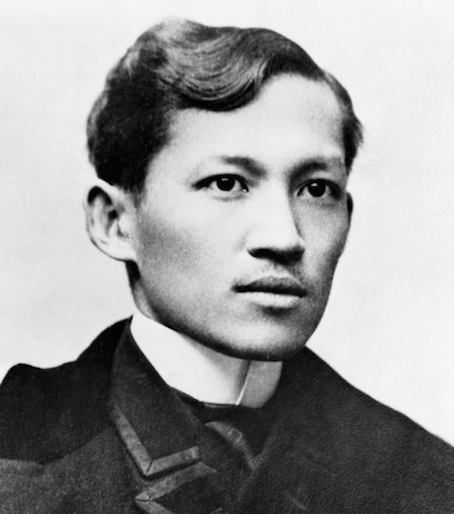
▲ Troubled in Both Heart and Purse
And yet he abruptly left Paris and moved to Brussels (January 1890). His friends said he must have fled to escape the way his love troubles were unfolding, but according to his own explanation, it had nothing to do with love at all — it was a matter of money. He said that his funds had run low from republishing Morga’s book, forcing him to economize sharply. At the time, he was troubled by problems of both the heart and the purse.
It was, above all, the problem of the “heart” that troubled him. The tyranny and outrages of the friars back home were growing worse by the day, and every ship brought news from his homeland — in particular, reports of the tragic events unfolding in his hometown of Calamba, where his own family and many acquaintances were, under various pretexts, being stripped of their land and driven from their homes.
That month (July 1890), he resolved firmly to return to the islands. If it proved impossible for his own hands to relieve his homeland’s misery, then he would at least share that hardship with the people of his hometown. And he decided that whatever calamity might befall him as a result of returning, he would pay it no mind. His friends repeatedly urged the dangers of returning in an effort to dissuade him, but his resolve did not waver.
Just then, a letter arrived from his brother Paciano. It brought word that the land-ownership dispute between Rizal’s father, Francisco, and the friars was to be tried before the High Court in Madrid. Recognizing that it would be advantageous to go to Madrid at this juncture and support the fight from the sidelines, he set aside, for the time being, his plan to return to the islands, and set out for Madrid instead.
He was also implored from home to petition the Queen of Spain directly about their plight, and he thought this, too, might be one way forward. But the direct petition to the Queen was blocked from every side and ultimately never succeeded. The latter half of that year was spent in Madrid, locked in struggle against the friar faction.
Around this time there was a Spaniard named Retana, who might be called the friar faction’s spokesman — what today we would call their propagandist. Since the lawsuit had been moved to Madrid, he too had returned there from Manila and was working actively to turn the situation in the friars’ favor. One day he wrote a piece in the newspaper viciously slandering the Rizal family, and declared publicly that the present lawsuit had arisen simply because Rizal’s father had failed to pay his rent.
Reading this, Rizal was outraged and sent a man to Retana to formally challenge him to a duel. Retana, suddenly repentant of his wrongdoing, published a statement of apology, and the affair was settled. But from that incident on, Retana became one of Rizal’s admirers, and went on to become one of the most authoritative of Rizal’s biographers. There are other examples like this as well — anyone who came into contact with Rizal, even someone who bore him ill will, would in the end come to admire and revere him. Therein lies something of his indescribably great character.
The nobility of his character had long been known among the parents back home, and many of them asked him to look after their sons who were studying in Spain. As a guardian of these students, he was beyond reproach — if anything, almost too fine a person for the role — but his manner of supervision was also exceedingly strict, so much so that some of the young men found being under his watch quite confining.
This was, admittedly, because the students tended to slip too easily into idle and dissolute living. Early that year, Rizal wrote from Brussels to Madrid, pointing out and condemning the prevalence of gambling among the students, and delivered a sharp rebuke: “Anyone who truly thinks of the Philippines as it now stands should not be able to live at ease for even a single day. If it’s gambling you want, there was no need to come all the way to Spain — you could do that just as well back home.” Among the students, he was regarded as something of a nuisance.
▲ A Break with His Comrades
He saw out 1890 in a rush of activity, and 1891, which arrived just as hurriedly, proved to be the year of his deepest mental anguish. Early in the new year, among the Filipinos resident in Madrid, Rizal clashed with a comrade over the editorial direction of the newspaper La Solidaridad. The man he clashed with was del Pilar.
Del Pilar was a lawyer by profession, older than Rizal, involved in politics, and a man of steady nerve. In Manila he had headed a certain organization, gathering information on the Philippines’ misgovernment and sending it to Madrid, and also serving to collect and send funds to the Filipino movement’s organization in Madrid. This drew the enmity of the friar faction, and in the end (1888) he fled to Spain.
Compared with Rizal, he knew the seamier side of the world intimately. By the time he arrived in Spain, Rizal’s fame already seemed to resound throughout the land, but del Pilar too was fairly well known for his past activities, and he was warmly welcomed by the resident Filipinos, coming to be spoken of, alongside Rizal, as one of the twin pillars of Filipino leadership abroad.
Rizal was dissatisfied with the way La Solidaridad was being edited. So, at a gathering of those involved early in the new year, he proposed that the paper be made an organ of the Filipino association, with its editorial policy to follow the association’s direction. Del Pilar insisted, and would not yield, that the paper should maintain an independent stance in all things, save for deferring to the wishes of those who supported the movement through the organization in Manila.
At this gathering, the election for president of the association also failed to produce a winner with the required number of votes, for Rizal or anyone else. Three ballots were taken, and the result was the same each time. At this, Rizal rose from his seat and declared, “With our comrades divided like this, there is no point in my remaining here. I will go to another country and do what I can, on my own” — and with that, he left. His comrades, who knew that Rizal always did as he said, were astonished and tried to stop him, but he would not be swayed.
▲ The Battlefield Is the Philippines
It was not solely over this dispute about the newspaper that he left Madrid. Having once observed the actual state of his fellow countrymen resident in Spain, he had already come to feel that they could ultimately accomplish nothing worthwhile for their homeland, and this dispute merely made that conviction unmistakably clear.
At the same time, it also became clear that there was no hope whatsoever for the case pending before the High Court, and so he resolved firmly: “Europe is enough already. The land where I must work is my homeland.” Around that time, in a letter to an acquaintance in Manila, he wrote a passage to this effect: “If Filipinos resident in Europe believe they can accomplish anything toward relieving the Philippines’ present plight, that is a grave mistake.
Medicine is effective only when applied close to the wound. It is only because I cannot bear to cause my parents further suffering that I forcibly remain abroad; otherwise, whatever might happen to me, I would already have returned to the Philippines. The battlefield is the Philippines. The Philippines is the very place where we must fight together and win together.”
As one means of reforming his homeland, he sought to open a school in Hong Kong, teaching science, art, and languages, and devote himself entirely to the education of the young. Someone even came forward promising to provide the necessary funding. It was around this time that word came that Leonor — his beloved, who was supposed to have waited a hundred years for his return to the Philippines — had consented to marry another man. He felt as though he had been struck by a hammer blow to the heart.
コメント