

Timeline
| 1983 | “Japayuki-san,” a term for women from various Asian countries who went to work in Japan, becomes a buzzword. Entry to Japan on entertainer visas expands |
| 1993 | The Technical Intern Training Program for foreign workers is created (building on a training-program precursor from the 1960s) |
“Japayuki-san” and the Entertainer Visa: The Light and Shadow of a Little-Known Human Exchange
From Karayuki-san to Japayuki-san
“Japayuki-san” is a term for women who traveled to Japan, by then a high-growth economic power, to work as migrant laborers. Becoming a buzzword around 1983, the term describes a phenomenon in which, amid widening gaps between rich and poor, stories spread that “working in Japan for six months could build you a house back home,” drawing many women from the Philippines and other Asian countries to Japan.
Entertainer Visas, Promoters, and Filipino Pubs
Most of the women who came to Japan obtained “entertainer visas” as performers of song and dance. By 1994, more than 30,000 Filipinos were registered as foreign residents on entertainer visas, and in 2004 new entrants on entertainer status reached an all-time high of 82,741. Filipino pubs became a fixture of Japan’s nightlife, and Filipina Ruby Moreno, who had worked as a pub hostess, made her acting debut in the TV drama “The Men Who Loved a Filipina” (directed by Satoshi Mizushima).
The Tightening of Entertainer Visa Rules and Its Side Effects
At the same time, it became an international concern that a considerable number of women were being forced into hostess work under exploitative contract terms, or falling victim to human trafficking disguised as entertainer employment. In 2004, the U.S. State Department’s Trafficking in Persons Report placed Japan on its watch list, and in December of that year the Japanese government drew up an “Action Plan of Measures to Combat Trafficking in Persons.” In February 2005, entry rules were tightened by removing, from the landing-permission criteria for entertainer visas, the route allowing certification via the Philippines’ own artist’s record book.
As a result, new entrants on entertainer status fell sharply to 47,765 in 2005 and just 8,607 in 2006 — a decline to roughly one-tenth of the peak within just two years. In fact, a similar tightening had occurred once before, in 1995 (when the number of foreign residents registered on entertainer status roughly halved, from 34,819 to 15,967), and the flow of workers from the Philippines has repeatedly gone through cycles of tightening and rebound.
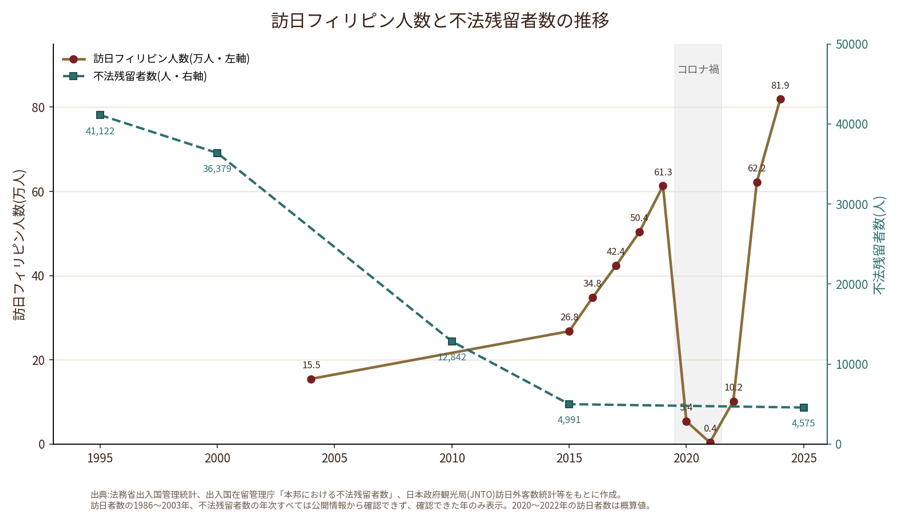
While the tightening was highly effective in reducing trafficking, it also produced the side effect that some women who found the legitimate route closed to them turned instead to “short-term stay” entries, entry with forged documents, or simply overstaying. The number of Filipinos overstaying in Japan reached 36,379 (the second-highest by nationality) in 2000, but has since fallen to 4,575 (fifth-highest) as of 2025, following stricter residency management and the growing prevalence of international marriages, among other factors.
Easing of Tourist Visas and a Move Toward Healthy Human Exchange
In place of the entertainer visa, what stands out in recent years is the growth of travel for tourism. Through the expansion of routes under the Open Skies Agreement, the introduction of multiple-entry visas in 2013, and the easing of visa-issuance requirements in 2014, the number of tourists traveling from the Philippines to Japan increased steadily, and by 2018 repeat visitors (their third to fifth visits) holding multiple-entry visas came to account for more than half of all visitors.
As of the end of 2024, Filipinos residing in Japan numbered 341,518, making them Japan’s fourth-largest foreign community after those from China, Vietnam, and South Korea. Once described in the era of “Japayuki-san” as a one-directional flow of people, this human exchange has today taken on a diverse and more equal character, spanning tourism, study abroad, technical internships, specified skilled worker status, and international marriage.
The Arrival of a Tourism Boom
Following the introduction of multiple-entry visas in 2013 and the eased requirements in 2014, tourism between Japan and the Philippines entered a phase of steady, upward expansion in both directions. The number of Filipino visitors to Japan grew steadily from about 240,000 in 2014 through 2019, before travel between the two countries was, for a time, effectively cut off almost entirely by the COVID-19 pandemic starting in 2020. The Philippines also suspended visa-free entry for Japanese nationals from March 22, 2020, and the pandemic brought a major disruption to human exchange through tourism.
With the easing of border-control measures, however, travel recovered rapidly, further boosted by the Japanese government’s continued relaxation of visa requirements to increase the number of visas issued. The number of Filipino visitors to Japan reached 622,300 in 2023 and 818,700 in 2024 (up 31.6% year-on-year), continuing to break all-time records and far surpassing pre-pandemic levels.
Conversely, the number of Japanese tourists visiting the Philippines also reached 383,719 in 2024 (up 27% year-on-year), and a simultaneous, bidirectional tourism boom is a defining feature of Japan-Philippines relations today. During this period, remarkable progress has also been made in expanding air routes between the two countries.
Philippine Airlines was the first to launch a scheduled direct flight linking Hokkaido and the Philippines. Boosted by growing interest in Hokkaido tourism after the popular 2017 Philippine film “Kita Kita,” set in locations such as Sapporo’s Moerenuma Park and the Otaru Canal, the airline launched Hokkaido’s first-ever scheduled direct flight, between Manila and New Chitose (Sapporo), on December 7, 2018.
This route was forced to suspend operations in April 2020 due to the COVID-19 pandemic, but in 2025 budget carrier Cebu Pacific entered the market, and in November of that year Philippine Airlines also resumed service after a five-year hiatus. Both carriers, however, continue to operate the route only seasonally, mainly in winter: Cebu Pacific is set to suspend service from June 2026, and Philippine Airlines is also to pause operations with the switch to its summer schedule in March 2026, with a winter resumption planned for November of that year.
This route, which lets travelers step directly from a perpetually summer island nation into the snows of Hokkaido, was initially described as a “striking” pairing of destinations, and it has indeed tapped into real latent demand among Filipino tourists wanting to see snow at least once in their lives. Even so, the route has yet to establish itself as a reliable year-round service.
Subculture Exchange: Anime, Music, and Culinary Connections
Just as “Voltes V,” mentioned earlier, overcame the adversity of being banned under the Marcos administration to grow into a cross-generational national anime, Japanese anime and cosplay culture have deeply taken root in the Philippines, especially among younger generations; events such as Komicon draw large numbers of cosplayers, and Japanese pop culture has firmly established itself in the Philippines’ urban centers. In recent years, a boom in Japanese food, especially a rapid proliferation of ramen shops, has also become notable, particularly in Metro Manila, with lines outside popular establishments now a common sight.
In music, too, two-way cultural exchange has quietly taken root. Numerous Japanese hit songs have been given Tagalog lyrics and have gone on to become hits in the Philippines as well. There has also been “reverse importation,” from the Philippines back to Japan. “Anak,” released in 1977 by Filipino singer-songwriter Freddie Aguilar, became a worldwide hit, and in Japan, Jiro Sugita had a hit with his own Japanese-lyric version titled “Musuko yo” (“My Son”), which Tokiko Kato also covered with her own translated lyrics. This exchange of hearts through song, shared between Japan and the Philippines, continues to be sung and passed down without losing its color today.
Human exchange between Japan and the Philippines, once described as a one-directional flow of people through the entertainer visa, has today transformed into a two-way cultural bond expressed through tourism, food, music, and subculture.
From Technical Interns to Specified Skilled Workers — and the People Who Sustain the Seas
From Technical Interns to Specified Skilled Workers
Under the Technical Intern Training Program for foreign workers, created in 1993 under the banner of “international contribution,” the Philippines has in recent years become one of the leading sending countries. As of the end of June 2025, the number of Filipino technical interns exceeded 40,000, ranking third by nationality after Vietnam and Indonesia.
That said, the program has faced strong criticism for having become, in practice, a means of securing labor for industries facing worker shortages, and a 2024 legal reform is reorganizing the program itself into a new “Employment for Skill Development” system. Under the “Specified Skilled Worker” status, created in 2019 to provide a pathway for those who have satisfactorily completed technical internships, the Philippines also accounted for 32,518 people (9.7% of the total) as of the end of June 2025, the fourth-largest after Vietnam, Indonesia, and Myanmar.
Acceptance of EPA Nurse and Certified Care Worker Candidates
Under the Japan-Philippines Economic Partnership Agreement (JPEPA), the acceptance of Filipino nurse and certified care worker candidates began in fiscal 2009. Under this scheme, candidates who have graduated from nursing schools or four-year universities work and train at Japanese hospitals and care facilities while aiming to pass Japan’s national licensing exams. To date (through the fiscal 2025 intake), a total of more than 3,800 Filipinos have come to Japan under this program — 695 in nursing and 3,105 in caregiving. As Japan’s population ages, this initiative can be seen as symbolic of the complementary relationship between Japan and the Philippines’ young and abundant workforce.
The “Ship for Southeast Asian Youth Program” and Government-Funded Students
The “Ship for Southeast Asian Youth Program” (SSEAYP), launched in 1974 based on a joint statement by Japan and Indonesia, Malaysia, the Philippines, Singapore, and Thailand, is also a long-running exchange program connecting young people in Japan with those in ASEAN countries, including the Philippines. In this program, young people aged 18 to 30 live together aboard a ship for about a month, engaging in discussion and cultural exchange; many young Filipinos have taken part every year, helping to cultivate the next generation of leaders.
Additionally, through the Ministry of Education, Culture, Sports, Science and Technology’s Japanese Government (MEXT) Scholarship program, students from the Philippines have continuously been sent to graduate schools and other institutions in Japan. Together with private-sector workforce-development initiatives such as the certified care worker candidate training program, these efforts form multiple, overlapping layers of human exchange.
The Filipino Seafarers Sustaining Japan’s Shipping
It is not widely known, but Japan’s ocean-going shipping industry — which handles 99.5% of the country’s seaborne trade — can no longer function without Filipino seafarers. The number of Japanese ocean-going seafarers, which stood at 56,833 in 1974, had fallen to around 2,000 by 2023, and it is Filipino seafarers who have filled this gap.
Filipinos are said to account for roughly 70% of the foreign seafarers working aboard Japan’s merchant fleet — around 40,000 people — and more than 70% of all crew members across Japanese shipping companies as a whole. Backed by a young population with a median age of 25.7, the Philippines has established itself as the world’s largest supplier of seafarers, and it also places strong emphasis on training excellent seafarers through cooperation with Japanese maritime education institutions. For a rapidly aging Japan, the presence of Filipino seafarers can be seen as a microcosm of Japan-Philippines cooperation — quietly but continuously sustaining the daily lives of the Japanese people in a way that is largely invisible to the public.
(Asahiko Yara, Chairman, Japanese Business Club, Philippines [JBCP], a non-profit organization)
コメント