
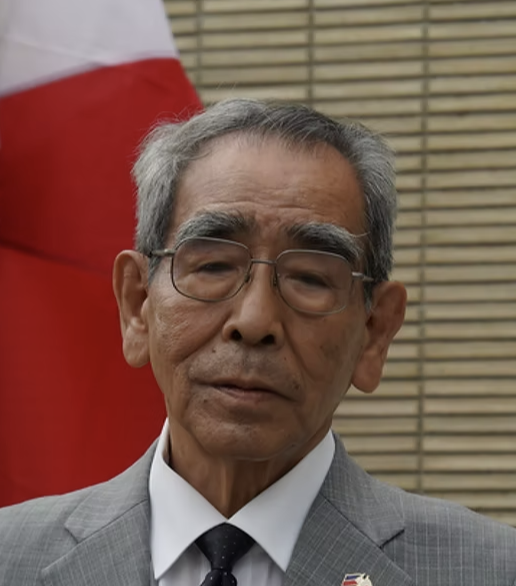
Pinoy-Hapon United Foundation (PHUF), a non-profit organization, Honorary Chairman Takeshi Asanuma
In early January 1945 (Showa 20), Mr. Osawa Kiyoshi set out north with a convoy of “tanker trucks” and other vehicles. By then, however, “armed guerrillas” were appearing everywhere, and because daytime travel was dangerous, the convoy moved by night. On the night of January 8, somewhere around “Malolos,” about 80 kilometers north of Manila, one large truck slipped a wheel off the road, and while repairs were being made in the dark, both of his legs were caught and badly fractured.
Entrusting the transport work to a younger Japanese colleague, he was admitted to the national “General Hospital” in Manila and underwent surgery, but in late January he became delirious, and did not fully regain consciousness until mid-February. Gunfights were taking place in that area as well, and American forces occupied the hospital; Osawa, still lying in his bed, became a “prisoner.”
He then underwent difficult surgeries at two “American military hospitals,” and in June he was placed in “Muntinlupa Prison,” which had become a Japanese prisoner-of-war camp. The American military surgeons and medics at each place seem to have been very kind, and with his fearless sociability and command of English, Osawa was valued by the chief surgeons and commanders at each location, and from his bed he is said to have assisted as an “interpreter” and helped with the handling of prisoners.
On August 15, when Osawa had begun to walk a little, Japan “surrendered.” In mid-September, General Tomoyuki Yamashita was brought to “Muntinlupa” along with several staff officers. Osawa recalled that even with his rank insignia removed, “General Yamashita” still cut a dignified figure.
In July 1953 (Showa 28), the then-“President Quirino,” in a radio address to his people from the United States, appealed to them to “forgive and forget” regarding Japanese war criminals, and released and repatriated 107 “death-row and life-sentence prisoners” held at “Muntinlupa Prison,” including Lieutenant General Shizuo Yokoyama of the Army, and sent them home.
In 1956 (Showa 31), “Japan and the Philippines” agreed to a set of treaties, and “diplomatic relations were normalized” after eleven years. I was in my third year of high school.
In September 1959 (Showa 34), a company called “Nanyo Bussan” sent Osawa to Manila as its “resident representative at its Philippine branch office.” It was his first time in Manila in 13 years. There were still few Japanese residents and conditions were unsettled, but he visited his old Filipino friends one after another and was given a hearty welcome.
He also appealed to the small number of Japanese there to unite and worked to organize them. In time he started various businesses of his own and became economically independent, and afterward he continued to strive to promote “mutual cooperation and mutual understanding” between the two countries, devoting himself to the development of the “Japanese Association of Manila” and other organizations “in every field.”
In 1962 (Showa 37), the Crown Prince and Princess (now the Emperor Emeritus and Empress Emerita) made their first official visit to the Philippines as representatives of the “Emperor Showa,” and were warmly welcomed, improving relations between the two countries. Osawa assisted behind the scenes.
In March 1973 (Showa 48), the Japanese government leased land of about 3,600 square meters, plus 5,000 square meters of approach path, on the “Calilaya hills,” 120 kilometers southeast of Manila, and erected a solemn “Memorial to the Japanese War Dead,” where a memorial service for the war dead hosted by the Japanese Ambassador is still held every August 15.
However, under the social norms of the time, the “spirits” of the 17 men “executed” here as war criminals were not enshrined there. Feeling righteous indignation, Osawa consulted with the bereaved families and those involved, negotiated with the Philippine government, leased land behind Muntinlupa Prison, and built a “Japanese cemetery,” installing a “memorial tower” and a “peace prayer bell.” At the same time, he spent his own money to carry out renovation work on “Muntinlupa Prison.”
Osawa passed away in Manila in 2002 (Heisei 14). He had been given the title of “Honorary Citizen of Muntinlupa” and decorations from both the Philippine and Japanese governments, and a memorial tower was erected by well-wishers on the shore of “Jamboree Lake” in Muntinlupa City in praise of his achievements. May he rest in peace.
コメント