
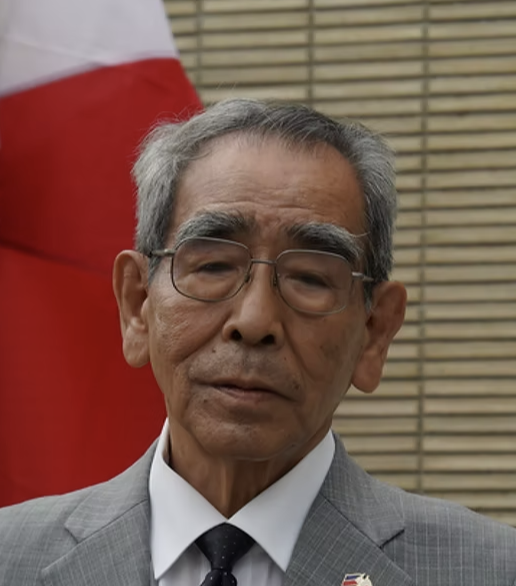
Pinoy-Hapon United Foundation (PHUF), a non-profit organization, Honorary Chairman Takeshi Asanuma
In Tokyo’s Hibiya Park stands a monument commemorating the visit to Japan of “Dr. José Rizal (1861–1896),” who is respected by the entire nation as the “Father of the Nation” of the “Republic of the Philippines.” It was erected on June 19, 1961, the 100th anniversary of his birth. A “bust” was added later, making it a solemn “memorial monument in his honor.”
He held many titles — revolutionary, physician, writer, translator — and is said to have understood ten languages, including English, French, German, and Spanish; truly, he deserves to be called a “genius.”
He earned his university qualification in Manila and twice studied in “Spain” and other European countries. On his second journey to Europe, in February 1888, he took an eastbound route via “Japan, the United States, and Britain,” and made a temporary landing in Tokyo.
During his stay in Tokyo he became acquainted with a young woman of a former hatamoto (shogunal retainer) family, “O-Sei-san (Usui Seiko),” and the two hit it off. She is said to have spoken a little English and French. They enjoyed kabuki performances and a trip to the hot springs at Hakone, and she introduced Japanese culture by taking him around art museums and other places; but the Doctor, who was devoted to great causes such as revolution, independence, and the enlightenment of the masses, set sail for the United States, reluctant to part from her. It was a short stay in Japan of less than two months.
It seems that the Doctor never spoke of “her” at all, either while in Europe or after returning to Manila. On December 30, 1896, the “Spanish authorities,” fearful of the “Doctor’s” influence over the masses, had him executed by firing squad, but among the “Doctor’s” belongings were found “a single photograph of her” and a diary recording his feelings for her, and so the existence of “O-Sei-san” became known. At the “Rizal Shrine” at the site of “Fort Santiago” in Manila, a photograph of “O-Sei-san” is displayed as one of the Doctor’s cherished loves.
”O-Sei-san” later married an Englishman but separated from him, and she died in Tokyo in 1947. Every year on December 30, the anniversary of “Dr. Rizal’s” death, floral tributes are sent from the “Philippine Embassy in Tokyo” to the “Doctor’s” monument in “Hibiya Park” and to “O-Sei-san’s” grave in “Zoshigaya.” A world of “revolution and romance”!
On August 15, 1945, “Japan was defeated.” Until the “normalization of relations between the two countries” in 1956, each side had its own position, and it took ten years to conclude the negotiations.
In November 1962, when Filipino sentiment toward Japan was still delicate, the “Crown Prince and Princess (now the Emperor Emeritus and Empress Emerita)” made their first official visit to this country as representatives of Emperor Showa. The Filipinos, who at first watched the two with some skepticism, were drawn in by their graceful bearing and the courtesy with which they treated everyone, and the cry went up for “Prince Akihito” and “Princess Michiko”; feelings toward Japan improved all at once.
In January 2016, after completing “memorial visits for the war dead” in various places at home and abroad, “Their Majesties the Emperor and Empress (now the Emperor Emeritus and Empress Emerita)” made a second official visit to this country as the last “memorial visit” of the Emperor’s reign, offering flowers and paying their respects in turn at the “Memorial to the Japanese War Dead in the Philippines,” the “American cemetery,” and the “Philippine military memorial.”
His Majesty also paid his respects at the “José Rizal monument,” and I, representing the “Japanese Association of Manila,” stood about five or six meters from His Majesty and bowed in time with His Majesty’s offering of flowers and bow. It was an honor beyond what I deserve.
It seems that “Dr. Rizal’s” maternal great-grandmother was a “Japanese woman,” and his unjust death was carried on into this country’s “revolution and independence.”
コメント