
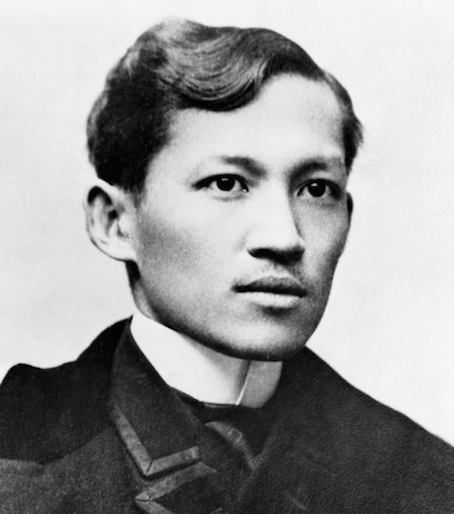
Yasotarō Mōri
▲ Moving to Paris
Just as the distant state of affairs in his homeland was troubling him so, a difficulty arose closer at hand as well. He was boarding at the home of a man named Beckett, the organist of St. Paul’s Cathedral, and the youngest daughter of that household fell in love with him, her ardor growing by the day. But Rizal already had a betrothed, a woman named Leonor. Even though correspondence between the two had lapsed, their absolute mutual trust in each other remained unchanged. Recognizing that lingering here any longer would serve the interests of neither party, and with his heart still lingering over the museum’s reading room, he made his intentions plain to Beckett and left London for Paris (March 1889).
By the time he moved to Paris, Rizal had already begun drafting the sequel to Noli Me Tángere, and it is said that once that was finished, he intended to write a third volume in French so that it might be widely read by Europeans. Meanwhile, preparations were steadily advancing for the republication of Morga’s Sucesos de las Islas Filipinas, for which Dr. Blumentritt wrote a preface and Rizal wrote an introduction. This was published at the end of that year and was received with tremendous acclaim.
Dr. Blumentritt was German, though said to have some Spanish blood, and he loved Rizal as if he were his own son. Deeply won over by Rizal’s brilliant talents, he comforted and encouraged him in countless ways.
When Rizal, with the aim of improving conditions in the Philippines, proposed as a first step organizing an International Association of Philippinists to arouse international interest in the Philippines and to study Philippine questions both historically and scientifically, Dr. Blumentritt readily agreed to become its president.
Dr. Rost (England) accepted the post of vice president, and Dr. Blanchet (France) that of director. This proposal, however, was never realized during Rizal’s lifetime — his wish was only carried on much later by others — but this episode alone shows how close his friendships were with eminent European scholars, and how much their trust he enjoyed.
▲ Taking Off the Mask
He grew confident in the power of his own pen, and wrote prolifically. His friends and comrades scattered across Europe, Hong Kong, and the Philippines, moved by his fervor, wrote prolifically as well. As a result, the newspaper La Solidaridad drew attention from every quarter, and the islanders in the Philippines, regarding it as their sole mouthpiece, placed great hopes in its struggle. Naturally, the watchful eye of the Spanish authorities upon this group grew ever sharper.
Here is one episode that vividly demonstrates Rizal’s courage. Until then, he and his comrades had always written under pen names for their contributions to the paper, but he firmly insisted on abolishing anonymity and was the very first to put his own real name to his writing. He said that anonymity was cowardice. This movement, he argued, demanded a readiness to sacrifice everything — even to lay down one’s life, if need be. If a man was prepared to face things with that degree of resolve, what was there for him to fear in donning a black hood? Better to declare oneself openly and proudly. It was also on his mind how much more it would encourage their comrades back home to see essays signed with real names.
And he constantly admonished his comrades never to distort the facts, never to exaggerate, and to hold to the principle of speaking the plain truth. The reason his writings struck their targets with such biting force was, without question, because he spoke the truth so plainly.
He wasted not a single moment, and in what leisure remained from his studies he took up poetry, painting, and sculpture as pastimes, so that to outward appearances he always seemed to be busy (his poetry was considered outstanding even among Filipinos, and he was awarded gold medals for both painting and sculpture). He was also scrupulously careful of his health, and was fond of fencing and shooting. A wealthy, well-to-do Filipino family in Paris at the time, the Boustead family, always welcomed him warmly, and he grew close to the eldest daughter of the house as a fencing partner. He himself soon recognized that her younger sister, Adelina, was, by temperament, best suited to share a lifetime of joys and sorrows with him — but thinking of Leonor, waiting for him lonely and far away in his homeland, he cleanly gave up any thought of that kind.

コメント