
Chronology
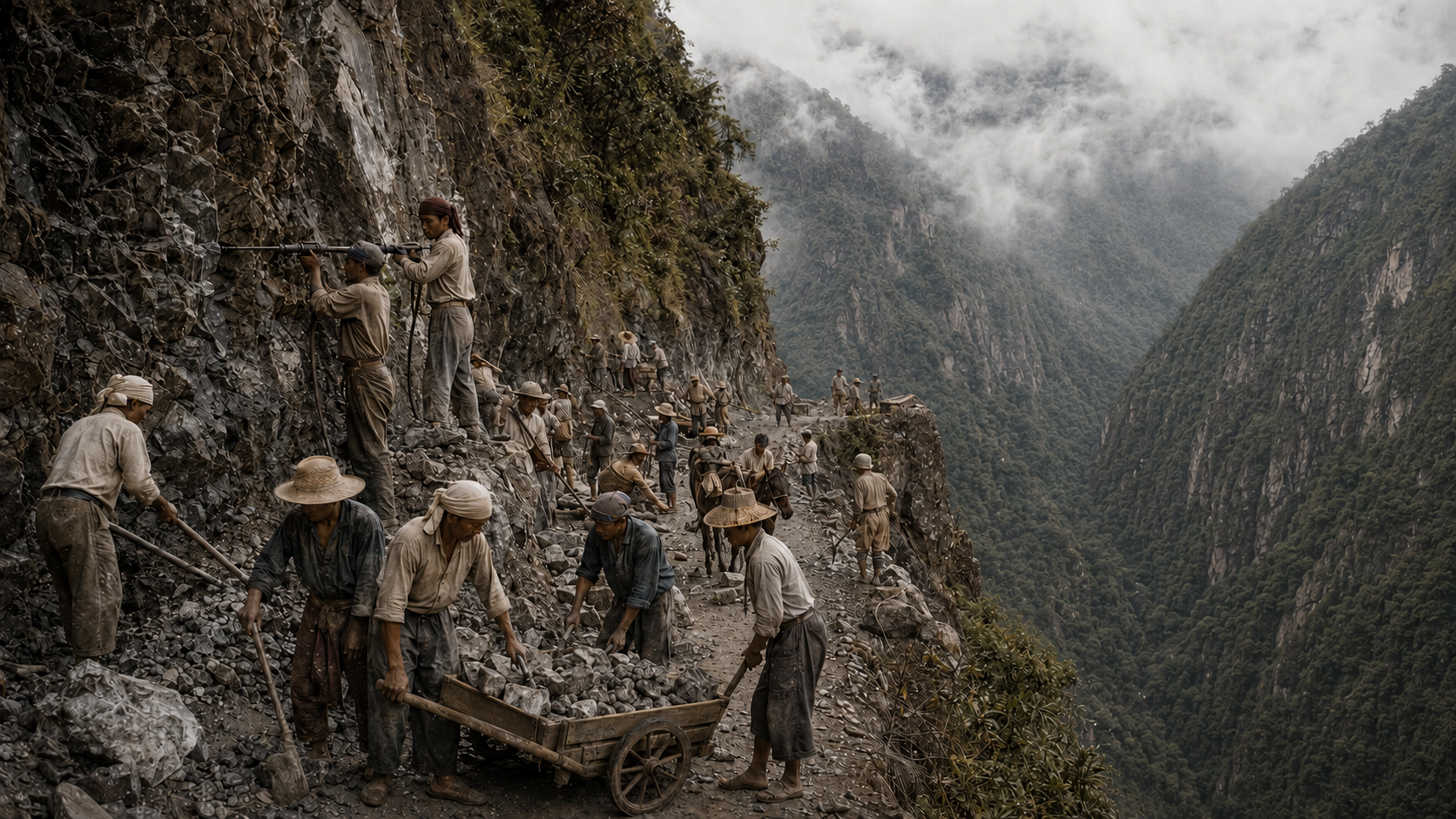
| 1903–05 | Construction of Kennon Road linking Baguio and Dagupan; roughly 1,500 Japanese laborers take part |
| 1907 | Kyozaburo Ota founds Ota Development Co. and establishes a Manila hemp plantation in Davao; Davao goes on to become Southeast Asia’s largest Japanese community |
| 1938 | Of Davao’s 18,000 Japanese residents, roughly 70% (an estimated 12,600) are from Okinawa |
| 1940 | Davao’s Japanese population reaches 20,000, making it the largest overseas Japanese community of the prewar era |
| 1970 | Okinawa Prefecture erects the “Tower of Okinawa” memorial in the Mintal district |
| 1982 | The Philippine Okinawan Association (POS) is established |
| c. 2018 | The Philippine United Okinawa Association (PUOA) is formed |
From the Kennon Road Project to Davao’s Manila Hemp Industry
In the early 20th century, under American colonial rule of the Philippines, construction began on “Kennon Road,” linking the hill station of Baguio with Dagupan at the foot of the mountains. Groundbreaking took place in 1903, and the road opened on January 29, 1905. Cutting through mountainous terrain, it was an extraordinarily difficult and costly engineering project for its time, with total expenditure exceeding 2.7 million US dollars. Around 1,200 laborers of various nationalities were initially gathered, but the work proved so grueling — with a casualty rate reportedly of “one death for every five meters of road built” — that the workers are said to have fled the site to a man.
Amid a change in construction supervisors and additional budget allocations, the newly appointed Major Kennon judged that he could no longer rely on these workers, and requested a supply of Japanese laborers from the Japanese consulate in Manila. Although anti-Japanese immigration sentiment was growing in the United States at the time, he dared to make this request precisely because he knew of the patience and diligence Japanese immigrants had shown in clearing the wilderness of California.
In the end, more than 2,300 laborers from 36 countries around the world took part in the construction, with the largest single group — some 1,500 workers — being Japanese. The site is said to have been brutal, claiming many lives to malaria and fatal falls. Japan at the time was still poor, and it was an era when surplus rural labor sought work abroad; alongside such laborers, engineers also joined the Kennon Road project, leaving their homeland to take on this perilous and difficult undertaking.
After the road’s completion, some of the Japanese laborers settled in Baguio, but many moved on to the Manila hemp (abaca) plantations of Davao on Mindanao Island, forging new lives there. Kyozaburo Ota, a labor contractor from Kobe, founded Ota Development Co. on May 3, 1907, developing plantations in areas such as Bago Daliao, and went on to establish several other plantation companies, including Mintal Plantation Co. Ota came to be known as the “Father of Davao’s Development,” and at its peak more than 30,000 Japanese settled in Davao out of admiration for him, making it one of Southeast Asia’s largest Japanese communities. By the 1930s, Davao Province had become the world’s largest producer of Manila hemp, an industry said to have been supported almost entirely by Japanese hands.
This Manila hemp still maintains a deep connection with Japan today. Bank of Japan notes (the 10,000-yen, 5,000-yen, and 1,000-yen bills) use conifer pulp mixed with Manila hemp (abaca) as a raw material, and the toughness of abaca fiber is one reason these notes remain durable even when wet.
The raw abaca used is imported mainly from the Philippines, and even in the most recently redesigned Bank of Japan notes issued in July 2024, abaca continues to be used as a raw material. That the Manila hemp industry — pioneered by the very Japanese laborers who once sweated over the construction of Kennon Road — continues to support Japan’s currency to this day might be called a curious twist of fate in the history of Japan-Philippines relations.
Traces of Okinawan Immigrants Who Gathered in Davao
Among the Japanese laborers who worked on the Kennon Road project were a great many from Okinawa Prefecture. Kozo Oshiro and Kizo Okigi, who were responsible for labor recruitment, were both from Okinawa, and recruited fellow Okinawans directly to send to the work site. After the road’s completion in 1905, Oshiro and others brought further waves of immigrants from Okinawa to Davao, incorporating them into the Manila hemp industry that Kyozaburo Ota had built (the Davao neighborhood name “Bago Oshiro” is said to derive from Oshiro’s name).
The weight of Okinawan immigrants within Davao’s Japanese community was extremely large: as of 1938, of the 18,000 Japanese residents, roughly 70% — some 12,600 people — are said to have been from Okinawa Prefecture. By 1940 the Japanese population had reached 20,000, making Davao the largest Japanese community in the prewar “Outer South Seas” region, with immigrants of Okinawan descent forming its core.
The Tower of Okinawa and Memorial Visits to Davao
In the fighting on Mindanao Island in the final stages of the Pacific War, an estimated 10,000 or more Okinawan residents of Davao alone are believed to have lost their lives. In 1970, after the war, Okinawa Prefecture built the “Tower of Okinawa” memorial in the Mintal district, the site of the former Japanese cemetery, to mourn the victims. Since then, a “Davao Memorial and Exchange Trip,” centered on bereaved family members from Okinawa Prefecture, has been held almost every year, reaching its 57th installment in 2025. In recent years the visiting delegation has sometimes been accompanied by Okinawa’s vice governor (Vice Governor Hajime Oshiro in 2025), and prefecture-level commemoration and exchange continue to this day.
Postwar Brides and the Okinawan Community in Manila
After the war, some Okinawan women married Filipino men who had worked at U.S. military bases in Okinawa under American administration, and moved with their husbands to the Philippines. Many of these women, sometimes called “postwar brides,” settled in Manila and built a distinctive community bridging Japan and the Philippines. In 1982, the Philippine Okinawan Association (POS) was established by young people of Okinawan descent studying at universities in Manila together with resident Japanese, reportedly numbering around 1,800 members by 2016. However, POS’s activities gradually declined thereafter, and around 2018 the Philippine United Okinawa Association (PUOA) was formed in its place, centered on second-generation Okinawan Vergie Higa Solis, and was formally established as a nonprofit organization registered with the Philippine Securities and Exchange Commission.
Working in cooperation with Okinawa Prefecture and the Okinawa Industry Promotion Corporation, PUOA continues to lead Okinawa-related initiatives on an ongoing basis, including hosting Okinawa food festivals, tasting events for Okinawan whisky and gin, performances by Okinawan dance troupes, and welcome receptions during visits by Okinawa Governor Denny Tamaki to the Philippines.
(Asahiko Yara, Chairman, Japanese Business Club, Philippines, Inc.)
コメント