
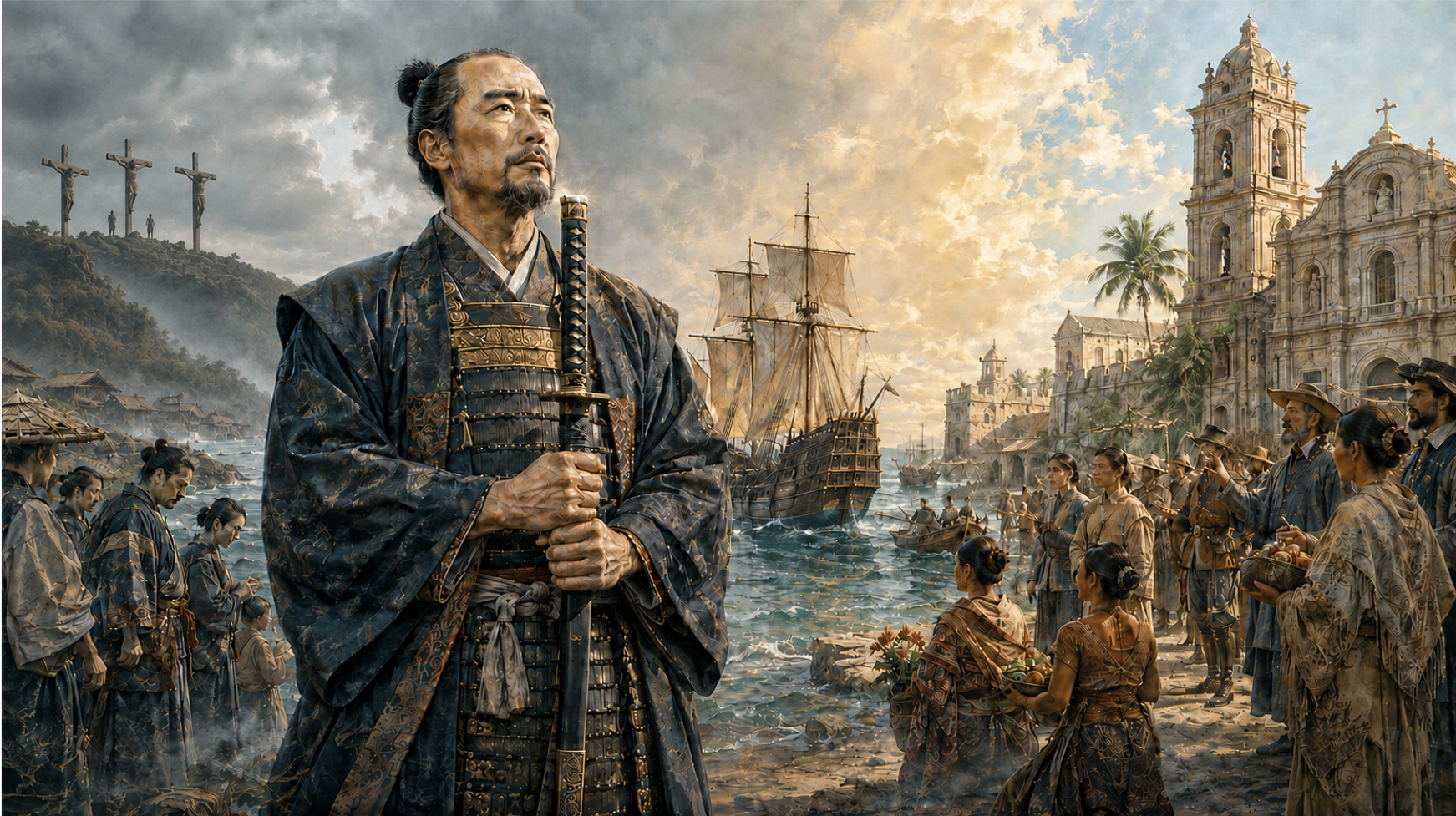
Chronology
| 1941 | About nine hours after Pearl Harbor (December 8 local time), Japanese forces bomb Clark Field; most of the U.S. Far East Air Force is destroyed on the ground; the Pacific War begins |
| 1942 | The Hukbalahap anti-Japanese resistance army is formed (March 29); Manuel Roxas narrowly escapes a death sentence |
| 1943 | Jose P. Laurel becomes President of the Japanese-sponsored “Second Republic” (October 14) |
| 1944 | The Kamikaze Special Attack Force is formed at Mabalacat, Pampanga, and flies its first mission (October 20–25) |
| 1944 | The pro-Japanese collaborationist organization Makapili is formed (December 8) |
| 1945 | Laurel’s “Second Republic” collapses with Japan’s surrender (August) |
| 1948 | Laurel is granted amnesty by President Manuel Roxas |
| 1974 | Filipino artist Daniel Dizon builds a memorial to the kamikaze pilots on the former Mabalacat airfield site |
The Same-Day Bombing of Clark Field as Pearl Harbor
For the Philippines too, the outbreak of the Pacific War came almost simultaneously with the attack on Pearl Harbor in Hawaii. Because of the time difference, the local date was December 8, but just a few hours after the Pearl Harbor attack, Japanese aircraft struck Clark Field, the main American air base in the Philippines.
General MacArthur is said to have gone nearly eight hours after receiving news of the Pearl Harbor attack without issuing clear orders for interception or a preemptive strike, and during that time most of the crucial bombers and fighters remained lined up on the ground. As a result, when roughly 200 Japanese aircraft arrived shortly after noon, the bulk of the U.S. Far East Air Force’s air power was destroyed on the ground — a devastating blow. This failure — allowing a similar surprise attack to succeed in the Philippines on the very same day, despite already knowing of the Pearl Harbor attack — has since come to be known as a “second Pearl Harbor,” and remains a major point of controversy regarding MacArthur’s initial response.
President Jose P. Laurel
Following the Japanese invasion of the Philippines in December 1941, the country became one of the fiercest battlegrounds of the Pacific War. On October 14, 1943, during the Japanese occupation, Jose P. Laurel became President of the Japanese-backed “Second Republic of the Philippines.”
While Laurel is often described as having headed a “puppet government,” he was also a leader forced to navigate a difficult course between pressure from the Japanese military and the protection of his people. His government collapsed in August 1945 with Japan’s surrender, and Laurel himself was indicted for treason after the war on charges related to collaboration (including cooperation on maintaining public order), but before being brought to trial he was granted amnesty in 1948 by President Manuel Roxas. This war exacted an enormous human toll on the Philippines: on the Japanese side alone, 518,000 lives were lost, and more than 1.11 million Filipinos died. Of the roughly 300,000 American troops committed to the campaign to retake the Philippines, an estimated 15,000 were killed and more than 48,000 wounded — and the toll grows further when the deaths from the Bataan Death March and in POW camps (numbering in the thousands) are added.
Filipinos Who Collaborated with Japan: The Makapili
Beyond the kind of governing collaboration represented by the Laurel administration, occupied Philippines also saw the emergence of Filipino organizations that more directly supported Japanese military operations. The foremost of these was the “Makapili” (short for Makabayang Katipunan ng mga Pilipino, or “Alliance of Filipino Patriots”), formed on December 8, 1944.
At the request of Japanese Commander Shigenori Kuroda, it was organized under the leadership of figures including General Artemio Ricarte — a former revolutionary-army leader who had gone into exile in Japan during the Meiji era and lived for many years in Yokohama — along with Benigno Ramos and Pio Duran.
The Makapili was organized as a military body with a rank structure equivalent to that of the Japanese army, and at its peak is said to have numbered around 6,000 members. Most were landless, impoverished farmers, and many are said to have joined drawn by postwar promises of land reform.
The Makapili not only supported Japanese military operations but is also said to have taken part in hunting down and informing on anti-Japanese guerrillas. Its members, who hid their faces behind woven baskets while informing on their countrymen, were feared by many Filipinos, and the organization is remembered in postwar Philippine history as the most reviled of the pro-Japanese collaborationist groups.
Anti-Japanese Guerrillas: The Hukbalahap
In sharp contrast to the Makapili, the most organized resistance movement against the Japanese occupation was the “Hukbalahap” (formally Hukbong Bayan Laban sa Hapon, meaning “People’s Army Against Japan”). It was formed on March 29, 1942, at the foot of Mount Arayat in central Luzon, through the merger of the Communist Party of the Philippines with socialist and peasant movement organizations from across Luzon.
Led by Luis Taruc, the organization began as an armed force of roughly 500 fighters organized into five companies, but rapidly expanded its influence among the impoverished peasantry of central Luzon, growing at its height into a guerrilla force of around 20,000. The Hukbalahap achieved considerable success in guerrilla warfare and sabotage against Japanese forces, inflicting damage on many Japanese troops. After the war, however, it clashed with the new, pro-American government, and from 1946 turned to an anti-government armed insurgency (the Huk Rebellion) that followed a complicated course before finally being suppressed in 1954.
That, within the same occupied Philippines, a faction that collaborated with Japan (the Makapili) and a faction that resisted it to the end (the Hukbalahap) existed simultaneously speaks to the depth of the division and hardship that Filipino society endured at the time.
Pampanga, Birthplace of the Kamikaze, and the Filipino Who Kept Its Memorial Alive
Mabalacat, in Pampanga Province on Luzon, is also the birthplace of Japan’s first organized “kamikaze” attacks. On October 20, 1944, Vice Admiral Takijiro Onishi organized the Kamikaze Special Attack Force here at Mabalacat, dividing 23 pilots under the command of Lieutenant Commander Asaichi Tamai into four units: the Shikishima, Yamato, Asahi, and Yamazakura squadrons.
On the morning of the 25th of that same month, the Shikishima unit, led by Lieutenant Yukio Seki, took off from Mabalacat East Airfield carrying only enough fuel for a one-way flight, and crashed into the U.S. escort carrier St. Lo off Leyte, sinking it. From then on, this tactic of one-way suicide attacks spread across the Philippines and, in the war’s final stages, to the defense of the Japanese home islands as well.
After the war, at a time when Filipinos who had been friendly to the Japanese — and their children — often faced cold treatment from those around them, the Filipino painter Daniel Dizon, who as a boy had come into direct contact with Japanese soldiers at Mabalacat and had been deeply moved by the discipline and patriotism of the kamikaze pilots, built a memorial to them in 1974 on the site of the former Mabalacat airfield.
Despite considerable opposition, he gathered like-minded supporters to found the “Kamikaze Memorial Society,” and later opened a “Kamikaze Museum” at his home, devoting his life to preserving both the memorial and the museum. After Dizon’s death, his family carried on his wishes, and in November 2022 Japanese Ambassador Kazuhiko Koshikawa honored Dizon and his eldest son, Liberato Guedeon Dizon, with a Consul-General’s commendation for their efforts in maintaining and supporting the memorial.
(Asahiko Yara, Chairman, Japanese Business Club, Philippines, Inc.)
コメント