
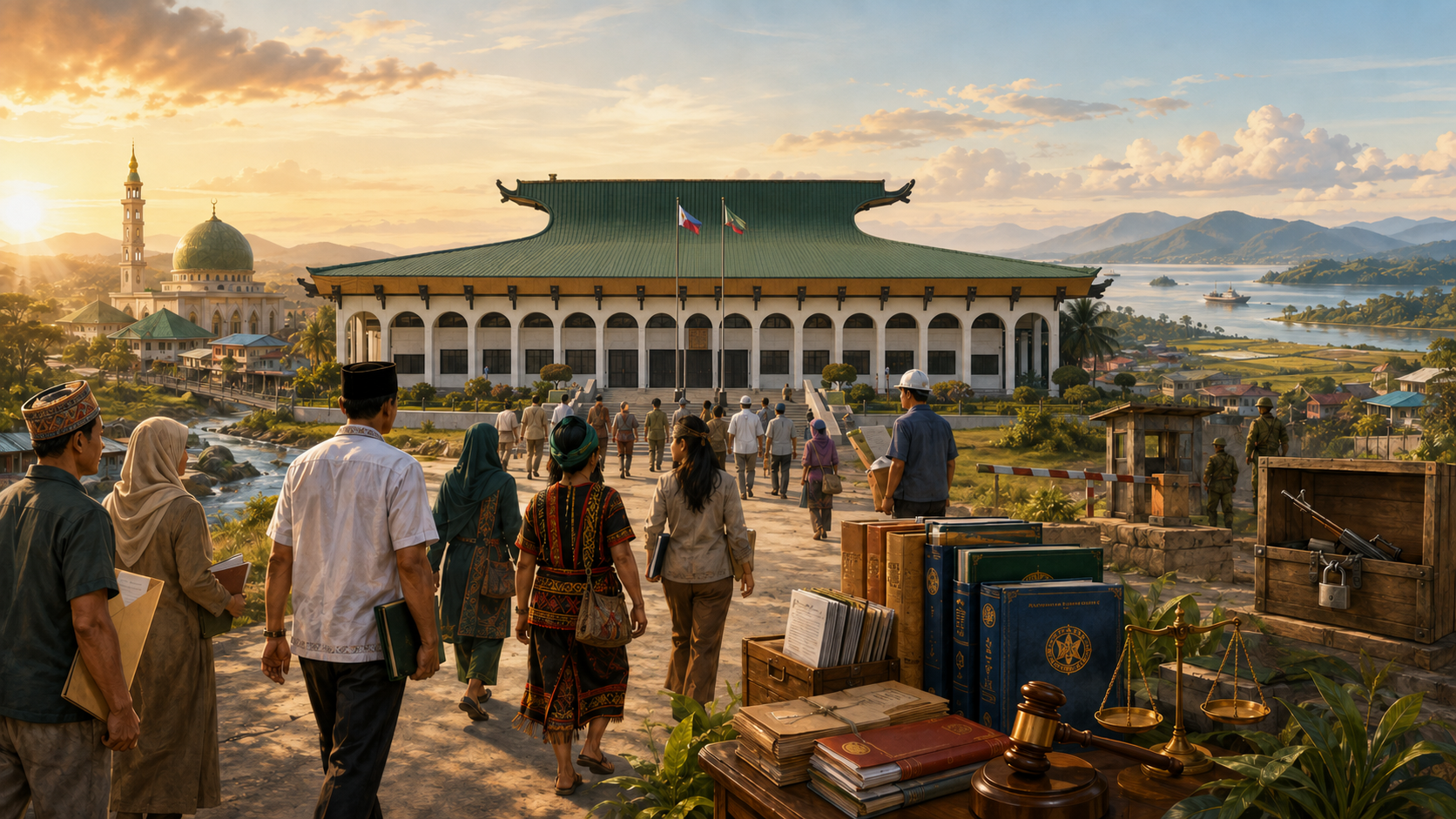
What Is the Bangsamoro Autonomous Government? — How It Differs from an Ordinary Philippine Local Government
The Bangsamoro Autonomous Region in the southern Philippines — formally the Bangsamoro Autonomous Region in Muslim Mindanao (BARMM) — has a political system and fiscal powers that differ from those of an ordinary province, city, or municipality.
It has its own parliament, chief minister, executive ministries, and revenue system. It receives the majority of national taxes collected within the region, and it also receives an annual block grant from the national government.
So is BARMM effectively a “state within a state” inside the Philippines?
The short answer is no.
BARMM has broad autonomy, but it is neither a state independent of the Republic of the Philippines nor a federal member-state on equal footing with the national government. Sovereign powers — foreign affairs, national defense, currency, citizenship, and immigration control — remain with the national government.
In this first installment, we examine how BARMM differs from an ordinary local government, whether the “75% of national taxes” figure is accurate, whether it can also receive grants from the national government, and whether it has an economic development advantage over neighboring regions.
BARMM Is Part of the Republic of the Philippines
BARMM was established under Republic Act No. 11054, enacted in 2018 and commonly known as the Bangsamoro Organic Law.
The law explicitly states that BARMM is “an inseparable and indivisible part of the territory of the Republic of the Philippines.”
The Philippine Constitution and national laws therefore apply in BARMM. Regional laws enacted by the Bangsamoro Parliament also cannot conflict with the Constitution or laws passed by Congress.
At the same time, BARMM is granted far greater autonomy than an ordinary local government.
The main differences are as follows:
- It has a parliamentary-style autonomous government
- The Bangsamoro Parliament elects the Chief Minister
- It can establish executive ministries that ordinary local governments do not have
- It has its own budget and revenue system
- It can levy and collect certain taxes within the region
- It has special authority over natural resource management and revenue sharing
- A Shari’ah justice system is recognized within a defined scope
- It maintains an intergovernmental coordination body with the national government
- It has a peace mechanism covering the decommissioning and reintegration of former combatants
An ordinary provincial governor is never chosen by the provincial council. In BARMM, however, the Bangsamoro Parliament elects the Chief Minister from among its members, and the Chief Minister then appoints the ministers who head each ministry.
In this respect, it resembles the parliamentary systems of countries such as the United Kingdom or Japan more than it does the Philippines’ own presidential system.
The Bangsamoro Parliament and the Philippine Congress Are Separate Bodies
The Bangsamoro Parliament is not a regional branch of the Philippine Congress.
The Philippine Congress is the national legislature, made up of the Senate and House of Representatives. The Bangsamoro Parliament, by contrast, is a legislature that enacts regional laws within the scope of BARMM’s autonomy.
Residents of BARMM vote in elections for the Philippine president, senators, House representatives, and local government leaders. On top of that, they also vote in Bangsamoro Parliament elections.
In other words, BARMM residents take part in national politics as Filipino citizens while also participating in the politics of their autonomous region.
As of August 2026, BARMM remains in a transition period, with the Bangsamoro Transition Authority (BTA) serving as both interim parliament and interim government. The first regular parliamentary election is scheduled for September 14, 2026.
Is It True That “BARMM Keeps 75% of National Taxes”?
Broadly, yes. But under the law, the current transition period actually works even more favorably for BARMM.
Article 12, Section 10 of the Bangsamoro Organic Law provides that, in principle, national taxes, fees, and charges collected by the national government within BARMM — excluding tariffs and import-related taxes — are shared as follows:
- BARMM side — 75%
- National government — 25%
This 75% share for the BARMM side includes not only the BARMM government itself but also the shares of its constituent provinces, cities, municipalities, and barangays.
There is, however, an important exception.
The Bangsamoro Organic Law provides that, for the first ten years after the law took effect, even the national government’s 25% share also goes to the BARMM side.
During this exception period, then, effectively 100% of covered national taxes collected within BARMM — excluding tariffs and import-related taxes — go to the BARMM side.
After the ten years end, the split reverts to the baseline 75% for BARMM and 25% for the national government. However, the national government retains room to extend the exception period at BARMM’s request.
It is worth noting that this does not mean residents and businesses are exempt from paying national taxes.
Residents and businesses pay taxes under national law as usual. It is the amount collected that is then shared between the national government and the BARMM side according to the ratios set by law.
Nor can the BARMM government freely change income tax, VAT, tariffs, or excise taxes. BARMM’s taxing power is constrained by the Constitution and the national tax system.
Republic Act No. 11054 — the Bangsamoro Organic Law
BARMM Also Receives a Block Grant, Separate from Its Share of National Taxes
Separate from its share of national taxes collected within the region, BARMM also receives an Annual Block Grant from the national government.
This point is important for understanding BARMM’s fiscal system.
It is not a trade-off in which the region gives up national government transfers in exchange for keeping 75% of national taxes.
The two are separate sources of funding.
The base amount of the Annual Block Grant is calculated from the net national internal revenue collections and net Bureau of Customs collections for the whole Philippines, set at the equivalent of 5% of that total.
This funding has the following characteristics:
- It is automatically appropriated in Congress’s General Appropriations Act
- It is released to the BARMM government without waiting for separate additional approval
- The national government cannot, in principle, unilaterally withhold or suspend it
- The specific allocation is decided by the Bangsamoro Parliament’s own appropriations law
- Education, health, and social welfare are designated priority sectors
- The block grant cannot be used to purchase firearms, ammunition, weapons, or explosives
Unspent amounts, too, are not, in principle, returned to the national government — they can instead be moved into a special fund within Bangsamoro’s treasury and reallocated in later years.
This degree of flexibility is a major difference from ordinary national-agency budgets or purpose-specific subsidies.
A Special Development Fund Also Exists
In addition to the national tax share and the Annual Block Grant, BARMM also has a Special Development Fund.
The Bangsamoro Organic Law provides for a total of 50 billion pesos, disbursed at 5 billion pesos per year over ten years, for BARMM’s rehabilitation, reconstruction, and development.
This reflects the fact that decades of armed conflict meant:
- Roads and bridges went undeveloped
- Schools and hospitals were in short supply
- Residents were repeatedly displaced
- Investment in agriculture and business stagnated
- Job opportunities for former combatants were scarce
These are the historical disparities the fund is meant to narrow.
In addition, national projects carried out by national government agencies, assistance from foreign governments and international organizations, official development assistance, and peace-related funds are also used within BARMM.
BARMM’s funding, in other words, comes from more than one source.
- BARMM’s own revenue — regional taxes, fees, business income, and the like
- Regional share of national taxes — 75% in principle; for the first ten years, the national government’s 25% share also goes to BARMM
- Annual Block Grant — a comprehensive transfer calculated from nationwide tax revenue
- Special Development Fund — 50 billion pesos in total for rehabilitation and development
- Natural resource revenue — special revenue-sharing depending on the type of resource
- National agency projects — nationwide projects in roads, ports, education, healthcare, and more
- International aid / ODA — reconstruction, peacebuilding, infrastructure, social development, and more
Not All Natural Resource Revenue Follows the 75% Rule
Some explanations claim “BARMM receives 75% of natural resource revenue,” but the 75% split for national taxes and the revenue-sharing arrangement for natural resources are separate systems, and treatment differs depending on the type of resource.
For petroleum, natural gas, coal, and uranium in particular, there is a provision for joint management by the national government and the BARMM government, with revenue shared in principle on an equal basis.
It is therefore inaccurate to assume that “BARMM 75%, national government 25%” applies uniformly to all natural resource revenue.
The 75% share of national taxes, the sharing of natural resource revenue, and the Annual Block Grant each need to be understood as distinct systems.
Does BARMM Have an Economic Development Advantage Over Neighboring Provinces?
Institutionally, it can be.
BARMM has access to all of the following:
- A large share of national taxes
- The Annual Block Grant
- The Special Development Fund
- Natural resource revenue
- National government projects
- International aid
- Peace and reintegration-related funding
and it can use them all at the same time.
Compared with an ordinary local government, the regional government also has much greater latitude to set its own policy priorities.
If it invests appropriately in education, healthcare, agriculture, industrial promotion, and road development, it has the potential to develop faster than neighboring regions.
But an abundance of funding does not automatically translate into economic growth.
BARMM still faces:
- Illegal firearms
- Private armies of politicians and clans
- Clan feuds (rido)
- Regional dominance by political dynasties
- Unclear land tenure
- Limited administrative capacity
- The risk of corruption
- Shortfalls in roads, ports, electricity, and communications
If the budget is spent on public services and productive infrastructure, this fiscal advantage can translate into economic development. But if it flows instead into patronage for political clans, ineffective projects, or corruption, abundant funding will not improve residents’ lives.
A more precise assessment, then, would be:
BARMM has a more favorable fiscal system than its neighboring provinces. But whether that favorable system translates into real economic development depends on security, administrative capacity, transparency, land issues, and safeguards against corruption.
Can Neighboring Areas Join BARMM in the Future?
Even if a neighboring province or municipality wishes to join BARMM, the BARMM government and Bangsamoro Parliament alone cannot approve its admission.
The 2019 plebiscite held under the Bangsamoro Organic Law set up a mechanism under which an adjacent area could take part in a vote on joining BARMM, based on either a resolution of its local council or a petition signed by at least 10% of its registered voters.
This, however, was a provision specific to the plebiscite that established BARMM.
Incorporating new provinces or municipalities into BARMM in the future would, in principle, require:
- New legislation or an amendment to the Organic Law by the Philippine Congress
- Defining the area to be covered
- A plebiscite as required under the Constitution
- Approval by the residents of the areas concerned
It is therefore politically possible for Sulu or other neighboring provinces to seek to join BARMM in the future, but this cannot be achieved through agreement with the BARMM government alone.
Ultimately, it would require legislation by the Philippine Congress and a plebiscite.
What Determines the Success of Autonomy Is How the Budget Is Used
BARMM holds legislative and fiscal powers far beyond those of an ordinary Philippine local government.
In particular:
- A large share of national taxes collected within the region
- The Annual Block Grant from the national government
- The Special Development Fund
- Participation in natural resource management
- Its own budget-making authority
these are important institutional pillars supporting BARMM’s economic development.
At the same time, the very fact that it can allocate its budget at some distance from national government oversight places a heavy burden of accountability on the BARMM government itself.
It is not enough to look only at the scope of its autonomy — it is necessary to continually verify whether that authority is actually improving residents’ education, healthcare, employment, agriculture, transportation, and public safety.
What determines BARMM’s success is not simply “how much funding it has obtained from the national government.”
It is who uses that funding, through what process, for what purpose, and what results it delivers for residents.
Coming in Part 2:
Part 2 will examine BARMM’s police force, the Armed Forces of the Philippines, land titling, public land, and currency.
Does BARMM have its own police force or military? Does state-owned land within the region belong to the BARMM government? And is the Malaysian ringgit, used in Tawi-Tawi, legal tender? We sort out the answers.
*This article is based on laws and government materials available as of August 2026.
コメント