
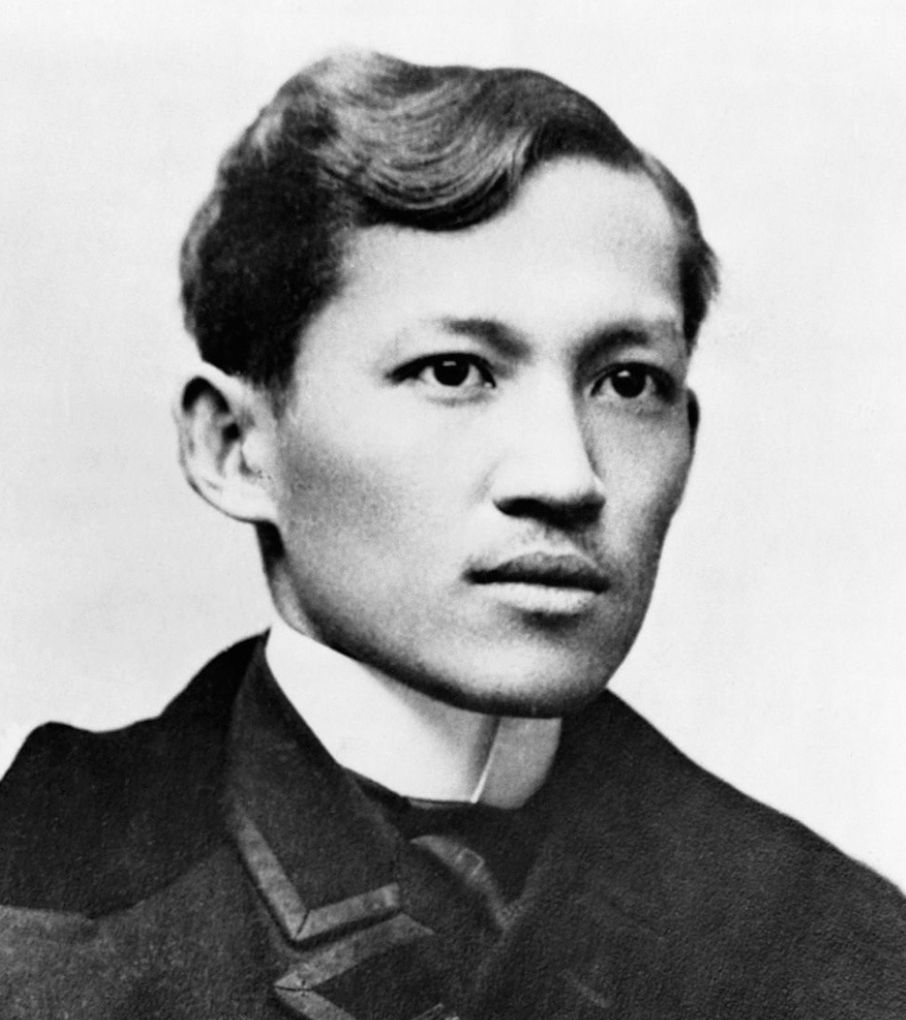
Yasotarō Mōri
Chapter Two: The Face of the Homeland
At last, Rizal departed Manila in secret. Looking back, this was the first step of the wandering life that would be his lifelong fate. Though a light of hope shone on the path ahead, he had only just barely come of age. He was now leaving behind his beloved parents, brothers and sisters, and his sweetheart — everything — to flee his homeland. He too was a child of man, and countless mingled feelings must surely have stirred within his breast.
At Singapore, he transferred to a French ship bound for Spain. Aboard ship, he drew in the sketchbook he carried with him to make up for his imperfect command of language, and worked to perfect his French. Before long he arrived in Barcelona, Spain. Barcelona was known as a breeding ground of reform. Mixing with the Filipinos residing there, he learned that plots for revolution existed among them. Yet he did not agree with any of these revolutionary schemes. He already held the conviction that “the Filipino people must first be bathed in the light of culture before they can attain freedom.” He would hold fast to this conviction for the rest of his life, but now, having come to Barcelona and met his countrymen and heard their revolutionary views, he felt all the more keenly that the intellectual liberation of the Filipino people was the more urgent priority. At the same time, from outside his country, he saw for the first time the true face of the homeland he sought to save.
The first letter from his elder brother Paciano described in great detail the astonishment of their parents and the commotion among relatives and acquaintances upon learning of his flight. It seems their father, particularly troubled at not having been told beforehand, had shut himself in a room and fallen silent, so that his brother had no choice but to reveal everything to him; since then, the letter said, their father too had recovered his spirits and was praying for Rizal’s good fight. His brother also advised Rizal that, to achieve his true purpose, he ought to go to Madrid.
Following his brother’s advice, Rizal went to Madrid, enrolled at the university there, and decided to study two subjects: medicine, and literature and philosophy. His brother’s counsel that he ought to be in the capital in order to understand Spain’s political currents proved sound. Alongside his studies, Rizal mixed with people from all walks of life, and among other things joined the secret Masonic society, where he came to know many Spaniards. Not a few of these Spaniards had long been dissatisfied with Spain’s colonial policy, condemned the misgovernment in the Philippines, and sympathized with Rizal.
While his studies and friendships proceeded smoothly, his problem was a lack of funds for tuition. The remittances from his uncle and brother in Manila were not enough. His father, wary of the authorities, did not send money to Rizal directly but assisted him via his uncle in Manila; even this, however, gradually became insufficient. This was partly due to the general economic downturn, but also to persecution directed at his father. His father farmed land leased from Dominican friars, and these friars, who despised Rizal, sought to make his father suffer by ordering the lease revoked and inflicting various other forms of persecution on the family. It is said that around this time, Rizal was so pressed for money that there were even days when he went without food.
▲ News from Home Weighs on His Heart
News from his home village weighed on his heart, but what troubled him even more was word that his sweetheart Leonor, in Manila, was growing weaker day by day since his departure. One can well imagine how his homesickness mounted, and how his longing for his native land was a feeling not to be taken lightly. Yet he also burned with the ardent desire to master medicine and restore his mother’s lost sight.
For this reason, he forced himself to set everything else aside and devote himself wholly to medicine. It was around this time that a letter from his mother urged him to compose a poem to console himself on his journey. He at once took up his pen and drafted a poem (October 7, 1882). This poem is said to reflect his mood at the time, and to be tinged with a particularly plaintive sorrow. For him, the way to forget his hardships and the troubles of home was to study with single-minded intensity. And study he did, with all his might. As a result, he mastered both his subjects with excellent results. The disciplined daily habits he had cultivated since boyhood grew ever more pronounced, so that he wasted not a single moment, took the appropriate measures to preserve his health, and still found time to indulge his general love of reading without neglect.
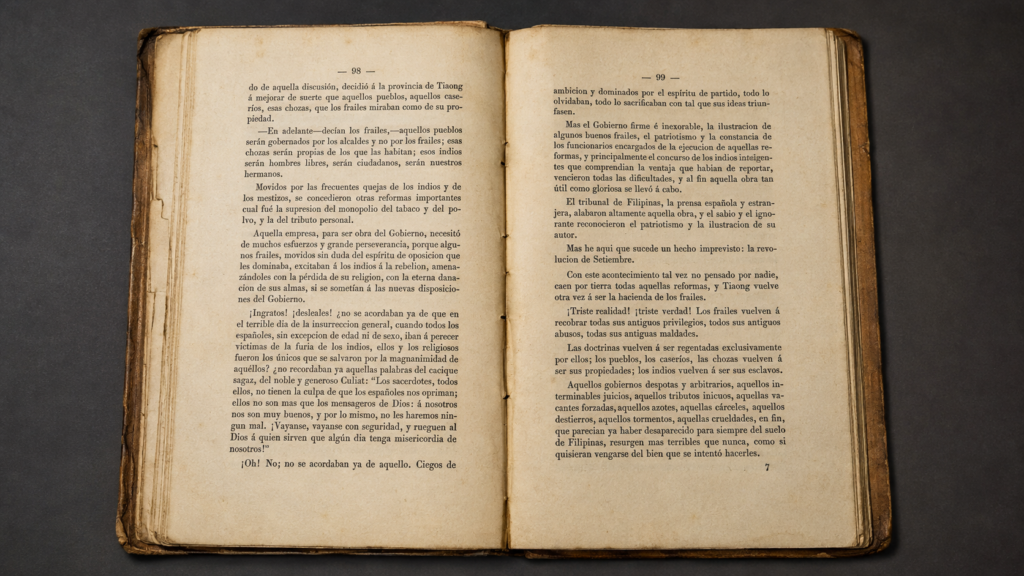
Among the books he read, two works in particular caught his attention: Harriet Beecher Stowe’s Uncle Tom’s Cabin and Eugène Sue’s The Wandering Jew. Stowe’s work especially led him to compare the plight of America’s enslaved Black population with that of the Filipino people, and a surge of sympathy welled up within him; he began to think of first stirring social opinion toward the Filipino people through his own writing. He confided this plan to Filipino acquaintances close to him, but some opposed it and others belittled its significance, so he resolved to carry it out alone. Only Dr. Ferdinand Blumentritt, a learned Austrian scholar and Rizal’s friend, strongly approved of the plan and encouraged him to carry it out. From then on, he continued writing his novel every day, in whatever spare time he could find.
Meanwhile, he completed his medical studies in 1885, but lacking the funds needed for his doctoral degree, he finally obtained it only through remittances from his brother — after waiting three years for them. At twenty-four, he now held the standing of a doctor. He then traveled to Paris to specialize in ophthalmology. There he studied under Dr. Wecker, who, recognizing his extraordinary talent, immediately made him a clinical assistant — a most fortunate turn of events for Rizal. Serving in this role, he acquired the various skills needed to treat his mother’s cataracts. The following year he studied as an auditing student at the University of Heidelberg in Germany for a stay of three months, after which he entered the University of Leipzig to study psychology and history. There he became acquainted with the famous historian Professor Friedrich Ratzel, who likewise recognized Rizal’s brilliance; after Rizal’s death, the professor praised him, saying, “Rizal gathered within himself the intellect of three continents, understood the condition of his homeland, and had attained the vast scientific horizon necessary to plan its intellectual development.” After finishing this term, he spent time in Berlin, where he formed a close friendship with the renowned scientist and author of a Philippine travelogue whom Rizal never forgot — Dr. Feodor Jagor.
コメント