
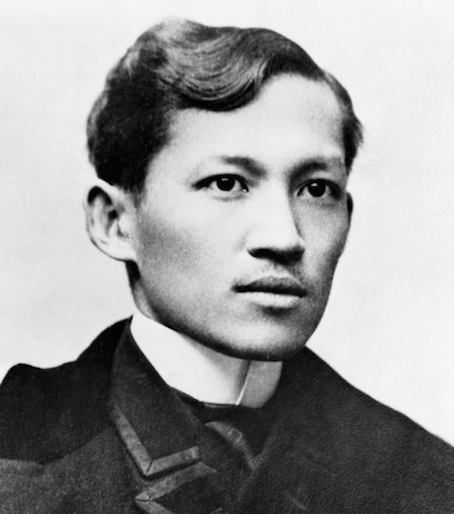
Yasotarō Mōri
▲ Exile in Dapitan
Upon arriving in Dapitan, Rizal was informed, by way of a letter of introduction from Father Pastells of the Jesuits in Manila, that if he converted back to the faith he would be permitted to lodge in the house of Father Sánchez, who lived in the town; otherwise, he was to reside in the house of his guardian, Carnicero.
Rizal refused to convert, and so came to live in his guardian’s house. Here, just as elsewhere, Rizal’s noble character led his guardian to hold him in genuine respect, and Rizal was permitted to move about freely on his own, needing only to report in once a week.
Rizal made use of this privilege to roam the surrounding area, sometimes staying away overnight, yet — so as to keep his guardian entirely at ease — he is said to have kept mealtimes with the greatest punctuality whenever he was at home. His guardian, moved by Rizal’s character, repeatedly wrote to the Governor-General reporting that Rizal had nothing to do with any plan for an armed uprising, that what he hoped for was the realization of reforms for the Philippines, and that he was in fact a supporter of the Spanish government. The reform proposals Rizal presented to his guardian were as follows:
- End the friars’ interference in government and their control of land, and give Spanish and Filipino clergy equal treatment.
- Reform the machinery of government across every department.
- Promote primary education, remove the friars’ interference in it, and raise teachers’ salaries.
- Let every matter in the Philippines be handled by equal numbers of Spaniards and Filipinos.
- Make the administration more moral in character.
- Open schools of art and craft in every provincial capital with a population of 16,000 or more.
“If these reforms were realized,” Rizal confided with conviction, “the Philippines would become the happiest country in the world.” What Rizal most regretted at the time was the failure of his Borneo plan. As a second course of action, he considered summoning his parents, relatives, and others to Dapitan, so that they might enjoy a peaceful life there together. His guardian enthusiastically supported this plan and applied to the Governor-General for permission.
The guardian’s motive for supporting this kind of plan, however, lay elsewhere. While he had genuinely come to admire Rizal’s character, he was at the same time secretly acting on behalf of the government authorities and the friar faction, working to make Rizal abandon his former political views and cultivate friendly relations with the Spanish government and the Catholic clergy. He therefore advised the Governor-General to accommodate Rizal’s wishes as far as possible, to place him under obligation, and thereby weaken him, stating: “In this way we may win Rizal over to our side, and through him also discover who leads the faction plotting an armed revolution.”

コメント