
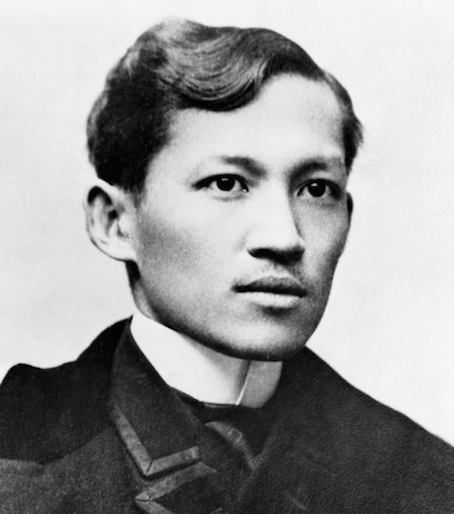
Yasotarō Mōri
Chapter Five: Willingly Into the Jaws of Death
Rizal set out for Manila carrying his passport and a guarantee of safe residence, but for the faction that regarded him as an enemy, his return to the Philippines was an opportunity too good to let slip. Indeed, the moment he left the waters off Hong Kong, the Spanish Consul-General stationed there is said to have cabled the Governor-General of the Philippines: “The prey has fallen into the trap.” Upon hearing of his departure from Hong Kong, voices condemning him arose in the Philippines, accusing him of having led an “anti-religious, unpatriotic enlightenment movement.”
He arrived in Manila on June 26, and passed through customs inspection without incident, but a piece of writing deemed a seditious document was confiscated from inside the pillowcase of his sister Lucía, who was traveling with him. This document was titled “The Poor Friars,” and told of how a bank somewhere in the East had failed, causing the friars to suffer enormous losses — and yet the friars publicly claimed that this money had never been their own, but belonged to widows and orphans.
That, of course, was only proper — friars who professed a life of poverty had no business having money of their own in the first place. Among those funds, the piece suggested, there was likely also money belonging to widows and orphans in Calamba — a biting, bone-deep satire that, on its surface, appeared almost sympathetic toward the friars.
Rizal was deeply troubled that this piece had turned up inside Lucía’s pillowcase, but Lucía later confessed, in her own words, that she had deliberately arranged for it to be confiscated, hoping the Governor-General himself would read it. On hearing this, Rizal is said to have exclaimed, “What a terrible, reckless thing to have done.”
Upon landing, Rizal went at once to pay his respects to the Governor-General. As the Governor-General was occupied, Rizal called on him again that evening at seven o’clock for the meeting. At that meeting, the Governor-General told him that the punitive measures against Rizal’s father would be rescinded, and that the exiled relatives would be pardoned — but on the matter of Rizal’s Borneo plan alone, he objected, saying, “I cannot approve of people emigrating to another country from a Philippines that is already sparsely populated.” This left Rizal no small measure of disappointment.
▲ The Purpose of His Return
Why, in the first place, did Rizal return to the Philippines even at the risk of death? As he himself put it, his motive was humanitarian: if he could not relieve his people’s suffering, then he would at least suffer alongside them. But that does not mean he returned home aimlessly, without purpose. Until then, he had remained essentially a solitary figure — a “propagandist,” a scientist, a poet, a philosopher — leaving the practical work of leading an organized movement to others (chiefly to del Pilar). He had now resolved to step forward and play a new role, one of actively championing nationalism.


コメント