
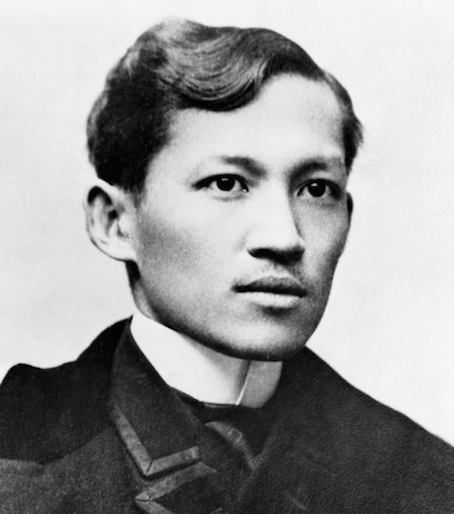
Yasotarō Mōri
Chapter Three: Leaving the Land of His Ancestors
One year after the publication of Noli Me Tángere, and just six months after returning to his island home, Rizal found himself fated to hastily leave his homeland once again. Seeing the islanders cling to him with an almost religious fervor — a sight that was, if anything, painful to behold — leaving the Philippines behind them was heartbreaking in the extreme, yet in the end it could not be helped. At the time, at the very least, heeding the Governor-General’s “advice” and going abroad was his best course of action. He sought a place, free from the prying eyes of detectives and informers, where he could set down the whole truth in writing. That place could be found nowhere but outside the Philippines. And so he left the Philippines. (February 3, 1888)
Soon after arriving in Hong Kong, he was introduced to a man who claimed to be a secretary to the Governor-General of the Philippines. This man attended to Rizal’s needs day and night and guided him about, sightseeing, doing his utmost to entertain him. Rizal soon realized that this man was actually a watchdog assigned by the Governor-General to keep him under surveillance, but reasoning that a man with nothing to hide had nothing to fear, he calmly accepted the man’s attentions regardless. During his stay in Hong Kong, an opportunity arose for him to obtain materials documenting the ill-gotten wealth of the Dominican friars in the Philippines.
This revealed just how tyrannically these friars were exploiting the ignorant islanders. It was, precisely for that reason, devastating material for the friar faction. Four years later, these materials were discovered hidden in the bottom of his sister’s basket, and the friars, shaken to their core by this discovery, went on to conspire behind the scenes to have Rizal arrested and, ultimately, executed by firing squad.
In Hong Kong, he also became close with a Filipino named Mauricio. This man was a gentle, mild-mannered gentleman who had been driven into exile in Hong Kong by the friar faction’s slanderous accusations. Rizal grew close to him, and later said of the friendship: “I was fortunate to have come to know this man. Thanks to him, I was able, in later years, to prepare myself for the worse fate that was to befall me.” By this time, he already sensed — and had resigned himself to — the fact that if he continued on his chosen path, it could only end with the friar faction’s schemes bringing about his death.
After a stay of about fifteen days, he left Hong Kong for Japan, arriving in Yokohama on February 28. No sooner had he reached his hotel than representatives from the Spanish legation in Tokyo came to greet him, urging him to stay at the legation during his time in Japan. He recognized that the hand of surveillance had reached even here, but as in Hong Kong, since he had nothing to hide in his conduct, he went along and accepted the legation’s hospitality as suggested. Accompanied daily by legation staff on sightseeing excursions to various places, he spent about a month in Japan — and he later said that this stay in Japan was the happiest period of his entire life.
With his particular gift for languages, he came, in the span of just one month, to speak Japanese well enough for everyday conversation, and on the streets he was often mistaken for “a Japanese who had recently returned home after a long time abroad.” He himself wrote of this in a letter sent from Tokyo to the Philippines: “It’s no wonder people mistake me for one, since my features resemble those of a Japanese.” He also recorded his impressions of Tokyo at the time, some twenty years after the Meiji Restoration, writing that “the Japanese are sincere, hardworking, courteous, and scrupulously clean.”
▲ A Linguistic Gift That Astonished People
When he set sail from Yokohama bound for Europe, he became friendly, aboard the same ship, with a Japanese journalist also traveling to Europe via the United States. Since this Japanese man was not fluent in foreign languages, Rizal took on the task of interpreting for him all the way to Europe. (On April 26, 1937 [Shōwa 12], the author met in Kobe with Dr. Austin Craig, an authority on Rizal, who said that despite years of research he had never been able to determine the identity of the Japanese man for whom Rizal had interpreted.)
He arrived in San Francisco on April 28, and traveling together with this Japanese companion, visited major cities including Ogden, Denver, Salt Lake City, Omaha, Chicago, and New York. Rizal remarked that while American cities had splendid buildings and were well-equipped as modern cities, they also had various shortcomings.
On May 16, he left New York behind and set sail for Europe. He grew friendly with various fellow passengers, and since he would generally converse with each in their own native language, this became the talk of the ship. On one occasion, a fellow passenger approached him and asked, “Just how many languages do you understand?” Rizal answered simply by listing what he knew, which came to seventeen: Tagalog (his mother tongue), Ilocano, Spanish, Latin, Greek, French, German, English, Arabic, Malay, Sanskrit, Hebrew, Swedish, Dutch, Catalan, Italian, Chinese, Portuguese, and Japanese.
At the time, he was only twenty-seven — a young man of fresh, youthful appearance — yet he was already known among leading authorities as one of the foremost linguists of his day, and was on friendly terms with these same authorities. Three years later, he also came to understand Subanon, Visayan, and Russian. He is said to have taught himself Russian by reading novels, dictionary constantly in hand. (Translator’s note: Tagalog, Ilocano, Subanon, and Visayan are all languages of the Philippines.)
There is also an anecdote from when he left Spain for Hong Kong (1891): he was the only Asian first-class passenger aboard. At his dining table sat five or six other passengers, mostly German men and women. During one meal, a gust of wind blew the dining-room door wide open. One of the ladies remarked to the woman beside her, “If the gentleman in front of me were a proper gentleman, he would close that door.” Rizal quietly rose from his seat, closed the door, and upon returning to his place, addressed the group in flawless German. The whole table fell into stunned silence, and from then on treated him with the utmost respect.
He arrived in London on May 24, and immediately obtained an admission pass to the reading room of the British Museum, where he tracked down a copy of Antonio de Morga’s Sucesos de las Islas Filipinas (“Events in the Philippine Islands,” published 1609). (Morga had served as Deputy Governor-General of the Philippines, stationed in Manila for seven years.) This was a book he had longed to read for nearly twenty years, ever since, at age nine, staying with his uncle in Biñan, he heard secondhand that the Governor of Hong Kong had spoken to his uncle about this very work, and had resolved that he must one day read it himself.
He went to this reading room every day, diligently copying out the book by hand while adding the annotations it required. What delighted him about obtaining this book was not merely that it fulfilled a years-long wish, but that it proved the existence of a sophisticated cultural order in the Philippines as far back as the seventeenth century — directly contradicting the Spanish government and public, who had uniformly spread the claim that the Filipino people had always been ignorant, stubborn savages incapable of cultural progress, and had used that very pretext to oppress the islanders.
According to this book, the Philippines had proper iron mines and gold-panning industries, along with thriving agriculture, a barter system, silk and cotton weaving, liquor brewing, weapons manufacturing, pearl harvesting, a civet industry, and the crafting of horn and shellfish goods — all existing in their own right. It became clear that the decline of the Philippines was the result of the systematic exploitation policies of the Spanish authorities. (Translator’s note: the “civet industry” refers to the trade of exporting musk secretions harvested from civet cats, for use as perfume.)
コメント