
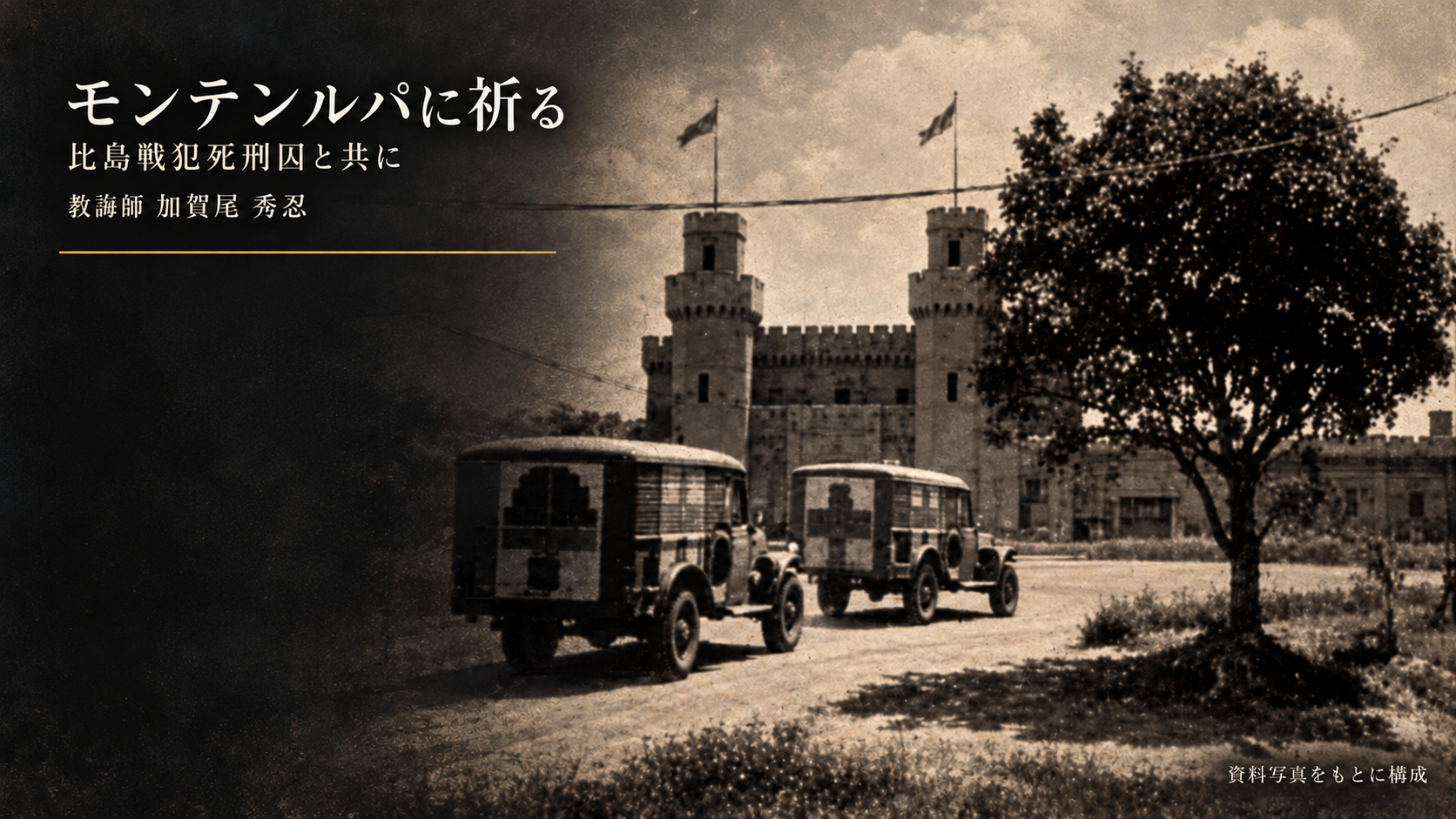
Chaplain Kagao Shunin
When I had finished writing this letter, I wanted to pray to the Buddha in a spacious place. I left my room and climbed to the cliff edge beside the grave of former Director of Prisons Misa, on a small rise nearby.
Looking out, to the east, beyond a dark green forest stretching left and right like a belt, Laguna Lake lay calm, just like the Seto Inland Sea. To the northeast, the mountains of Montalban, where the spirits of thousands of Japanese soldiers fell, now lay quiet as if nothing had ever happened, and beyond them the view faded into thin, light-filled clouds.
Ever since I came to Muntinlupa and learned that the direction of those mountains was the direction of my homeland, I had felt them to be a dear and special presence. Today was no exception. I faced that way, closed my eyes for a while, and prayed for the prosperity of the homeland and for the happiness of the families of all the people here at Muntinlupa, myself included.
Because the prison is such an abnormal environment, we are often looked down upon by the Filipinos. Although I ought to feel drawn to their simplicity, I could not help treating them with feelings of pity. Toward this vast natural scenery, however, I could feel only unconditional affection. The rows of mango trees and the groves along the roads near Muntinlupa in particular had an appearance worthy of the rich taste of their fruit, enough to stir the painter in me.
Above this beautiful seat of great nature, the deep-blue sky spread like a canopy. Why must human beings quarrel and kill one another? — I was once again lost in such thoughts when, since it was New Year, the families of the Filipino prisoners began arriving at the prison one after another by bus, car and horse-drawn carriage.
Inside the gate, there was already a great tide of people. On the concrete in front of the chapel, on the bare ground, or in the shade of the buildings, the families sat down close beside the prisoners and, as all tropical people do, ate the lunches they had brought, picking up the food with five fingers, chatting and laughing happily as if at a picnic.
Seeing this, I felt sorry for the war criminals in their cells — men who had no visitors, and who, unlike me, could not even see the scenery outside freely. Avoiding the crowd, I went to comfort them.
The war criminals had gone to bed only after two o’clock that morning because of last night’s entertainment and the seeing-out of the old year, and today they gathered in twos and threes and kept repeating stories of how enjoyable the events had been since Christmas.

コメント