
Nakahara Yoshinori
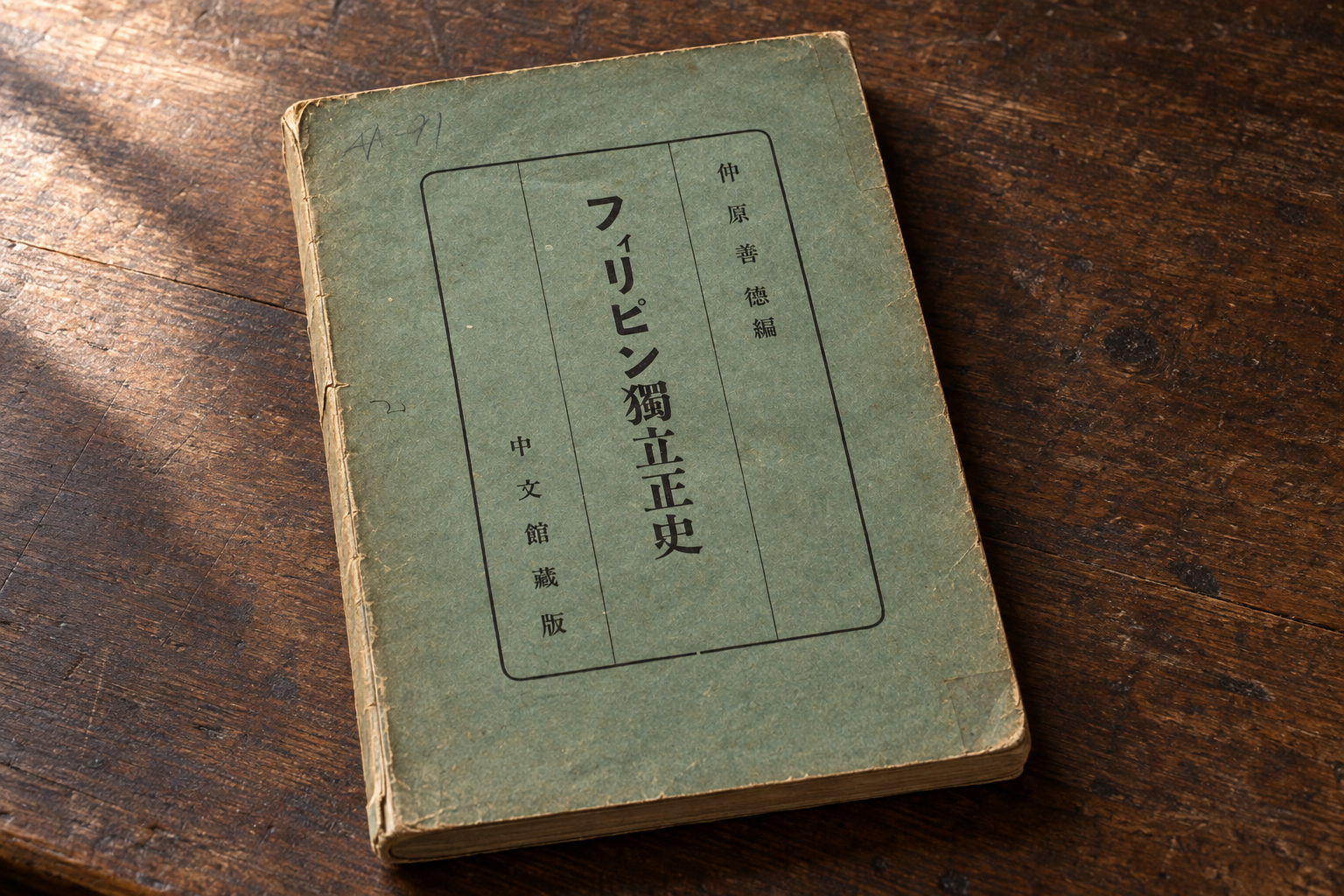
Nakahara Yoshinori (1888–1946), a researcher of the Philippines born in Okinawa. Over the prewar and wartime years he left behind numerous valuable works on Philippine settlement history, ethnography, and daily culture. He was the elder brother of Nakahara Zenchu, well known in Okinawan studies for his research on the “Omoro Soshi,” and after the war he was also involved in founding the Okinawan People’s Federation.
Preface I
On October 14, Showa 18 (1943), the Philippines declared its independence, and a ceremony marking the founding of the republic was held in the capital, Manila.
Looking back, one cannot help but reflect on how many long years, and how great a sacrifice, it took for the Philippines to win the honor of independence. Through four hundred years of rule by Spain and then the United States, it goes without saying that every struggle, riot, rebellion, and revolution waged in the name of the Filipino people was aimed at the single goal of independence. Many ardent patriots fell in that cause. Those who were exiled, banished, beheaded, or met violent deaths are beyond counting.
According to historical accounts, more than a dozen popular uprisings that might be called civil disturbances occurred during the era of Spanish rule. From this alone one can see how fervently the Filipino people longed for independence in the face of Spain’s tyrannical governance.
In 1898, when the Spanish-American War broke out, the patriots of the Philippine independence movement sought American support to achieve their long-cherished goal. The United States, for its part, responded to their wishes, and thus a joint military action to overthrow Spain came about.
Yet the course the United States subsequently took, under the guise of aiding independence, instead resulted in the seizing of Philippine independence for itself. For the independence party, this was like driving off the tiger at the front gate only to let in the wolf at the back. It was only natural that the patriots of the independence movement rose in indignation and declared war upon the United States.
Considered historically, relations between Japan and the Philippines are already of long standing, bound closely not only by geography and history but by still deeper ties of blood kinship. Indeed, in the Cagayan Valley to the north there is a settlement said to be descended from Japanese, and a similar legend exists in central Luzon as well, leaving no room to doubt the fact. In particular, in recent years, the opening of the Benguet mountain road and the development of Davao on Mindanao have made this relationship all the closer.
That relations between Japan and the Philippines are thus inseparably close in politics, economics, and even culture is attested to by a great many historical facts and documents. Yet it is clear that, through the long rule of the Philippines by Spain and then the United States, these historical facts were distorted or deliberately erased. That the military assistance rendered by Japanese patriots when the Philippine independence party declared war on the United States has gone almost entirely unrecognized is one such example.
Last autumn, when the ceremony establishing the Republic of the Philippines was held, I attended this great occasion as a representative of the Imperial Rule Assistance Association, and as I recalled the traces of the tireless efforts of so many comrades of that earlier time, I was moved by deep emotion.
After returning home, I attended the memorial service and the dedication of a monument to the late Captain Ishikawa Ushiro, master of the ship Nunobiki Maru, and offered a memorial address. In that address I wrote as follows.
It is our earnest wish to recall how, in years past, when the patriots of the Philippines rose to free themselves from Spanish rule, the rapacious nation of the United States seized the opportunity to indulge its greed, and in the end brought the Philippines under its own dominion.
Thereupon Generals Aguinaldo and Ricarte and others rose in indignation, resisted the United States, and sought to carry through their original goal of independence.
Even before this, forward-thinking men such as Yashiro Rokuro, Hirose Takeo, and Uchida Ryohei had come to believe that the Empire’s national defense should extend its front line to the Philippines and Malaya, and that by doing so the stability of East Asia could be secured; they devoted themselves to this design. At about that time, their comrade Nagano Yoshitora traveled to the Philippines himself, and, recognizing that the momentum toward independence was running strong, returned home to vigorously plan support for it, awaiting his opportunity.
In due course, in the summer of Meiji 31 (1898), Mariano Ponce, a representative of the Philippine independence movement, came to Japan, and through Sun Yat-sen, then living in exile in Japan, sought the assistance of sympathizers there. Through this, exchanges between the two sides grew very close.
Private citizens and patriots such as Hirayama Shu, Miyazaki Torazō, and Uchida Ryohei worked hard as intermediaries, while forward-thinking figures such as Toyama Mitsuru, Ōkuma Shigenobu, and Hiraoka Kōtarō likewise exerted themselves in support. At the same time, Chief of the Army General Staff Kawakami Sōroku and others quietly lent their strength and provided assistance behind the scenes.
In this way, by the following year, Meiji 32 (1899), the arms and ammunition that the Philippine independence army had requested were procured in Japan, and the steamship Nunobiki Maru was purchased to transport them to the Philippines. Captain Hara Tei and other chivalrous men gathered their own comrades separately and hurried on ahead to the Philippines.
The Nunobiki Maru, after secretly loading its cargo of arms and ammunition at Moji, sailed on to Nagasaki and from there set out on the long voyage to the Philippines. It departed on July 19, Meiji 32, and patriots supporting the Philippine independence army, including Nagano Yoshitora and Hayashi Masabumi, were also aboard. The spirits of the party ran high enough to pierce the heavens.
And yet, what bitter misfortune followed. The ship was caught in a violent typhoon in the East China Sea and was tossed about by raging waves. It was wrecked off the Pescadores near Taiwan, and, save for a few of the lower-ranking crew, everyone aboard, together with the vessel and its cargo, was buried beneath the sea.
Thus this grand plan to aid Philippine independence collapsed, and the independence army, though it fought bravely, could not secure victory and in the end was forced to submit to American forces. Ah, who, looking back on those events, could fail to feel bitter regret?
Two and a half years after the outbreak of the Greater East Asia War, the forty years of American rule crumbled in a single morning, and here, for the first time, the Philippines achieved its long-cherished wish of independence with Japan’s support. The joy and emotion of the Philippines’ eighteen million people can well be imagined.
One passage of the declaration of independence reads as follows.
“We hail this independence as a manifestation of divine will, which permits the peoples of all nations of the world to seek freedom and independence, and which allows every nation to attain the standing that is properly its own.”
It further states as follows.
“To build a republic founded on peace, freedom, and morality, and, as one link in the Greater East Asia Co-Prosperity Sphere, to contribute to the creation of a new world order.”
In these words we clearly see the Philippines returning to its true place within East Asia, and we see, as a member of the Greater East Asia Co-Prosperity Sphere, its earnest devotion to the revival of East Asia.
Now, at this dawn of the building of Greater East Asia, when all of Eastern history that has been distorted by heaven-defying forces is about to be fundamentally rewritten by our own hands, it is deeply significant that this book should be published.
I also have no doubt that this book, as its compiler hopes, will not merely stand as the true history and true biography of the Philippine independence movement, but will bring even greater benefit to the building of Greater East Asia.
This is because the true reality of what is called “East Asia as one family” and “Asia is one” is vividly shown in this book, and it is only through this that we can first grasp a part of that truth.
Having compiled this book, I am filled with deep emotion, and I have taken it upon myself to write this preface and recommend it widely to the world.
June 1, Showa 19 (1944)
Written by Kuzuu Yoshihisa
Preface II
The Philippines has at last achieved its independence.
That it has broken free of four hundred years of Western bondage, been restored to Asia, and taken its place as one wing of the Greater East Asia Co-Prosperity Sphere under the guidance of our great Empire of Japan is truly a cause for joy. This is, needless to say, none other than the result of the Emperor’s august virtue.
That the exchange between the Philippines and our Empire has an extremely long history is clear even from the accounts in the Nihon Shoki. Thereafter, however, relations became especially close in the Toyotomi era and, in particular, the Tokugawa era, and further, at the time of the independence movements of Aguinaldo and Bonifacio, patriots of our country rendered assistance, both material and moral, by every means available.
Of the circumstances of that assistance, aside from fragmentary records such as those concerning the Nunobiki Maru incident, little has been handed down to the world.
That the Philippines has come to achieve independence under the protection of the Empire may, depending on how one looks at it, be seen as the fulfillment of the aspirations of these departed patriots, and I think it may fairly be called a deep bond of fate.
This time, Mr. Nakahara has compiled Aguinaldo’s own memoir, “The True Story of the Philippine Revolution,” together with Mr. Hirayama’s writings concerning the Philippine and Chinese revolutions, and has made public to the world their hitherto hidden achievements.
This book is more than sufficient to convey the true circumstances of the Philippine war of independence of forty-five years ago, and to give us a glimpse of the role played, not so much by the Empire itself, as by the patriots of the Empire who took part in it.
I believe it will prove not merely of historical interest, but also an important reference in considering the future of relations between Japan and the Philippines.
September, Showa 18 (1943)
Homma Masaharu
コメント