
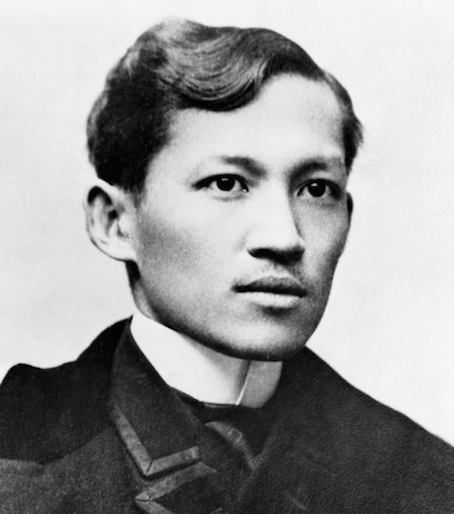
Yasotarō Mōri
Chapter Seven: His Noble Spirit Lives On Through the Ages
Immediately after Rizal’s execution, the Spanish authorities carried his body away to some undisclosed location, and kept the burial site a closely guarded secret. This was to prevent his relatives, friends, and admirers from moving the body elsewhere, or from carrying off any of his personal effects as relics of the great man.
His sisters rushed at once to the spot where Rizal had fallen, hoping to gather up the earth stained with his blood, but the groundskeeper turned them away, insisting no blood had been spilled there. They then searched the nearby cemetery for any freshly dug grave, and at last discovered one buried between the inner and outer fences of Paco Cemetery. The guard forbade them entry, but after explaining the circumstances they were let in, and, slipping the gravedigger some money for cigarettes, they removed some of the earth atop the grave and buried, together with the body, a small marble slab they had brought with them, engraved with Rizal’s initials reversed as “RPJ,” as a marker for later.
At the time, ordinary Filipinos, when speaking of Rizal, would never utter his name, referring to him simply as “the departed one.”
Twenty months after Rizal’s death, on August 13, 1898, the Spanish garrison in Manila raised the white flag of surrender to American forces. Rizal’s warning — that Spain would lose the Philippines unless it mended its ways — had, tragically, come true.
Upon hearing of Spain’s surrender, Rizal’s sister Narcisa, along with his lifelong comrade Higinio Francisco and two or three others, immediately opened Rizal’s grave, but found only his hat and shoes still holding their shape. Just to be sure, they examined the inside of the shoes once more, but found nothing at all in the end. They then placed his remains in a box and had them cremated.
With Spain’s defeat and the arrival of the Americans, Filipinos everywhere raised their voices, without any reservation, in praise of Rizal. The land across the lake that he had gazed at, endlessly, as a boy, became a newly established province and was named Rizal Province. When the Philippines’ national holidays were established, it was by the wish of the entire Filipino people that December 30 was designated a holiday — and, indeed, it is the holiday that Filipinos observe with the greatest devotion, the greatest solemnity, and the deepest meaning.
On the fiftieth anniversary of Rizal’s birth (1911), elementary schools across the country held special commemorative ceremonies — a fitting tribute, given that these very schools had been established on the basis of his ideals.
The site of his place of exile in Dapitan became Dapitan Park, and the town built a Rizal Elementary School and a Rizal Memorial Hospital. Places associated with Rizal now bear explanatory bronze plaques. In the town plaza of Dapitan stands a monument to Rizal, inscribed with an epitaph to the following effect:
“José Rizal lived in this place for four years as an exile (July 17, 1892 – July 31, 1896), and, in response to the social and economic needs of this region, willingly offered his abilities, his knowledge, and his means, together with his skills as an engineer, a farmer, a teacher, and a surgeon, for the benefit of this land. The Government of the Philippines, the Government of Moro Province, the Municipality of Dapitan, and the free and united Filipino people, who have lived to see ‘the dawn of a better day,’ have here established facilities to carry on the many works of practical public benefit to which Rizal devoted himself, as an enduring memorial that shall not forget ‘those who fell in the night.'”
On Rizal’s memorial day (December 30, 1905), William Jennings Bryan delivered an address on Rizal, in which he stated, in part:
“If I may draw a single lesson from Rizal’s life, it is that he stands as an example of a great man who gave himself for the happiness of his country. Rizal is dead — but he lives on as a standing rebuke to those self-serving scholars who, having fully enjoyed the privileges of education, refuse to share their learning with their fellow countrymen. His life is of the most precious value to the Filipino people, to the Filipino children who study him, and to men and women, young and old, alike.”
Once Spain suffered its crushing defeat at the hands of the United States, public opinion at home erupted, and voices grew louder insisting that a major cause of the loss of the Philippines was Spain’s failure to heed the warnings of patriots like Rizal, and its unjust execution of him. The Masonic headquarters in Madrid hung a plaque honoring Rizal’s virtue in its great hall. The street near the Barcelona military prison where he had been confined was renamed Rizal Street. Governor-General Polavieja, who had condemned Rizal to death by firing squad, was later
appointed mayor of Girona, whereupon pamphlets attacking him were distributed on all sides by unknown hands. They carried Rizal’s portrait and his final farewell poem, along with the charge that the loss of the Philippines was the result of Polavieja’s own failures. He was driven out by the citizens of Girona.
Among the world’s nineteenth-century figures, it is said that no one has had more monuments erected in his honor than Rizal. Even the poorest Filipino household, it is said, will have nothing else but a portrait of Rizal on its wall. The nation’s reverence for him has only grown deeper with the years, even taking on something of the character of idol worship, to the point that mystical rumors once circulated widely that Rizal, like Christ, would one day appear again.
Rizal’s father died in the year of the Spanish-American War. His mother lived to see her years of hardship rewarded, as her son came to be mourned and revered with deep affection both at home and abroad. The Philippine Assembly sought to compensate the Rizal family for at least their material losses, but his mother firmly declined to accept it. When she passed away in 1911, the whole nation went into mourning; the Governor-General of the Philippines, members of the Assembly, and high officials attended her funeral, and government offices closed for a day in a gesture of condolence.
コメント