
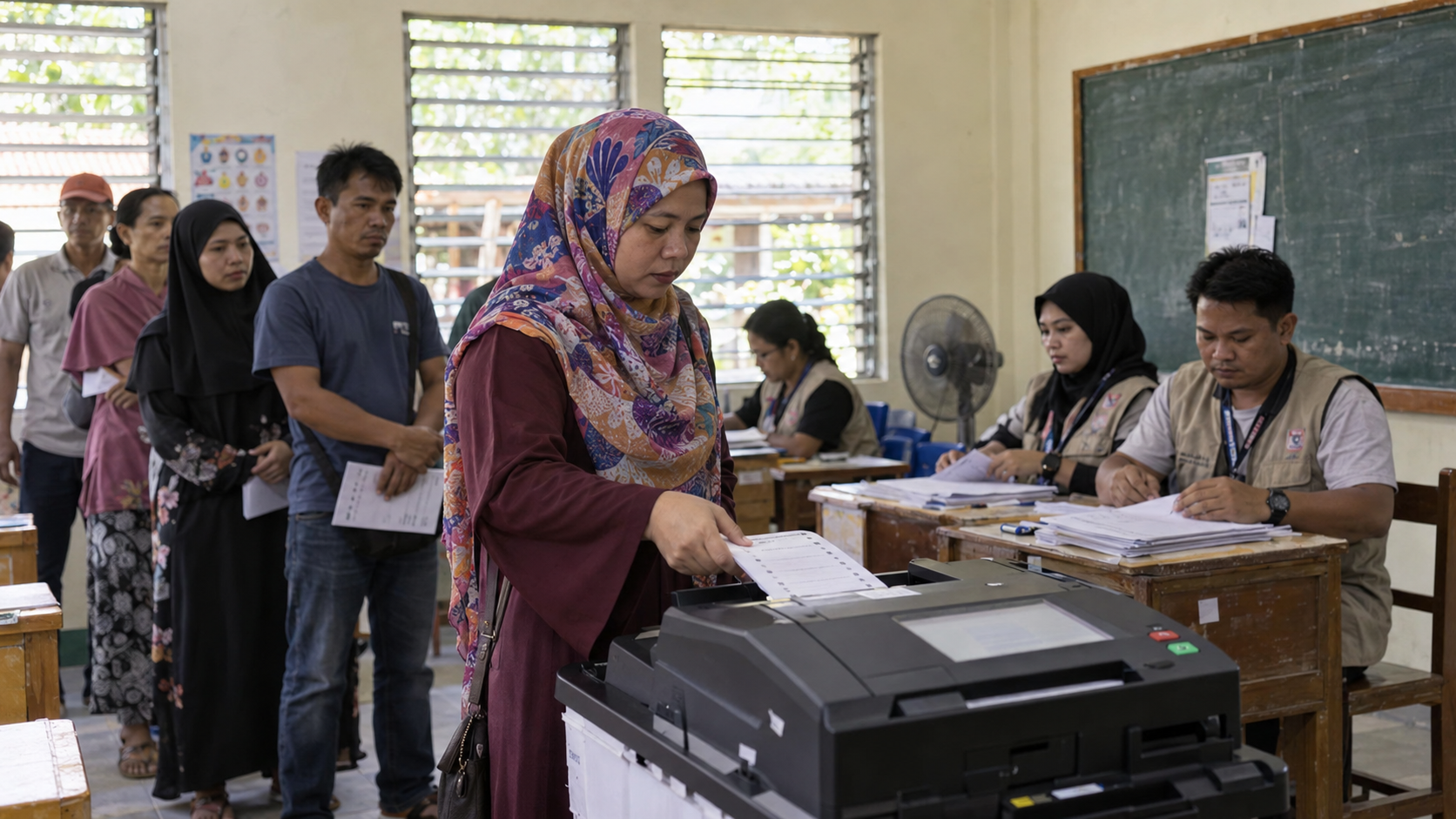
On Monday, September 14, the Bangsamoro Autonomous Region in Muslim Mindanao (BARMM) in the southern Philippines held its first parliamentary election since the autonomous government was established. In a region that endured prolonged armed conflict, residents choosing representatives of the autonomous government through the ballot marked a major milestone in the peace process between the Philippine government and the Moro Islamic Liberation Front (MILF).
The newly elected Bangsamoro Parliament has 80 seats: 40 party-list proportional-representation seats, 32 seats elected from electoral districts, and 8 special seats reserved for women, youth, indigenous peoples, settlers, and Islamic scholars, among others. Rather than residents directly electing the region’s Chief Minister, BARMM has adopted a Japanese-style “parliamentary cabinet system,” in which elected members of parliament choose the Chief Minister themselves.
Roughly 2.4 million voters were registered, and the Philippine National Police and the Armed Forces of the Philippines deployed more than 20,000 personnel for the election. Even so, shooting incidents occurred in Cotabato City and elsewhere from the eve of the election through election day, leaving at least three people dead and more than a dozen injured. In some areas, pre-marked ballots were seized and had to be reprinted. Cotabato City was placed under the direct control of the Commission on Elections (COMELEC), but voting across BARMM as a whole proceeded largely peacefully.
In unofficial partial tallies, the Bangsamoro Federal Party (BFP), led by incumbent interim Chief Minister Abdulraof Macacua, was locked in a close race with the United Bangsamoro Justice Party (UBJP), which grew out of the MILF, over party-list votes. With roughly 84% of votes counted, BFP had approximately 560,000 votes to UBJP’s approximately 510,000, putting BFP slightly ahead. The BARMM Grand Coalition (BGC) also drew about 330,000 votes, making it more likely that several parties will form a coalition after the election than that any single party will secure an outright majority in parliament.
In the run-up to this historic election, the Japanese government has quietly played an important supporting role. Rather than dispatching armed forces as in a United Nations peacekeeping operation, Japan has backed the peace process through the dispatch of civilian personnel to international monitoring teams, indirect support for peace negotiations, and the development of roads, schools, clinics, and water-supply facilities, as well as agricultural and human-resource development.
In particular, through the Japan-Bangsamoro Initiative for Reconstruction and Development (J-BIRD), launched in 2006, Japan has continued projects — via the Japan International Cooperation Agency (JICA) and others — aimed at letting communities worn down by conflict actually feel the benefits of peace. Rather than imposing security by force of arms, this is Japan’s own brand of “unarmed peacekeeping”: preventing the recurrence of conflict by improving residents’ livelihoods and building trust in local administration.
BARMM was established in 2019, built on the 2014 Comprehensive Agreement on the Bangsamoro between the Philippine government and the MILF. It carries real significance that people who once led an armed movement have laid down their weapons, formed political parties, and now submit themselves to the judgment of voters. At the same time, the disarmament of MILF combatants remains incomplete, and concerns persist that old-style local politics — rivalries and vote-buying among political clans, and the poaching of legislators — could find their way into the new parliament.
This election is not the completion of peace but the true beginning of self-governance. Whether BFP and UBJP can build a stable coalition while checking each other, rather than either side monopolizing power, and whether the Bangsamoro people themselves can safeguard — through elections and parliament — the peace that Japan has supported for some twenty years, is the question that now must be answered.

コメント