
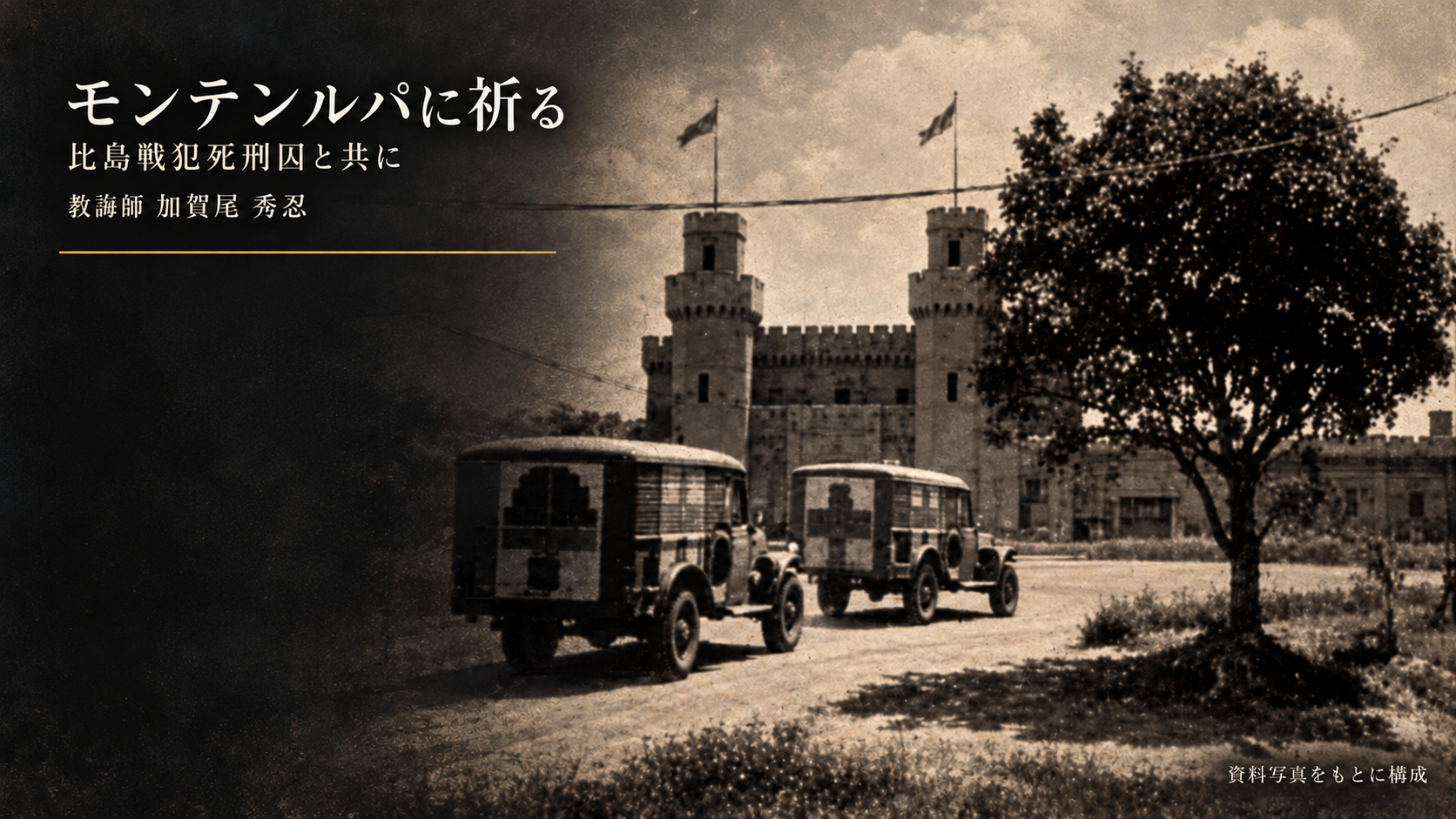
Chaplain Kagao Shunin
Christmas is the most enjoyed day of the year, and so on the Filipino prisoners’ side, for a week from the 23rd, movies, plays, dances, popular songs and even strip shows came from Manila, and the place was so lively that one could hardly believe it was a prison.
The Japanese war criminals, too, held a mahjong tournament in the corridor of the communal cells on the 24th, and then on the night of the 31st staged an entertainment in the corridor of the solitary cells, which they billed as the “Iwato-za” (Iwato Theater).
Although the stage and props were hard to come by in a prison, everyone built them with the greatest of effort. The program included dances, sword dances, popular songs, comedy, harmonica performances, comic monologues and rokyoku ballads, and, as period dramas, “Mori no Ishimatsu” and “Beyond Enmity” (Onshu no Kanata ni). For the little time they had to practice, the results were remarkably good, and even Director Balagtas and the other officials who came to watch as guests were wide-eyed.
For that very reason the war criminals could not forget the pleasant afterglow, and talked it over together, filled with a bright mood; for the time being, the shadow of death had vanished from their hearts. On the “Bungei Shimbun” (Literary Newspaper) posted on the wall, too, they had written one hope after another: “This year, at last.”
Ordinarily I would not even want to talk about a bad dream, but the atmosphere was so bright that I told them a little about this morning’s dream. Yet the war criminals who heard it did not take it much to heart that day.

コメント