
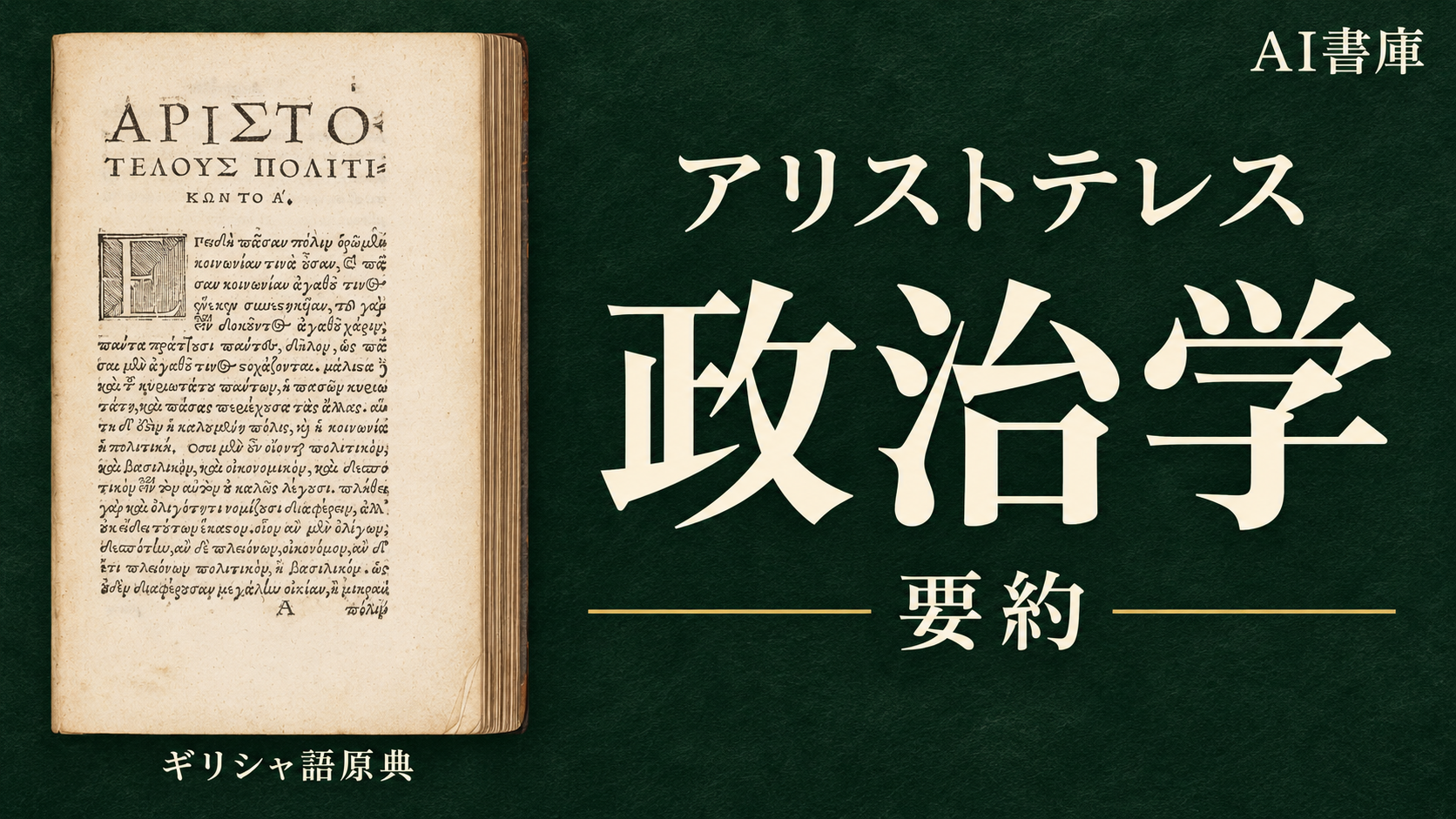
“Politics” is a work written in Greece in the 4th century BC that examines what the state is, who should rule, and what institutions human beings need in order to live well. Consisting of eight books, it considers not only the ideal state but also the many actual forms of government and the causes of their rise and collapse. At its center is the idea that the purpose of a political community is not mere survival or the acquisition of wealth, but the realization of the good life for its people.
Aristotle argues that every community is formed to aim at some good. Households that meet the necessities of life gather into villages, and from several villages arises the polis, a self-sufficient community. The polis comes into being for the sake of life, but it continues to exist for the sake of the good life. The state here is not the huge modern nation-state but is based on the city-state in which citizens take part in politics.
Human beings are by nature “political animals” not simply because they form herds. Humans have speech and can discuss with others not only pleasure and pain but also what is beneficial and what is just or unjust. Households and the state come into being where such judgments are shared. The individual is not a being who reaches completion independently of the community, but one who develops abilities and virtues through life in common. The state is the place where such human potential is realized.
Book 1 discusses household management, property, slavery, and the acquisition of wealth. The activity of obtaining goods necessary for life is distinguished from the activity of increasing money without limit. Wealth is a means to a good life, and its acquisition should not itself become a limitless end. Aristotle is also critical of generating money from money through interest. On the other hand, the argument justifying slavery by “nature” and the argument placing women in a subordinate position are serious limitations of this work.
Book 2 examines Plato’s ideal state and institutions such as those of Sparta. Aristotle criticizes the plan to hold family and property in common for the sake of thoroughgoing unity of the state. A state is made up of different people, and erasing that diversity damages the state itself. Moreover, with common property, everyone tends to rely on others and its management tends to be neglected. He places importance on recognizing private property while, through virtue and custom, making its use serve the community as well.
Book 3 defines the citizen and the constitution. A citizen is not simply someone who lives on the land but someone who takes part in the offices of judging and governing. Who counts as a citizen differs by constitution, and if the scope of citizenship changes, so does the character of the state. The virtue of a good citizen and the virtue of a good person also do not always coincide, for the ability to support a given regime well does not necessarily mean goodness as a human being.
The criteria for classifying constitutions are the number of rulers and whose interest their rule aims at. He holds as correct forms monarchy, in which one rules for the common interest; aristocracy, rule by the few; and polity, rule by the many. As their respective deviations he names tyranny, oligarchy, and democracy. The democracy criticized here, however, is not the same as modern constitutional democracy. It refers to a form in which the poor majority rule solely for their own interest.
The core of this classification is that it does not judge the good or bad of politics by numbers alone. The wealthy claim political rights on the basis of their superiority in property, and free citizens on the basis of equality in freedom. But both tend to mistake one aspect of justice for the whole. The state is not merely an alliance for trade or defense but a community aiming at good actions and a fulfilling life. The rightness of politics is judged in light of that common purpose.
From Book 4 onward, emphasis is placed on institutions that are actually practicable. The same best constitution does not suit every state. Institutions must be designed according to population, the distribution of property, ways of life, and so on. Aristotle values a polity that combines elements of democracy and oligarchy. He also argues that a state with a large middle stratum, which eases the conflict between rich and poor, is less likely to fall into extreme forms of rule and is more likely to be stable.
Book 5 analyzes the causes of political upheaval and civil strife. People rebel against a regime because of unequal treatment, unjust gain, insult, fear, and the like. Even small injustices and violations of institutions, if left alone, lead to great upheavals. To preserve a constitution, it is necessary to prevent any one group from monopolizing gain and power, to respect the law, and to maintain a fairness that citizens can accept. What is important are institutions that do not depend solely on the goodwill of individual rulers.
The last two books discuss the desirable state and education. The happiness of a state is not determined solely by the size of its territory or military strength. War exists for the sake of peace, and labor for the sake of worthwhile leisure. Leisure is not idleness but time for activities that fulfill human abilities, such as learning, music, and contemplation. Education does not remain a private matter but becomes a concern of the whole community. The ultimate purpose of politics is not to keep increasing wealth and power, but to create an order in which people can cultivate virtue and lead fulfilling lives.


コメント