
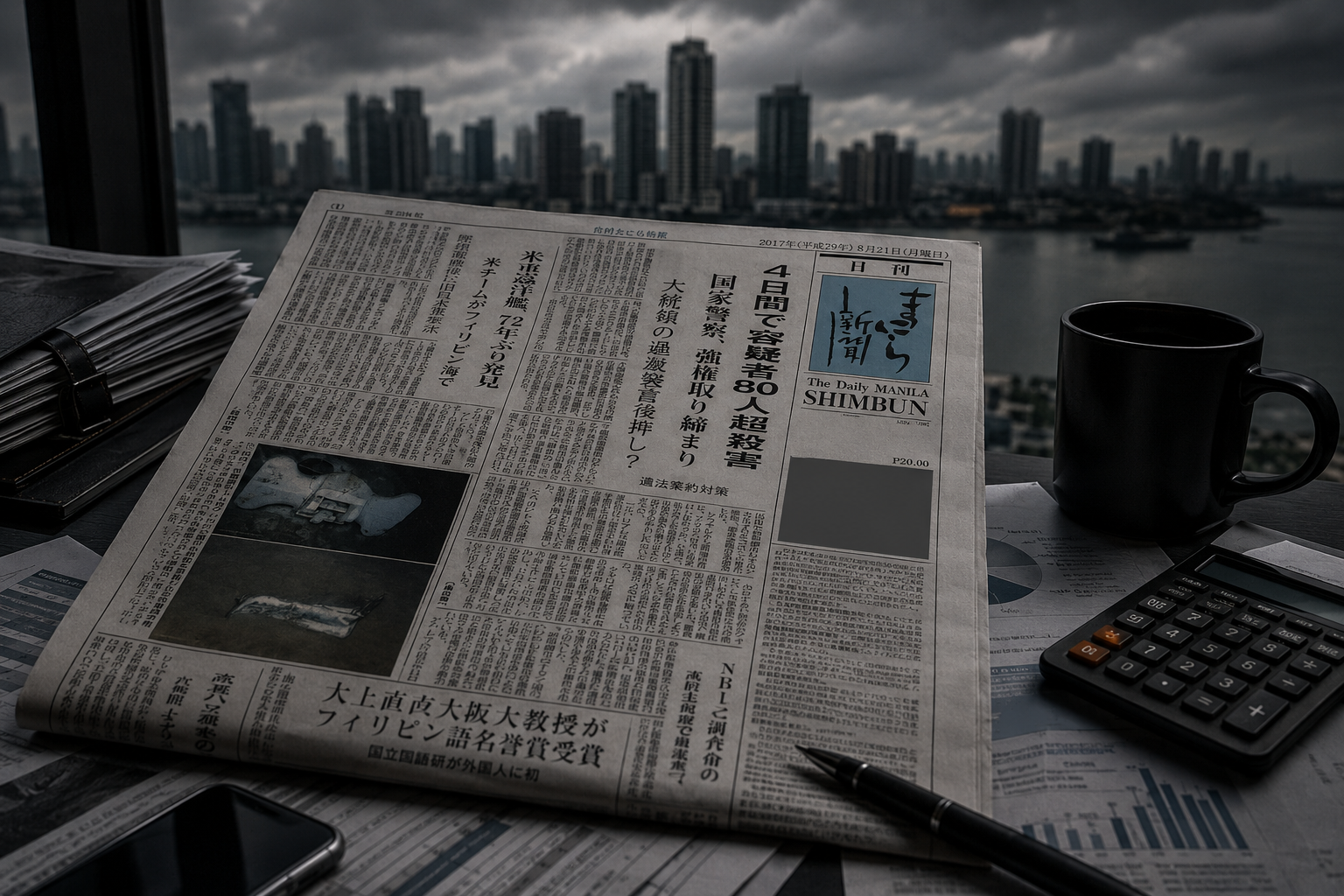
In a major investment fraud case involving the Philippines-based financial firm S Division Holdings Inc. (SDH), the Tokyo Metropolitan Police Department’s Economic Crime Investigation Division arrested nine men and women — including the company’s de facto operators — on August 8, 2025, on suspicion of violating the Financial Instruments and Exchange Act (unregistered business operation). Subsequent investigation found that total damages had reached roughly ¥46 billion, affecting an estimated 5,500 victims. The case was also deeply entangled with the management of the Nikkan Manila Shimbun, the Philippines’ only long-running Japanese-language daily newspaper, which as a result ceased print publication entirely as of September 30, 2025.
Overview of the Case
- Arrest dates: August 8, 2025 (suspected violation of the Financial Instruments and Exchange Act); re-arrested August 27, 2025 (suspected fraud)
- Number arrested: 9 men and women (names confirmed for 2; the remaining 7 reported anonymously, with only occupation and age given)
- Charges: soliciting and selling unregistered foreign corporate bonds (SDH bonds); some suspects re-arrested on fraud charges over part of the scheme
- Damages in the filed charges: approximately ¥131 million from 9 investors (of which approximately ¥73 million, from four victims including a man in Gifu Prefecture, relates to the fraud re-arrest)
- Estimated total damages: approximately ¥46 billion from around 5,500 people over roughly eight years, from 2016 to 2024 (initial reports put the figure at about ¥17.1 billion from around 2,400 people for 2021–2023, but the scope expanded as the investigation progressed)
- Investigating agency: Tokyo Metropolitan Police Department, Economic Crime Investigation Division
Names of Those Arrested (Confirmed)
- Hajime Sumi, 45 — resident of Takarazuka, Hyogo Prefecture. De facto operator of SDH. Also served as representative of Step Capital Management (Kita Ward, Osaka), the group company that served as the domestic point of contact.
- Aoi Ikeda, 38 — resident of Matsuyama. Former president of SDH, and also the former president of the Nikkan Manila Shimbun, discussed below.
For the remaining seven, media outlets have reported only that they are “men and women aged 31 to 49” who are “SDH executives and people connected to two soliciting agencies.” Their names had not been made public as of this writing. The Metropolitan Police Department has also not disclosed whether any of the nine have admitted to or denied the allegations, citing the need to avoid interfering with the investigation.
The Scheme — Investment Seminars Promising “24% Annual Returns”
Sumi and his associates conducted individual solicitations and investment seminars through unregistered agencies, including one called Zero Management. They told prospective investors that “the Philippines is developing rapidly” and that funds would be used as “working capital for business in the Philippines,” offering purported annual returns of 6% to 24% to induce them to purchase SDH bonds. SDH claimed to operate six group companies in the Philippines spanning finance, real estate, call-center (BPO) operations, and language-school management, and had even acquired a rural bank locally to obtain a financial services license.
Some investors initially did receive payouts, with roughly ¥5.5 billion reportedly paid out in interest in total, but payments stalled from January 2024 onward, and with little of the principal ever returned, numerous civil disputes arose with investors. The Securities and Exchange Surveillance Commission had already flagged the violation of the Financial Instruments and Exchange Act as early as June 2023 and petitioned the Osaka District Court for a business prohibition and suspension order, but solicitation reportedly continued even after that.
Connection to the Nikkan Manila Shimbun
The single biggest reason this case shocked the Japanese community was its connection to the Nikkan Manila Shimbun, the long-established Japanese-language newspaper serving Japanese residents of the Philippines.
Aoi Ikeda, one of those arrested, was both a former president of SDH and a former president of the Nikkan Manila Shimbun. The paper had already been rocked once before, in January 2024, when Ikeda was detained by the Philippine Bureau of Immigration just as she was about to board a flight from Manila International Airport bound for Dubai, UAE. At the time, the bureau disclosed that multiple complaints had been filed over fraud allegedly conducted out of Makati City, and remarked that “the Philippines is not a haven for criminals.”
Following the announcement of the arrests on August 8, 2025, some Japanese media outlets reported that the “name of a historic Japanese-language newspaper had been exploited” and that it had “been used as a tool for fraud amid financial difficulties.” In response, the Nikkan Manila Shimbun published the following notice in its pages that same day:
“Some Japanese media are currently reporting in a way that suggests the Manila Shimbun knowingly participated in illegal fundraising. The Manila Shimbun has had no involvement whatsoever in such conduct, and in fact no longer has any relationship with the ‘S Division Holdings Inc.’ named in these reports. We apologize to our subscribers and other stakeholders for any concern this may have caused.”
Despite this notice, however, the paper’s deteriorating finances apparently could not be reversed, and the Nikkan Manila Shimbun ended its print edition, published continuously since its founding, on September 30, 2025. While it is said to continue publishing on its website, this effectively brought down the curtain on the history of a rare daily Japanese-language newspaper that had reported on Philippine society and Japan-Philippines relations through its own original reporting, and had sent many young reporters on to major Japanese media organizations.
Developments Since the Arrests
On August 27, the Metropolitan Police Department re-arrested three suspects, including Sumi and Ikeda, on suspicion of fraud. The charge concerns the sale of SDH bonds between November 2022 and February 2023 on the false claim that the company was “earning substantial profits from a call-center business in the Philippines,” allegedly defrauding four victims, including a man in Gifu Prefecture, of approximately ¥73 million. It is also alleged that, over the long period from 2016 to 2024, the scheme collected a total of roughly ¥46 billion from around 5,500 people. Sumi is also believed to have already been placed on a Philippine entry ban and watch list by the authorities there.
Lessons to Avoid Becoming a Victim
- Be immediately suspicious of any investment promising unusually high, sustained returns such as “6% to 24% annually.” Legitimate financial products do not normally offer yields like this on a continuing basis.
- Whether a firm is registered with Japan’s Financial Services Agency is the bare minimum thing to check before investing. Always verify a firm’s registration status on the websites of the Securities and Exchange Surveillance Commission or the Financial Services Agency.
- Keep in mind that even seemingly credible backing — such as being “published by a historic Japanese-language newspaper” or being “an established corporate group in the Philippines” — can itself be used as a tool of deception.
- For overseas investments, especially foreign corporate bonds or offshore funds with unclear registration status, contracts are often presented only in English, leading investors to sign without fully understanding the terms. Always have a third party, such as a lawyer, review the contract before signing.
- Solicitation can continue even after the Securities and Exchange Surveillance Commission has already petitioned for a business suspension against an operator. Be especially wary of any operator or individual who has ever been the subject of administrative action.
Sources: Jiji Press, Tokyo Shimbun Digital, Toyo Keizai Online (article by Naoji Shibata), Yahoo! News (including reports distributed via Japan Today, Mainichi Shimbun, and Nippon TV News24), and Kigyo Homu Navi (reports published August–October 2025).

コメント