
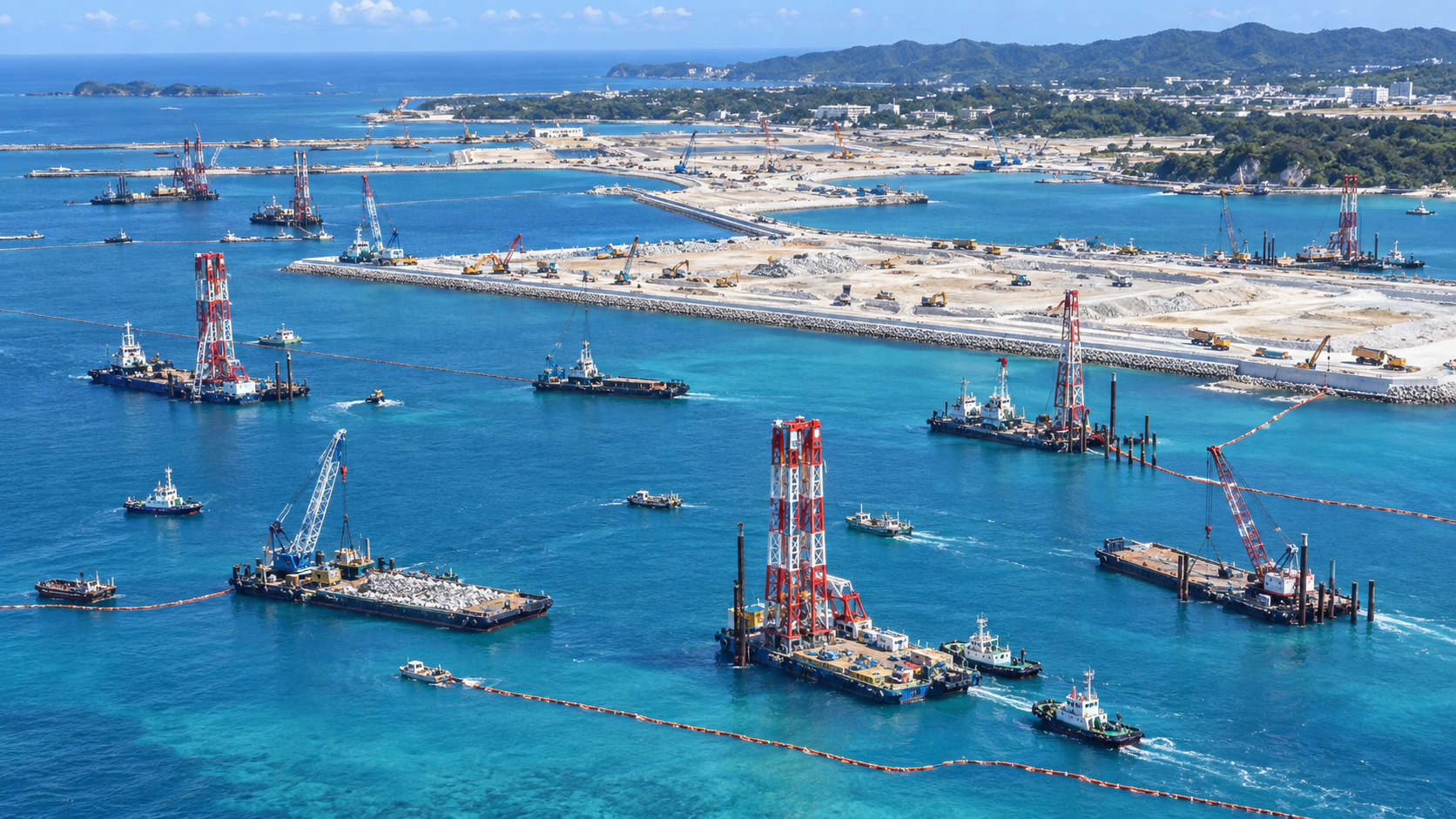
The relocation of Marine Corps Air Station Futenma to Henoko has been the single biggest flashpoint in postwar Japan’s security policy and in the debate over Okinawa’s burden of hosting U.S. military bases. With the victory of a pro-relocation candidate in the recent gubernatorial election, the last obstacles to the Henoko relocation have now been all but cleared away.
Opposition to this plan — rooted in concerns over environmental destruction and the permanent entrenchment of a base — has remained persistent. Yet weighing the practical realities and security necessities in the round leads to a single conclusion: relocation to Henoko is, in fact, the most realistic and best available option for eliminating the dangers posed by Futenma.
First, there is a practical rebuttal to the “relocate outside the prefecture, or outside Japan altogether” argument. Opponents criticize the concentration of bases within Okinawa and call for another prefecture to take one on — yet when the government previously sought an alternative site under the banner of “at minimum, outside the prefecture,” not a single local government anywhere in Japan came forward to accept it. As things stand, with no municipality anywhere shouldering any share of the national defense burden, to simply keep insisting on relocation “outside the prefecture” is, in effect, to accept the permanent entrenchment of Futenma — an airfield sitting in the middle of a residential area and reputed to be the most dangerous in the world — and to leave the danger to the lives and safety of the surrounding residents unaddressed indefinitely. Since no other prefecture is willing to step forward, then, selecting an alternative site within Okinawa itself is an unavoidable choice if the real danger is to be removed.
Second, there is the matter of local residents’ consent and democratic process. Opposition to the Henoko relocation is often framed as an Okinawa-wide movement, yet residents of the immediate Henoko area itself — the three Kubi districts — have, at the very least, shown a willingness to accept and even welcome the plan, with an eye toward revitalizing the local economy, overcoming depopulation, and securing infrastructure investment as part of a broader development package. The local Nago Fisheries Cooperative, too, has accepted the landfill work in exchange for compensation — a practical choice by local residents prioritizing “economic benefit,” not unlike the choices made by communities elsewhere in Japan that have hosted nuclear power plants. To shout opposition while disregarding the direct consent of those most immediately and locally affected carries the contradiction of trampling on the very residents’ right to a livelihood and their own local self-determination that the opposition claims to defend.
Third, there is a rebuttal to concerns over environmental destruction. Criticism of the landfill work in Henoko’s Oura Bay centers on its impact on coral reefs and the dugong, yet Okinawa itself has previously accepted comparable marine development projects for the sake of economic promotion and convenience — the reclamation of the Awase tidal flats and the construction of Naha Airport’s second runway among them. As for the dugong, placing such disproportionate, absolute value on one particular local population, when viewed against its habitat on a global scale, is itself putting the matter backwards — weighing the exceptionally weighty public interest of human life and regional security against a purely localized environmental concern is, at bottom, a case of losing sight of priorities.
Fourth, there is a rebuttal to arguments over the extended construction period, the enormous cost, and the scale of the runways. Henoko’s runways, at roughly 1,800 meters each (two, in a V-shaped configuration), are smaller than Futenma’s roughly 2,700-meter runway — but this is a rational and deliberately restrained specification, consistent with a purely defensive security posture that avoids granting unnecessary long-range strike capability against other countries, and does not pose an excessive threat to neighboring states.
1,800 meters is more than sufficient for operating Ospreys and fighter jets, and nearby infrastructure suitable for larger aircraft already exists in the form of Kadena Air Base and Naha Airport. Moreover, it is simply inconceivable, given Japan’s alliance commitments and national credibility, that the Japanese government would abandon the project on account of soft ground conditions or ballooning costs — and there is no reason Japan’s advanced civil-engineering capability and economic strength should be unable to see it through to completion.
Furthermore, even should U.S. forces someday scale back or withdraw their operations there, the base’s functions could be handed over to Japan’s Self-Defense Forces and put to use in the defense of the Southwestern Islands; alternatively, since a runway of 1,800 meters is a length fully sufficient for the takeoff and landing of medium-sized passenger aircraft, joint civilian use or full civilian conversion is also possible. For these reasons, the national budget invested in the project will by no means go to waste.
In light of all these points, the Henoko relocation plan can be concluded to represent the most realistic, rational, and restrained decision available — and with the victory, in the gubernatorial election held on September 13, of the candidate who accepts the relocation plan, it can be said that the last obstacle to it has now been removed.
コメント