
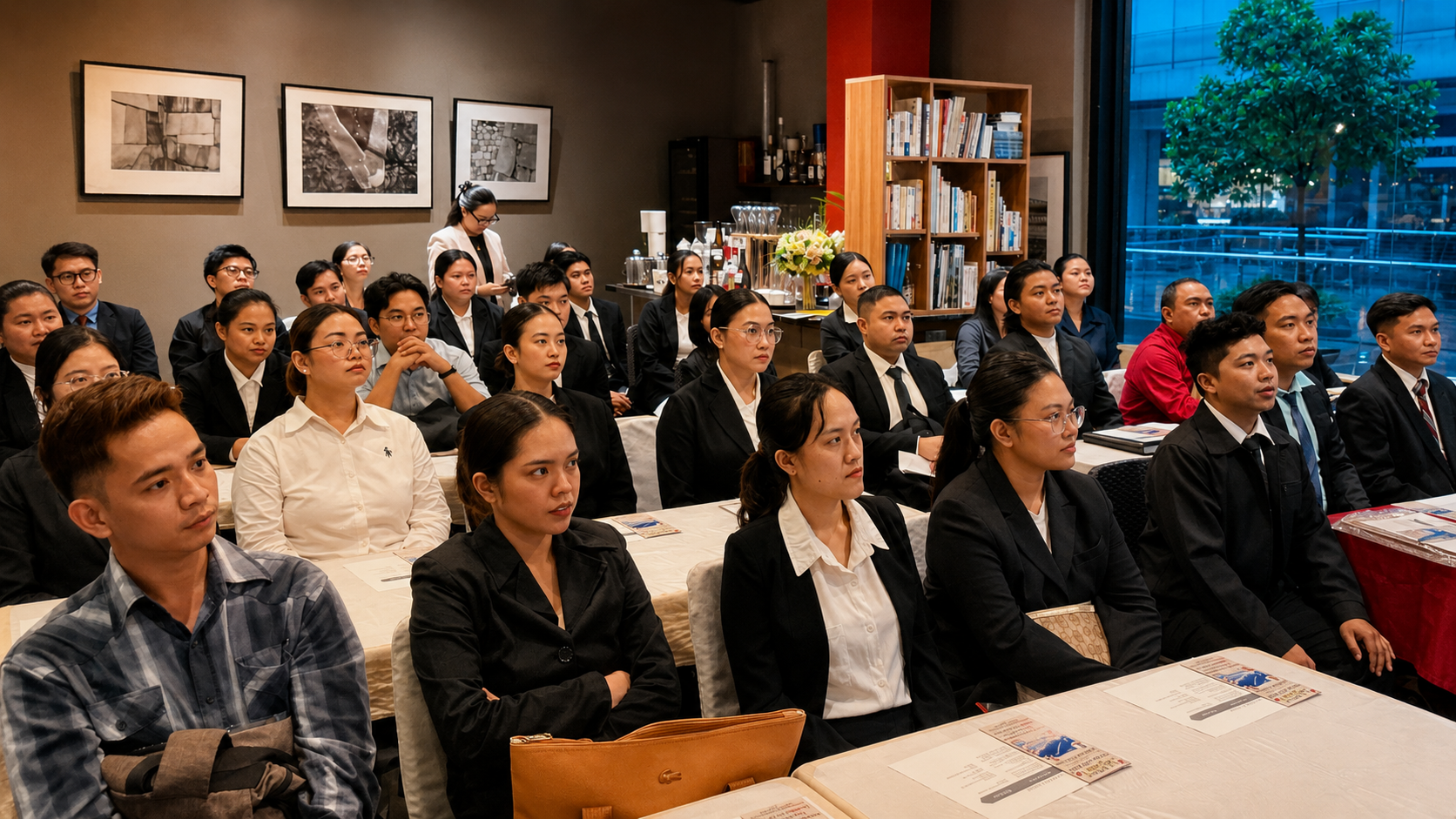
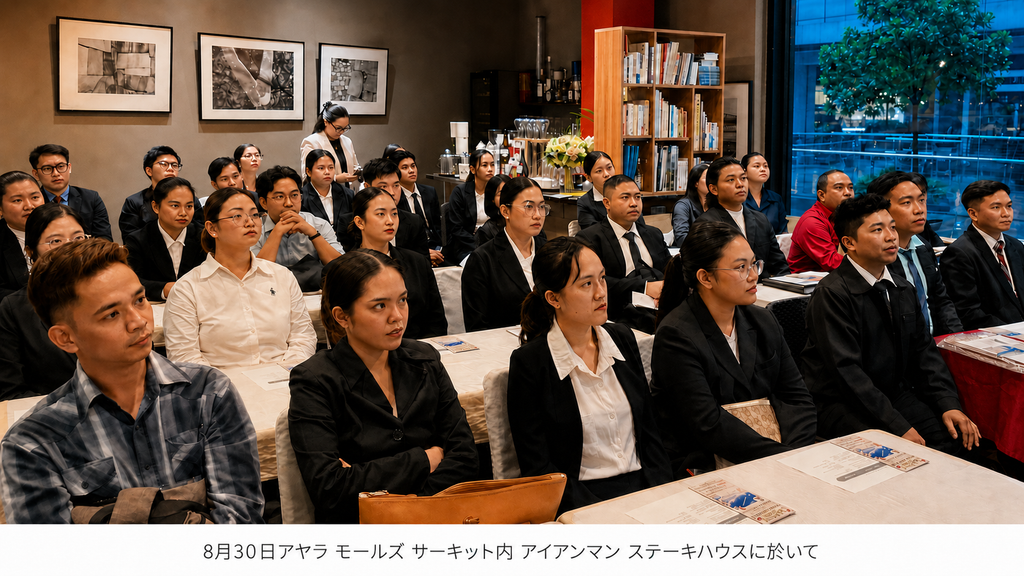
Amid continuing heavy rain caused by the southwest monsoon, known locally as “Habagat,” an orientation and interview session for Filipino candidates aspiring to become certified care workers in Okinawa Prefecture was held in Makati City on August 29. The interviews were conducted by the Okinawa Foreigners Caregiver Project Corporative Association (chaired by Yasushi Yonamine) and Step World Japanese Language Institute (Naha City; Vice Principal Kōichi Nakasuji). This year’s ninth cohort of the certified care worker training program drew more than 100 applicants, and 35 candidates who passed a rigorous document screening advanced to the interview stage.
Metro Manila had been hit by intermittent heavy rainfall since the previous day, raising concerns about flooded roads and disrupted transportation. Candidates’ attendance was therefore in doubt, but only one arrived late, with nearly everyone reaching the venue on time. The fact that so many candidates showed up despite the bad weather spoke to the depth of their enthusiasm for the program. The venue was attended by eight representatives of the cooperative, who had arrived in Manila the night before, along with three representatives from PJ LINK, which handles pre-departure Japanese-language instruction and on-site interpretation, and three representatives from its parent company, Withus.
The orientation was led by Secretary-General Motohiro Suzuki, with interpretation by Asahiko Yara. After a promotional video about Okinawa Prefecture and the cooperative was shown, Chairman Yonamine delivered opening remarks. Secretary-General Suzuki then explained the details of the program and its upcoming schedule.
The explanation covered upcoming procedures, including when interview results would be announced, moving into the dormitory, pre-departure Japanese language study, applying for and obtaining a Certificate of Eligibility and visa, and the planned departure for Okinawa in early April of next year. Careful explanations, in both Japanese and English, were also given regarding the costs required before departure, the status of residence after entering Japan, and working conditions such as salary and leave. The candidates listened intently, taking notes with serious expressions.
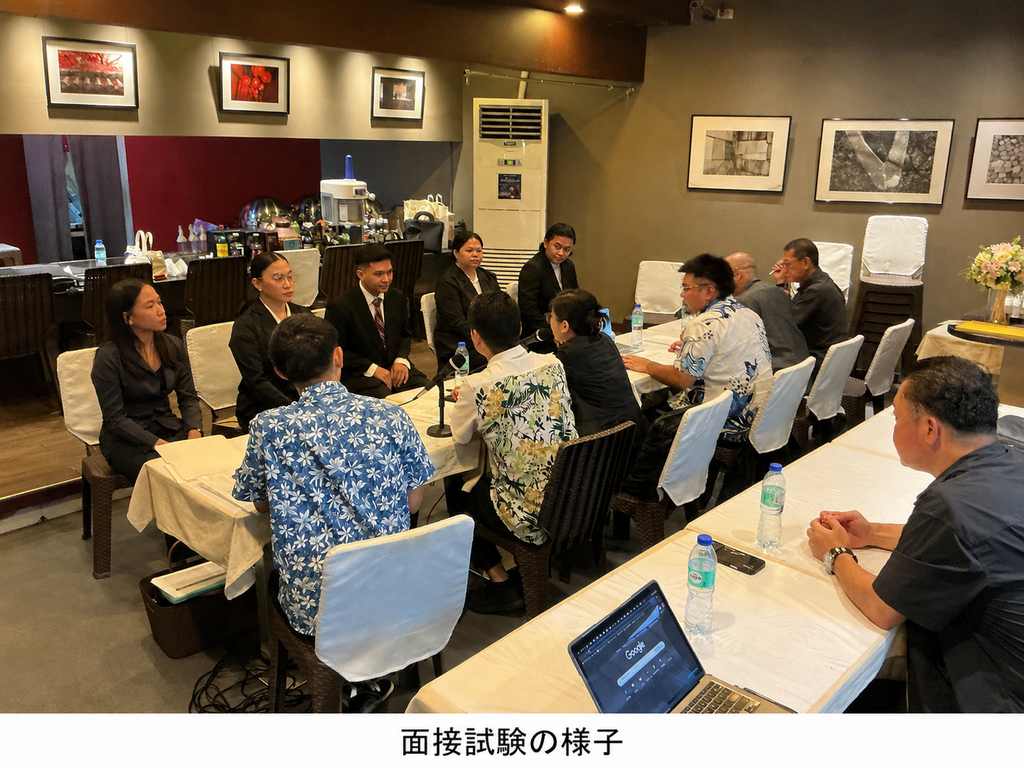
The interview examination that followed was conducted in groups of five candidates at a time. Six interviewers questioned each candidate individually about their motivation for applying, their experience studying Japanese, their experience with communal living, and whether they had obtained their families’ consent.
Though visibly nervous, the candidates answered the questions crisply and clearly. At times, a candidate’s amusingly imperfect Japanese drew laughter from the examiners. Even so, they approached the selection process for a program that would shape the course of their entire lives with evident seriousness.
Under the program, candidates spend their first three years working part-time at care facilities for up to 28 hours a week while studying basic Japanese at a language school and acquiring caregiving skills at a vocational welfare college. For the following five years, they work at care facilities under the same conditions as their Japanese counterparts, gaining practical work experience.
The cooperative covers the cost of pre-departure Japanese language study, dormitory fees, and travel expenses to Okinawa. It also advances the tuition for the Japanese language school and the vocational welfare college; under the program’s terms, this advance is forgiven once a candidate completes the full eight-year program. If a candidate withdraws partway through, however, they are obligated to repay the full amount of the advanced tuition.
To date, 67 Filipino candidates have gone to Okinawa through this program. Those who withdraw partway through — mainly due to marriage or illness — are said to account for only about 10 percent of participants.
Meanwhile, seven candidates have so far passed the national certified care worker examination. For people from a country where Japanese is not the native language and kanji is not used in daily life, this is regarded as a relatively strong result.
Chairman Yonamine, noting that the program will mark its tenth year since launch next year, expressed his intention to continue it going forward in order to address the ongoing shortage of certified care workers within Okinawa Prefecture. He also noted that Filipino caregivers are described as “cheerful and hardworking,” and are well regarded by both the receiving care facilities and their residents.
The candidates who passed this round of interviews will, after completing pre-departure Japanese language study and the procedures for obtaining their status of residence, depart for Okinawa as the program’s ninth cohort in early April of next year.

コメント