
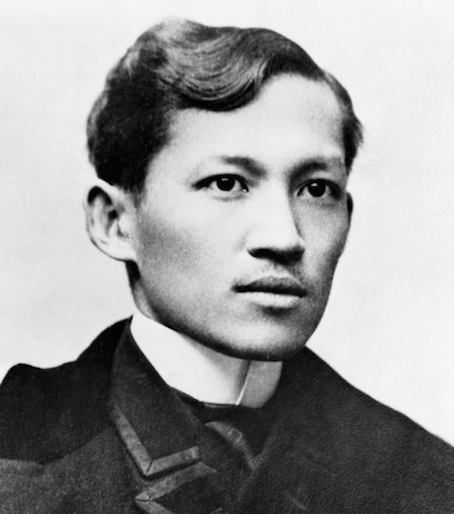
Yasotarō Mōri
There was an American engineer named Taufer working as a pump operator for the Hong Kong fire department. He lived a fairly comfortable life, but had long been blind. He was a kind man, and when a British non-commissioned officer he knew died suddenly in Hong Kong, he took in one of the man’s daughters as an act of charity toward the bereaved family. That girl — named Josephine — had Irish blood in her and a bright, cheerful disposition. During Rizal’s time in Hong Kong, she had known him as “the Spanish doctor,” and when, after Rizal returned home, his reputation as an eye specialist began to spread, she urged her adoptive father to go and be examined by him.
Her adoptive father, moved by this, eventually traveled to Dapitan with her help to visit Rizal (February 1895). While he stayed there receiving treatment, Rizal and Josephine fell in love. He came to love this lively, buoyant young woman with all his heart, and talk eventually turned to marriage. Taufer, however, had relied on Josephine for his daily care ever since losing his first wife, and on hearing that there was no hope of recovering his sight, he had already fallen into some despair; now, faced with the prospect that the girl he had raised as his own for seventeen years would marry and leave him to a lonely, empty future, he suffered a sudden mental breakdown and tried to take his own life with a razor. Rizal happened to discover him in time and wrested the razor away, averting tragedy — but the marriage talk was suspended for the time being, and Josephine returned to Hong Kong together with Taufer.
On the way back to Hong Kong, after talking things over with her adoptive father, it was decided that he would return to Hong Kong accompanied by a nurse, while she parted from him in Manila. She then called on Rizal’s sister (who was living in Manila at the time), stayed for a while, and returned once again to Dapitan. It was clear that the friars would obstruct any formal marriage between the two, and there was no real hope of a proper wedding — yet his mother sternly warned him that even if they lived together as common-law husband and wife, he must never betray his principles, and so the two of them spent happy days together as a common-law couple. This does indeed appear to have been a happy period in Rizal’s life. In a letter he sent to his sister on January 15 (1896), he wrote of how delightful the year-end and New Year holidays had been. Around this time, Josephine gave birth prematurely to a child, who died three hours after delivery.
When Josephine first came to Dapitan, she was accompanied by a woman of about the same age. This woman was said to be a keeper of scriptures at a certain large temple in Manila, and during Josephine’s stays in Manila she had visited that temple to see her on several occasions. Rizal’s fellow activists, ever wary of the friars’ machinations, began to suspect that Josephine might in fact be an agent sent by the friar faction. Rizal’s father, who was in Manila at the time, was especially suspicious of Josephine on this point and warned Rizal to be careful. Prompted by these warnings from those around him, Rizal himself began to notice things in her behavior that, on reflection, seemed suspicious. Without ever raising the matter of espionage directly, he told her it would be best for them to live apart for the time being, gave her a fair sum of money, and sent her back to Hong Kong. At their parting he composed a short farewell poem as a keepsake for her.
Josephine, however, did not go to Hong Kong. Instead she went to see Rizal’s sister Narcisa in Manila, explained the situation, showed her the farewell poem, and pleaded fervently that she wanted, whatever it took, to return to Rizal once more — and in the end she and Narcisa traveled together back to Dapitan. Rizal, confronted with Josephine’s return, was considerably at a loss, but finally resolved to tell her plainly that she was suspected of being a spy. On hearing this, she flew into a rage in the manner characteristic of the Irish temperament, weeping and crying out as if half out of her mind to protest her innocence; she wept through three days and three nights, and her evident sincerity moved his heart, so that he once again agreed to let Josephine live with him.
コメント