
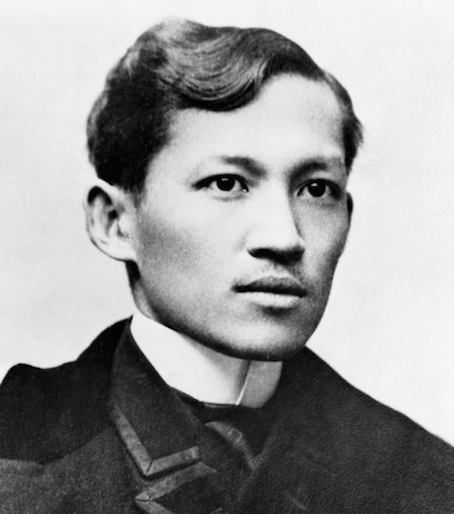
Yasotarō Mōri
His Approach to Education
He had long argued that improving the situation in the Philippines required educating the Filipino people, so it is easy to imagine how keenly interested he must have been in this small village school as his first opportunity to put his educational philosophy into practice.
His pupils were seventeen children from the town’s more well-off families, and his guiding principle was to advance moral, intellectual, and physical education in equal measure. He taught moral education through everyday conduct; for intellectual education he focused mainly on arithmetic, geometry, English, and Spanish, while also teaching field excursions, swimming, and gymnastics. In what might be called natural science, his students accompanied Rizal to help collect plants and insects and received hands-on instruction with real specimens — here too, the three strands of moral, intellectual, and physical education were present.
He paid particular attention to teaching his pupils not to be superstitiously afraid of anything: for example, when there was a local legend that climbing a certain tree would bring misfortune, he deliberately had the children climb it. During recess the students would gather together in the shade of a tree called the talisay, so he named his residence Talisay after it, and composed “The Song of the Talisay Tree” to commemorate it.
Because his time in Dapitan was, in the end, so short, this educational undertaking produced no concrete results worth noting — but it holds significance as the first occasion on which he put into practice his long-held belief that improving conditions in the Philippines depended above all on the education of its people.
Two Incidents
Materially, he was in fact rather well provided for, and to outward appearances he was living out his days in genuine contentment — yet inwardly there was something that chafed at him deeply: the cry of a conscience demanding freedom and justice. In February 1894 he finally petitioned the Governor-General to be released from his exile. In his petition he stated plainly that he had committed no crime whatsoever — or if he was guilty of anything, it was the same thing every other Spaniard was guilty of, namely wishing for Spain’s prosperity and strength.
Upon receiving this petition, Governor-General Despujol came in person to inspect Dapitan, but refused to grant it, telling him, “You’d like to make yourself king of this place, wouldn’t you.” Rizal also sought to establish a settlement in the north of Luzon, but this too was denied. And because the Governor-General’s manner in refusing him was so extremely rude, Rizal resolved, reluctantly, to settle permanently in Dapitan. (The Governor-General was later replaced by Blanco, who came to sympathize with Rizal from the heart.)
According to one account, the authorities and the friar faction had conspired to disappoint and discourage Rizal at every turn, hoping thereby to deepen his family’s and relatives’ sense of pity for him and ultimately induce him to abandon his political convictions. In the end, they simply failed to see the true measure of the man.

コメント