
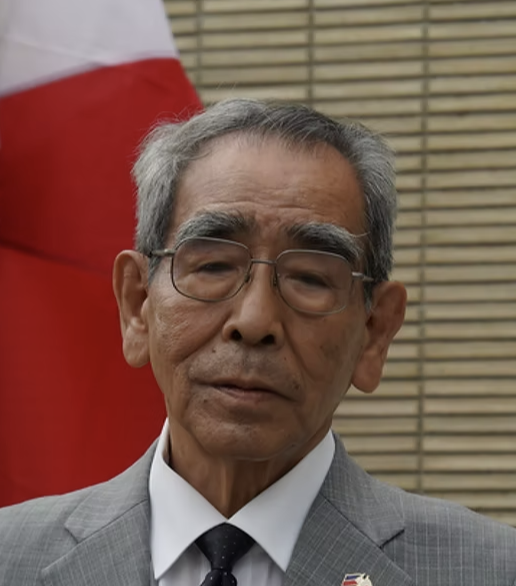
Pinoy-Hapon United Foundation (PHUF), a non-profit organization, Honorary Chairman Takeshi Asanuma
Sakai City lies just south of Osaka City. It was a port town historically tied to the old “Osaka,” yet it maintained its own political independence. The “Sakai merchants” cultivated a distinctive culture of their own, engaging in contact with foreign countries even before the Keichō era, and trade with overseas partners flourished right up until the country’s isolation policy took hold. Even afterward, people gathered there from all over for trade both large and small — and, it seems, firearms and other weapons were sometimes quietly traded as well. Unlike Osaka, which developed rapidly and politically after the Meiji Restoration, Sakai remained a provincial town with a settled, cultured atmosphere. During the Edo period, connoisseurs of refined pursuits such as the tea ceremony gathered there as well.
A famous antiwar poem from the Russo-Japanese War era, Yosano Akiko’s “Thou Shalt Not Die” — “You, child of a merchant house of Sakai, proud of its long-standing name, who are to inherit your parents’ name — you must not die… Even should the fortress of Port Arthur fall, what does it matter if it falls…” — captures the antiwar spirit of the people of Sakai. Yet as of May of Shōwa 20 (1945), Sakai itself had still not come under concentrated American bombing attacks. Even so, because naval-related facilities were located there, it had been subjected to single bombing runs and strafing attacks by carrier-based fighter planes.
In mid-May, our family of four (mother, older brother, myself, and younger sister) moved together with my uncle’s family of three from our grandparents’ house outside Nara to Yata Village, Naka-Kawachi District, Osaka Prefecture, just east of Sakai City (now Yata, Higashisumiyoshi Ward, Osaka City — still more than 12 kilometers from central Sakai). It was a quiet rural village about a 60-minute walk east from Suginomoto Station on the national railway’s Hanwa Line, and my brother (a third-grader) and I (a first-grader) transferred to the village’s national school. The villagers were all kind to us, and in particular there was a young man of 17 or 18 at our landlord’s house who taught me all sorts of things. It was he who taught me the names of the different types of American fighter planes.
Nara, where we had spent about two and a half months, had seen no air raids at all, but here — even though it was on the outskirts — it was still Osaka, and air-raid sirens often rang out, closing school for the day. At such times, my brother would often take me down to the early-summer waters of the Yamato River with a small fishing rod. It was there that I learned to swim — and to dive underwater, too. Later, as a junior-high student, I swam a full kilometer in a long-distance swimming class and earned a black stripe on my swim cap, and in high school I joined the swim team. It is the one and only accomplishment the war ever left me.
Even so, American fighter planes kept coming. They attacked Sakai on a regular basis — in broad daylight. Air-raid sirens would wail, and the roar of carrier-based aircraft would come rumbling in from the direction of Sakai. The American planes would attack Sakai, circle in the skies above Yata Village, and then head back toward Sakai again.
One day, an air-raid warning sent us home from school before noon. My brother and I, together with five or six neighborhood children, were walking along a path through the fields when suddenly an American fighter plane — probably a Grumman — came straight toward us overhead! All of us threw ourselves down flat in the field.
With a rattling da-da-da-da! of gunfire, a straight line of bullet holes was carved into the ground about 30 meters to our right, striking a farmhouse just beyond. The enemy plane climbed away in an instant and flew off toward Sakai. It was terrifying — I was shaking all over. I heard afterward that the household’s cow had been killed, its barn destroyed, and one family member wounded. There were no anti-aircraft guns or air-defense positions anywhere in the area — we were completely at the enemy’s mercy.
The next day, an upperclassman reported the incident at school, and it seemed some damage had occurred in the village as well, so the school issued an order banning the wearing of white clothing that would stand out from the air. My mother promptly dyed all of my and my brother’s open-collar shirts and white clothes a mouse-gray color. Even so, the “Rising Sun” headband we wore and the cloth name tag sewn onto our chests (bearing our name, address, school, grade, and blood type) remained white.
On June 15, Shōwa 20 (1945), in the middle of the day, a large formation of B-29s carried out wave after wave of attacks on Sakai City and the southern part of Osaka City, and a considerable portion of the historic town of Sakai burned to the ground.
A very sad event befell my own family as well.
コメント