
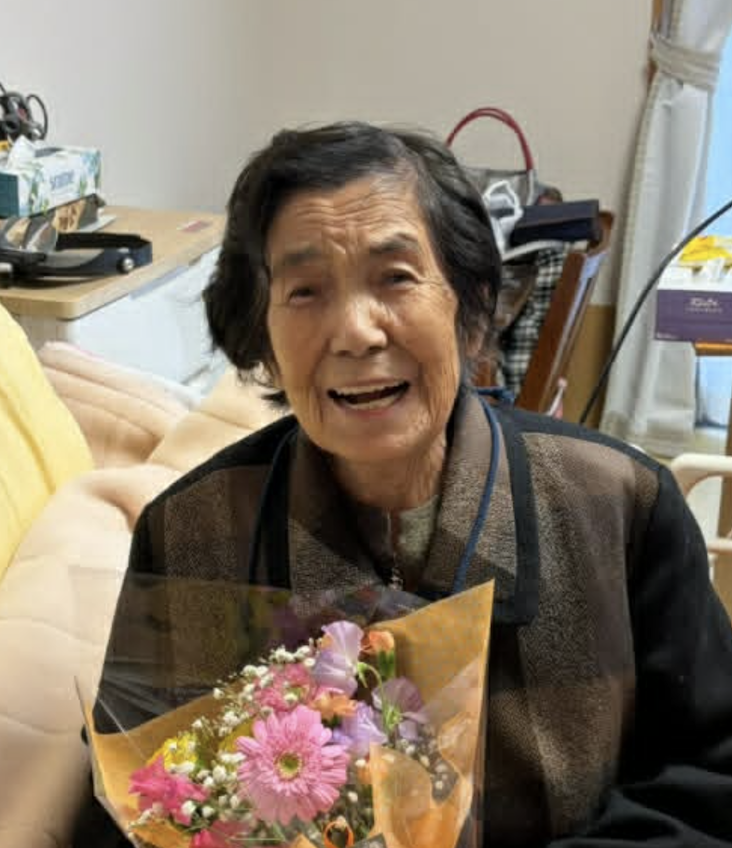
Hisako Kamikita (maiden name: Kimura), born January 8, Shōwa 9 (1934), in Arakawa Ward, Tokyo — a repatriate from Korea. Mother of two daughters and one son. Her father was a craftsman specializing in special glassware. She now leads a two-residence life, dividing her time between her home in Takayama, Gifu Prefecture, and “Pension Krone,” a guesthouse she runs in the town of Samboan, Cebu Province, in the Republic of the Philippines.
To Japan by Repatriation Ship
At last, the day came when Hisako and her family were able to board a ship. Hisako does not remember the name of the repatriation ship, but it must, of course, have been one of the ferries connecting Busan, Fukuoka, and Senzaki.
To keep her younger brothers from being swept off the deck by the raging waters of the Genkai Strait, Hisako tied their bodies to her own with a rope she found on the ship. Telling herself that everything would work out somehow as long as they made it to Japan, she endured twelve hours on that freezing, snow-swept deck.
A few days later, when the shores of Japan — the land they had dreamed of — finally came into view, everyone aboard erupted in joy.
But it was not at Hakata that Hisako’s family was able to land. As luck would have it, Hakata Bay was, at that moment, filled with American occupation warships, and the repatriation ship was denied entry to the port. Forced to give up on Hakata, they were instead put ashore at the next port, Senzaki, in Nagato, Tottori Prefecture.
The First Night at Senzaki
At Senzaki, fortunately, there was a kind benefactor who gave Hisako’s ragged, exhausted family bedding and a place to sleep. Thanks to that person, Hisako was able to sleep wrapped in a warm futon for the first time in five months, since leaving Yeongdeungpo on August 15. Now well into her eighties, Hisako hopes to find the chance to visit that unforgettable town of Senzaki once again.
To Nagasaki, and Then to Kumamoto
Upon reaching Japan, Hisako’s family planned to stay, for the time being, at the family home of her stepmother’s hometown in Nagasaki. Had they landed at Hakata, Nagasaki would have been just a stone’s throw away, but having been put ashore at Senzaki instead, the family had to endure days on end, rattling along by train, on the long journey toward Nagasaki. For their travel and living expenses within Japan, the banknotes that her stepmother, Matsuyo, had hidden by sewing them into the collar and sash of her kimono proved invaluable.
As it turned out, the stepmother’s family home in Nagasaki City was not especially far from the hypocenter of the atomic bomb, yet it had escaped destruction. But when they arrived at the house, they found a note posted there saying the family had evacuated to Kumamoto, so Hisako’s family set off for Kumamoto instead. There, Matsuyo was safely reunited with her parents and younger sister, and after spending about ten days together, the whole group returned together to Nagasaki.
School Life in Nagasaki
With the help of these grandparents-by-marriage, to whom she had no blood relation, Hisako transferred into the sixth grade at Shinkozen Elementary School in Nagasaki City, and graduated a few months later. She then entered Kwassui Girls’ School. A few months after that, under the newly promulgated school system, Kwassui Girls’ School was upgraded to become Kwassui Junior and Senior High School.
In order to secure stable work and a place to live large enough for the whole family, her father and stepmother entrusted the children to their grandparents in Nagasaki and set off for Osaka.
Separation from Her Birth Mother, and Her Stepmother, Matsuyo
As mentioned earlier, Matsuyo was not Hisako’s birth mother. Her father, Suezō, had seven children with his first wife, and Hisako was born the fourth daughter among them. Since her father made his living purely on the strength of his craftsman’s skill, moving wherever the pay was best, the family drifted from place to place across Japan — Tokyo, Chiba, Kyoto, Osaka — and Hisako, then still in elementary school, was forced to change schools each time.
While the family was living in Fushimi, Kyoto Prefecture, her father suddenly announced that he was calling a taxi to go to Osaka, where he had been working alone, away from the family, at the time. Hisako and her siblings were thrilled to ride in a taxi — such a luxurious mode of transport — for the first time. In truth, however, their parents had already divorced: of the seven siblings, their mother would keep the first four, along with the newborn youngest son, while their father would take Hisako and her two younger brothers and leave the household. Her father, without ever explaining to the children that he and their mother had divorced, or that the family was being torn apart, simply set off for Osaka, taking only the three of them with him.
When they arrived in Ikuno Ward, Osaka, an unfamiliar woman came out to greet them. Hisako was told that this woman was her new mother. It was only then that Hisako learned, for the first time, that her parents had divorced, that her father had already remarried, and that she was now separated from her birth mother and the rest of her siblings. What a selfish father, Hisako thought — divorcing a wife who had borne him seven children, and tearing brothers and sisters apart, all so he could be with another woman.
Her stepmother’s name was Matsuyo. Matsuyo, too, had been married before. Her first husband had been a diplomat; the two of them had had a child together, but the child had died shortly after birth. Her husband’s cold indifference to the child’s death disillusioned Matsuyo so thoroughly that she divorced him at once and returned to Japan. She then met Hisako’s father — through an introduction from an acquaintance, the president of a glassworks where he worked — and married him.
Having already given birth once, Matsuyo was by no means unable to bear children. And yet, throughout her life with her new husband, she never chose to have a child of her own. It is said that her reason was a fear that, were a new child born, it would create friction with Hisako and her two brothers, the children her husband had brought into the marriage. Matsuyo was, besides being beautiful, what was then called a thoroughly modern woman — accomplished in the shamisen, nagauta singing, flower arranging, the tea ceremony, and more. She could even cook dishes like stew, a rarity for the time, which perhaps was only to be expected of a former diplomat’s wife. Skilled as she was in all these accomplishments, however, Matsuyo never chose to teach any of them to Hisako. It seems her reasoning was that, if she taught Hisako these arts, Hisako might end up wanting to enter that world professionally — and that this would be a problem.
コメント