
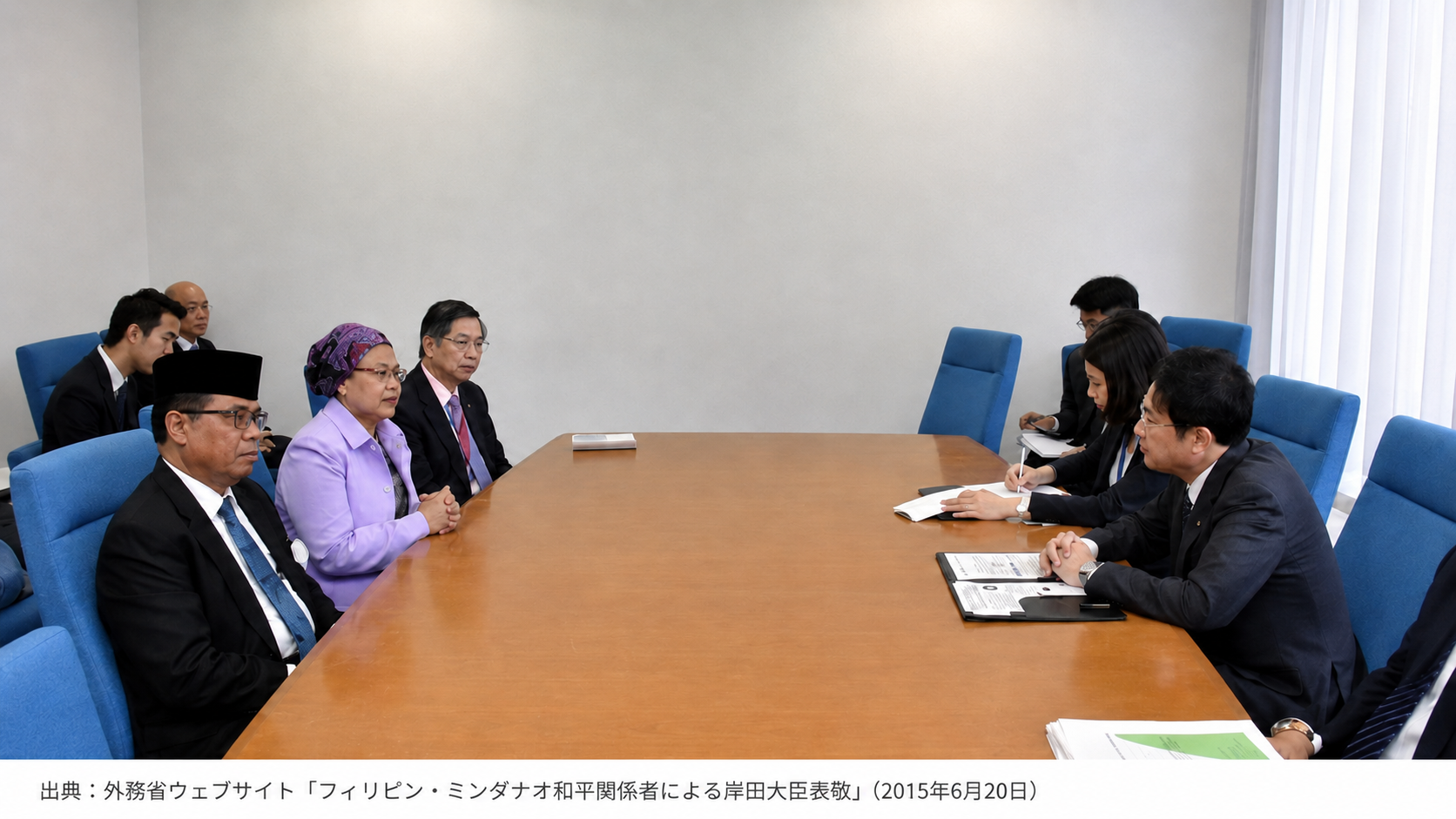
From Armed Group to Autonomous Government — How JICA Supports BARMM’s Administration
In March 2014, the Philippine government and the Moro Islamic Liberation Front (MILF) signed the Comprehensive Agreement on the Bangsamoro.
But signing the peace agreement was not the end of the conflict.
The MILF had operated for decades as an armed group fighting government forces. While it had experience commanding units and negotiating ceasefires, it had limited experience drafting budgets, managing civil servants, or delivering administrative services — roads, education, health, agriculture — to the population.
The ability to run an armed organization is different from the ability to run an autonomous government.
If the new autonomous government took office but the administration failed to function and people’s lives did not improve, disillusionment would spread — the sense that “nothing changed even after laying down arms.” That disillusionment could push former combatants back toward armed groups and shift popular support toward extremists who oppose the peace process.
The role of the Japanese government and JICA also shifted — from supporting the ceasefire and peace negotiations to helping turn the peace agreement into a functioning administration, economy, and society.
The Challenge After Peace Was “Building a Government”
The Comprehensive Agreement on the Bangsamoro set out the basic policy for establishing a new autonomous government within the Philippine state.
But a peace agreement alone does not make a government run.
Making the new autonomous government function required, at minimum, the following preparations.
- Design the autonomous government’s organizational structure and ministries
- Divide authority between the central government and the autonomous government
- Take over staff, assets, and programs from the former ARMM
- Establish budgeting, procurement, accounting, and personnel systems
- Train administrative officials
- Draft a regional development plan
- Continue services such as roads, education, health, and agriculture
- Support the reintegration of former MILF combatants and their families
- Create new jobs and industries in disarmed areas
What Japan and JICA emphasized here was not constructing office buildings, but cultivating the people who would work in them and the administrative systems they would use.
Preparations for the Autonomous Government Began Back in 2013
Starting in July 2013 — a year before the comprehensive peace agreement was even signed — JICA carried out the “Comprehensive Capacity Development Project for the Bangsamoro.”
At the time, neither the Bangsamoro Organic Law nor the autonomous government’s territory had been finalized.
Japan was investing in institutional design and human resource development at a stage when there was no guarantee the new autonomous government would actually come into being.
The project targeted the Bangsamoro Transition Commission, which was preparing the future autonomous government’s institutions, along with administrators from the former Autonomous Region in Muslim Mindanao (ARMM), local government staff, and agriculture/industry stakeholders.
The main areas of support were as follows.
| Field | Support Provided |
|---|---|
| Organization/Institutions | Autonomous government structure, administrative systems, transition planning |
| Human resource development | Training for administrators, technical staff, and local leaders |
| Public services | Administrative capacity for water supply, roads, agriculture, etc. |
| Local industry | Agricultural processing, product development, sales |
| Development planning | Formulating the Bangsamoro Development Plan |
| Regional cooperation | Coordination among the autonomous government, local governments, and community organizations |
The project continued until 2019 and was later used as the foundation for BARMM’s administrative structure. JICA: “Comprehensive Capacity Development Project for the Bangsamoro”
Why Former ARMM Staff Were Also Included
The new BARMM could not be run by MILF-affiliated personnel alone.
BARMM’s predecessor, the ARMM, already had administrative agencies and staff handling education, health, agriculture, public works, and more.
The ARMM had been criticized for its weak fiscal base, limited administrative capacity, and the influence of powerful local clans. But excluding staff with actual experience delivering services to residents risked halting administration the moment the new government took office.
On the other hand, simply keeping the old ARMM system intact risked producing an autonomous government that was “just the old sign with a new name.”
What was needed was to integrate former ARMM staff’s administrative experience, the MILF’s political legitimacy, and newly recruited specialists into a single government.
Rather than cultivating a single political faction, JICA supported the transition from the old system to the new one.
This is a distinctive feature of Japan’s support.
Drafting the Bangsamoro Development Plan
Alongside building the autonomous government’s organizational structure, JICA supported the formulation of a development plan for the entire Bangsamoro region.
The plan incorporated the fields needed for the region’s economic self-reliance: agriculture, fisheries, roads, ports, electricity, water supply, and local industry.
The Bangsamoro region is rich in agricultural resources, but years of conflict had delayed the development of roads, irrigation, warehouses, ports, and electricity.
Even if farmers produce crops, poor roads keep them from reaching market. Unstable electricity makes it hard to process or refrigerate produce. If ports don’t function well, logistics costs rise for island communities.
Poverty could not be treated as merely an agricultural-technology problem — production, processing, logistics, and sales needed to be improved as a single integrated system.
The development plan JICA supported later became the foundation for selecting concrete projects in roads, electricity, agriculture, and other sectors.
2018: The Bangsamoro Organic Law Is Enacted
It took about five years from the comprehensive peace agreement to the establishment of the autonomous government.
Implementing the peace agreement required the Philippine Congress to enact a law establishing the autonomous government, and residents of the target areas to approve it by referendum.
In July 2018, Republic Act No. 11054, the Bangsamoro Organic Law, was enacted.
A plebiscite was held in January and February 2019, determining BARMM’s establishment and which areas would join.
On February 22 of that year, the Bangsamoro Transition Authority — serving as the provisional autonomous government and interim parliament — was inaugurated.
MILF Chairman Murad Ebrahim became the first interim Chief Minister, with former MILF/MNLF members, former ARMM administrators, women, and indigenous representatives joining the interim government.
The stage had begun in which armed group leaders would run the region not with guns, but through administration and parliament.
Not Letting Administration Stop the Moment BARMM Launched
The greatest risk at the launch of the new government was that administrative services would be interrupted during the transition from the old ARMM to BARMM.
While organizational names, staff status, ministry authority, budgets, assets, and contracts were all changing, schools, hospitals, agricultural support, and road maintenance could not simply stop.
So in 2019, JICA launched the “Project for Enhancing the Capacity of the Bangsamoro Autonomous Government.”
The focus of the support was strengthening the interim autonomous government’s administrative management capacity.
- Organizational and personnel management
- Staff training systems
- Surveys of administrative needs
- Inter-ministerial coordination
- Policy formulation
- Agriculture and livelihood improvement
- Coordination with local governments
- Response to COVID-19
- Local industry development
The project was extended beyond its original schedule and ran until March 2026.
Japan’s support shifted from the stage of building the peace agreement to the stage where the government born from that agreement actually delivers public services.
Is Road Construction Peacebuilding?
Roads and bridges occupy an important place in Japan’s Bangsamoro support.
At first glance, road construction looks like a public-works project unrelated to peace.
But in conflict-affected areas, a lack of roads reinforces poverty, the absence of administration, and insecurity, each feeding the others.
Without roads, farmers cannot get their produce to market. Children struggle to reach school, and patients cannot be transported to hospitals. Government staff, police, and medical personnel also find it hard to reach remote areas.
Once roads are built, the following effects can be expected.
- Lower transport costs for agricultural products
- Improved access to markets and jobs
- Easier travel to schools and hospitals
- Administrative services reaching remote areas
- Increased interaction between regions
- Easier evacuation and relief during disasters
- Armed groups finding it harder to dominate areas without government presence
In 2019, JICA provided a yen loan of about $220.4 million for a road network improvement project in conflict-affected areas.
The project improves and upgrades roughly 100 kilometers of roads in conflict-affected areas of Mindanao, strengthening connections to major cities and arterial roads. JICA: “Conflict-Affected Areas in Mindanao Road Network Development Project”
Roads not only support residents’ daily lives — they are also the foundation for the BARMM government to actually govern the entire region.
Toward a Government That Can Maintain, Not Just Build
Even if aid builds roads, they deteriorate within a few years without maintenance.
An autonomous government that keeps relying on the central government or foreign aid agencies for repairs cannot really be called self-reliant.
So from 2026 to 2029, JICA will carry out new technical cooperation to strengthen BARMM’s Ministry of Public Works’ capacity to improve and maintain its road network.
The main components are as follows.
- Formulating a road classification plan
- Developing a road and bridge database
- Determining repair priorities
- Standardizing maintenance operations
- Pilot projects at local public works offices
- Building the capacity of Ministry of Public Works staff
This shows JICA’s shift from aid that provides roads directly to aid that builds BARMM’s own capacity to plan and manage roads. JICA–BARMM Road Network Management Capacity Enhancement Project
Support for Marawi’s Reconstruction
In 2017, Marawi — the capital of Lanao del Sur province — was seized by the Maute Group and Abu Sayyaf-affiliated forces.
The fighting with the Philippine military lasted about five months, destroying large areas of the city and displacing a large number of residents.
The Battle of Marawi showed that peace with the MILF did not automatically make violence in Mindanao disappear.
Extremists opposed to the peace process recruit members by exploiting weak administration, poverty, youth unemployment, and public discontent.
Japan and JICA provided grant aid of about ¥2 billion — roughly $18.3 million at the time — for road restoration and other work within Marawi city.
Marawi city and its surrounding areas were subsequently included in road network development projects as well.
Road restoration relates not only to urban reconstruction, but also to the return of displaced residents, logistics, administrative services, and preventing extremists from re-infiltrating the area. JICA: “Marawi Recovery Support”
Why Support Agriculture and Livelihoods?
In BARMM, many residents work in agriculture, fishing, and small-scale commerce.
But conflict has left farmland abandoned, destroyed roads and irrigation, and restricted access to markets.
Even after former combatants disarm, without a stable income they risk returning to illegal arms trading, private armies, criminal organizations, or extremist groups.
JICA supported training for autonomous government staff and local agricultural extension workers, rice-farming techniques, agricultural processing, and local industry development.
What matters is not giving former combatants special treatment alone.
If only former combatants receive cash or farming supplies, residents who never took up arms may resent that “those who carried guns come out ahead.”
For that reason, peace support needs to support former combatants, their families, host communities, and residents affected by the conflict together, as one.
Reintegration is not something that ends by handing money to individual combatants. It means creating options for a legal livelihood and employment within the community.
Is JICA Carrying Out the Decommissioning?
The registration and verification of MILF combatants and weapons, and the decommissioning itself, are handled by the Independent Decommissioning Body, established under an agreement between the government and the MILF.
JICA is not the one collecting weapons or detaining combatants.
What the Japanese government and JICA are primarily involved in is creating the socioeconomic conditions that make decommissioning sustainable.
- Former combatants earning income through farming or business
- Families gaining access to education and healthcare
- Roads and water infrastructure being built in host communities
- The autonomous government delivering administrative services
- Preventing conflict between communities and former combatants
- Developing local industry and employment
Handing over a weapon can be done in a day. But the transition from combatant to civilian takes far longer.
Japan’s role lies not in weapons collection itself, but in creating an environment where people no longer need to pick up a weapon to survive.
Decommissioning Is Not Yet Complete
According to the Philippine government, from 2015 through the third phase, roughly 26,000 MILF combatants and 4,625 weapons had been processed for decommissioning.
But the final, fourth phase has not been completed.
The government had targeted 14,000 combatants and 2,450 weapons for the final phase, but the MILF postponed it, arguing the government had not sufficiently fulfilled its obligations — such as socioeconomic support for already-decommissioned combatants.
This issue shows that development assistance and decommissioning cannot be separated.
The government side holds that weapons should be surrendered first; the MILF side argues that the promised livelihood support should come first.
JICA’s agriculture, livelihood, road, and administrative support can help bridge this distrust. But Japan cannot fulfill the agreement between the government and the MILF on their behalf.
The Results of Japan’s Support
Over more than 20 years, the support of the Japanese government and JICA has produced certain results.
- Delivered a peace dividend to residents
- Earned trust from both the government and the MILF
- Supported the Narita talks and peace negotiations from the sidelines
- Developed administrative personnel even before the autonomous government was established
- Supported the formulation of the Bangsamoro Development Plan
- Helped prevent an administrative gap at BARMM’s launch
- Improved basic conditions such as agriculture, roads, and water supply
- Contributed to Marawi’s reconstruction
- Linked former combatants’ reintegration with regional development
- Is building BARMM’s own capacity to manage infrastructure
This was not simply about providing funds — it was a long-term investment in people, institutions, and communities.
The Limits of Japan’s Support
On the other hand, there are many problems Japanese ODA alone cannot solve.
Delayed Decommissioning
The MILF’s final phase of decommissioning has not been completed, and illegal weapons remain in the region.
Private Armies and Clan Politics
The private armed groups of local politicians and powerful clans, and inter-clan feuds, cannot be resolved immediately through administrative support alone.
Corruption and Administrative Capacity
Gaps exist between the autonomous government’s ministries in staffing, expertise, and budget execution capacity. If foreign aid increases but procurement, auditing, and information disclosure remain inadequate, public trust will be lost.
Regional Disparities
Maguindanao, Lanao, Basilan, Tawi-Tawi, and other areas differ in geography, security, and industrial structure. Attention is also needed to the gap between areas with extensive road development and island communities where aid is harder to reach.
A Prolonged Political Transition
BARMM’s interim governance has been prolonged. The transition from an interim period in which peace-process leaders run the administration, to normal politics in which residents elect their government and power can change hands, is essential.
Aid Dependence
Continued reliance on the central government or foreign aid would prevent BARMM from developing its own capacity for taxation, planning, and maintenance.
Whether Japan’s support has succeeded cannot be judged solely by the number of roads built or training sessions held.
The ultimate benchmark is whether, after the aid ends, BARMM can deliver administrative services on its own, maintain its facilities, and earn the trust of its residents.
Did Japan “Build the Bangsamoro Government”?
The parties that built BARMM were the Philippine government, the MILF, the MNLF, the Philippine Congress, and the residents who took part in the plebiscite.
Japan did not design the autonomous government or impose it from outside.
The role of the Japanese government and JICA was to provide funding, technology, human resource development, and a diplomatic venue so the parties themselves could carry out the peace and autonomy they had chosen.
This position matters.
If a foreign aid agency decides an autonomous government’s policies on its behalf, administrative capacity never develops. Conversely, simply handing over funds without checking results can invite corruption, inefficiency, and political bias.
JICA has taken the approach of respecting BARMM’s own ownership while jointly advancing planning, training, pilot projects, and institution-building.
Japan’s role is not to be the protagonist of peace, but to support the parties to peace until they can run their own government.
What Four Installments Have Shown
Part 1 covered why Japan took part in reconstruction support after the 1996 MNLF peace agreement, and why it began full-scale support for Mindanao in 2001–2002.
Part 2 examined how J-BIRD (the Japan-Bangsamoro Initiatives for Reconstruction and Development) began in 2006, and how Japan sent development experts rather than soldiers to the international monitoring team.
Part 3 showed how Japan’s development assistance grew into diplomatic mediating capacity, through its participation in the International Contact Group in 2009, the 2011 Narita talks, the 2012 Framework Agreement, and the 2014 comprehensive peace agreement.
This final installment has laid out how Japan supported the training of administrators, development planning, roads, agriculture, livelihoods, and the reintegration of former combatants, in order to turn the peace agreement into a functioning autonomous government.
This engagement of more than 20 years can be summed up in three stages.
- Sustaining the ceasefire
- Bringing the political agreement to fruition
- Making the post-peace government and society function
Japan was involved in all three stages, each in a different way.
Conclusion — Not Just Stopping the Fighting, but Reducing the Reasons to Return to It
Military peacekeeping monitors so that armed factions do not resume fighting.
But simply monitoring a ceasefire line does not resolve land disputes, poverty, unemployment, the absence of administration, lack of education, or public distrust.
What the Japanese government and JICA aimed for was not imposing peace by force.
Build schools, health centers, wells, and roads. Raise farmers’ incomes. Enable former combatants to live as civilians. Train administrators, and enable the autonomous government to deliver services to residents.
And support the institutions through which political demands can be realized through parliament, elections, and administration, rather than guns.
Japan’s Bangsamoro support is neither ordinary ODA nor conventional ceasefire monitoring.
It was peacebuilding that, without using military force, reduced the reasons to return to fighting, one by one.
What ultimately matters is not the amount of Japanese aid or the number of facilities built.
It is whether BARMM’s residents come to trust their autonomous government rather than armed groups, and whether a society takes root in which political change comes through elections rather than guns.
※This article is based on materials available as of August 2026 from the Japanese government, JICA, the Philippine government, and other sources. Foreign-currency conversions for road-project costs, etc., are based on figures at the time of announcement.
Main References
- JICA: Comprehensive Capacity Development Project for the Bangsamoro
- JICA: Project for Enhancing the Capacity of the Bangsamoro Autonomous Government
- JICA: Conflict-Affected Areas in Mindanao Road Network Development Project
- JICA: Marawi Recovery and Road Development
- JICA: BARMM Road Network Management Capacity Enhancement Project
- JICA: Peace and Development in Mindanao
- JICA, “Comprehensive Review of Mindanao Support”
- Philippine Government Peace Process Office / MILF: Statement on Deferring Decommissioning
コメント