
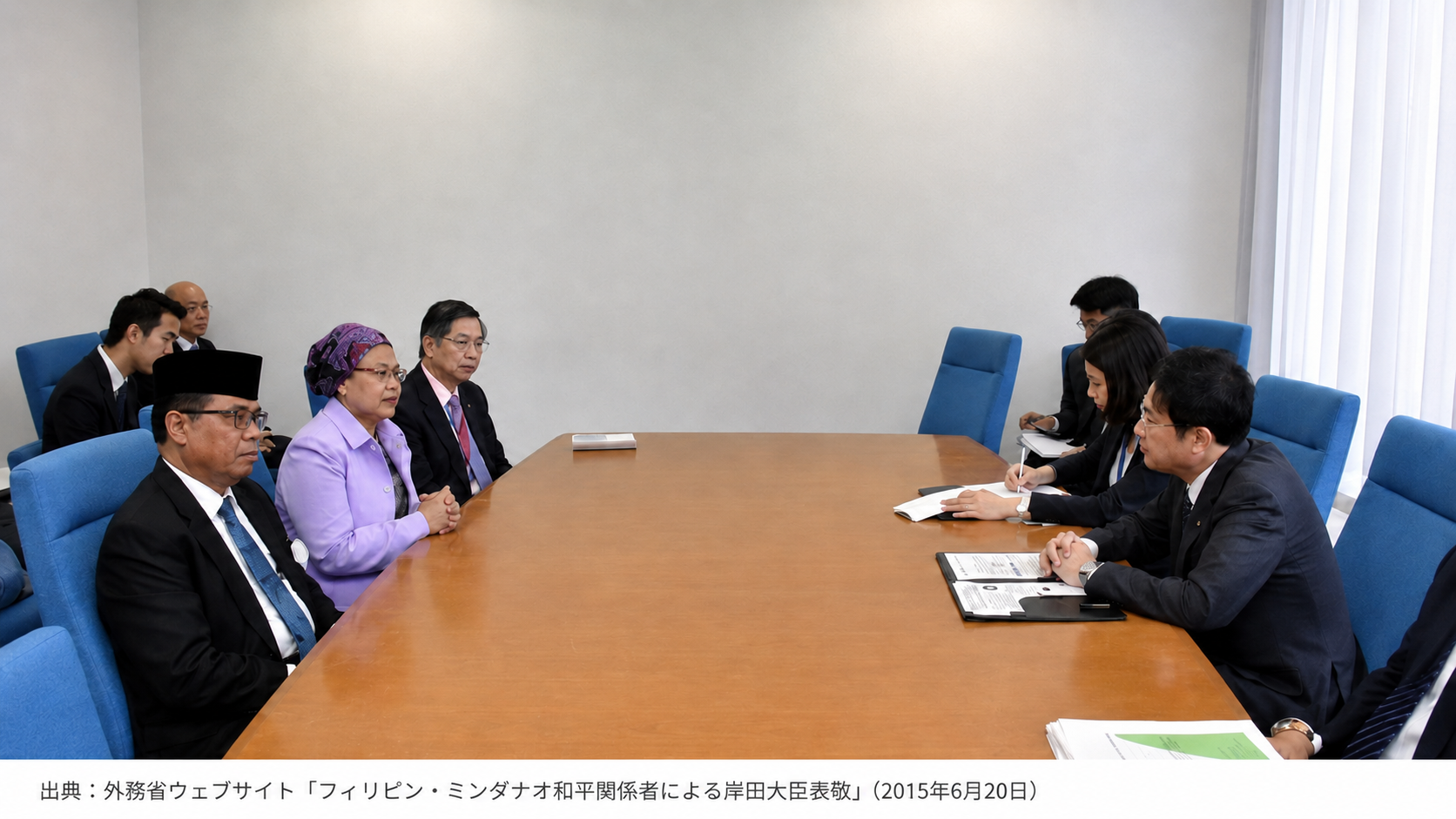
The Narita Summit Between the President and the MILF Chairman — How Japan Supported the Peace Negotiations
In 2006, the Japanese government launched J-BIRD (Japan-Bangsamoro Initiatives for Reconstruction and Development) and dispatched socioeconomic development experts to the International Monitoring Team (IMT) in Mindanao.
Japanese experts visited villages in conflict-affected areas to assess the need for schools, health clinics, wells, and farm roads. Through this work, Japan built a distinctive relationship of trust with the Philippine government, the Moro Islamic Liberation Front (MILF), local governments, and residents alike.
That trust produced a major diplomatic breakthrough in August 2011: the first-ever summit between President Benigno Aquino III and MILF Chairman Al Haj Murad Ebrahim, held in Japan.
The meeting took place neither in Manila, nor in Cotabato near the MILF’s home base, nor in Malaysia, which was mediating the peace talks.
It was held at a facility in Japan, near Narita International Airport.
How did Japan — a development donor — come to serve as the diplomatic go-between linking the Philippine president and the MILF’s supreme leader?
Japan’s Involvement Grew Into Three Layers
Japan’s and JICA’s support for peace in Mindanao combined three functions:
- Peacekeeping: the International Monitoring Team (IMT) — ceasefire monitoring and socioeconomic development
- Peacemaking: the International Contact Group (ICG) — advising the peace negotiations and building trust between the parties
- Peacebuilding: J-BIRD — poverty reduction, regional development, and human resource development
The “peacekeeping” referred to here is not the same as a UN peacekeeping operation.
Japan did not deploy its Self-Defense Forces; instead, it sent civilian experts, primarily responsible for socioeconomic development, to the IMT. Rather than enforcing a ceasefire by force, Japan used the space the ceasefire created to build schools, wells, and health clinics — letting residents feel the tangible benefits of peace.
Development assistance alone, however, could not bring about a final political agreement between the government and the MILF.
So in 2009, Japan moved into the field of peacemaking itself — supporting the negotiations directly.
From the 2008 Collapse of the Peace Talks to Their Resumption
Negotiations between the Philippine government and the MILF suffered a major setback in 2008.
The two sides had prepared a draft agreement known as the MOA-AD (Memorandum of Agreement on Ancestral Domain), covering the Bangsamoro’s ancestral domain, governance, and land issues.
But local politicians and others opposed to the negotiation process and the treatment of territory filed a petition with the Supreme Court, blocking the agreement from being signed. The Supreme Court itself ruled the draft agreement unconstitutional.
Fighting subsequently flared up again between some MILF units and government forces, displacing large numbers of residents.
Restarting the peace process would require more than the negotiating methods used before.
Malaysia continued to serve as the lead mediator, but a new mechanism was needed to advise both the government and the MILF, liaise with the international community, and support the continuation of talks.
In December 2009, the International Contact Group was established.
What Was the International Contact Group?
The International Contact Group was a mechanism to support the peace negotiations between the Philippine government and the MILF from the outside.
Japan was involved from the group’s founding, attending the peace talks as an observer.
Japan’s role was not to take over as lead negotiator from Malaysia. Rather, it was to advise on the substance of the talks, help the parties communicate with each other, and connect international support to the peace process.
The IMT and the ICG have similar-sounding names but different roles.
- IMT (International Monitoring Team): mainly active in Mindanao’s conflict-affected areas — monitoring the ceasefire, conducting field surveys, and supporting socioeconomic development
- ICG (International Contact Group): mainly active at the negotiating table — advising the talks, mobilizing international support, and building trust
- J-BIRD: mainly active in local communities and government institutions — development, human resource development, and poverty reduction
Following the ICG’s establishment in 2009, formal peace negotiations between the government and the MILF resumed in February 2010.
Japan had become a country involved in all three stages: on-the-ground development support, ceasefire monitoring, and political negotiation.
How Development Assistance Became Diplomatic Credibility
As a general matter, a country mediating peace talks needs the trust of both parties.
A country with strong ties only to the Philippine government would be viewed by the MILF as lacking neutrality. A country seen as too close to the MILF’s demands would be viewed by the Philippine government as interfering with national sovereignty.
For the Philippine government, Japan had long been a major ODA donor and an important partner supporting infrastructure, public administration, agriculture, and education.
For the MILF, meanwhile, rather than trying to dismantle the organization by force, Japan — through J-BIRD — built schools, health clinics, and wells even in areas under MILF influence.
Japanese experts worked not only in government-controlled areas, but also in areas that could only be accessed with the cooperation of people connected to the MILF.
Through this fieldwork, Japan did not merely declare itself neutral — it demonstrated, in practice, that it could work with both sides.
Trust was further reinforced by the fact that the Japanese government and JICA continued their support even after the 2008 collapse of the peace talks.
Japan came to be seen not as a country that provided funding only when peace was going smoothly, but as one that stayed engaged even when negotiations failed and security deteriorated.
The Aquino Administration Takes Office
In June 2010, Benigno Aquino III was inaugurated as President of the Philippines.
The Aquino administration made peace with the MILF one of its key policy priorities. Yet deep mistrust still remained between the government and the MILF.
The MILF believed that past administrations had failed to honor their commitments. For its part, the government harbored doubts about whether the MILF would genuinely disarm and accept autonomy as part of the Philippine state.
Under the normal negotiation process, government and MILF negotiating teams met for talks in Malaysia.
But meetings between negotiating teams alone take time to produce politically difficult decisions. It was necessary for the top leaders of both organizations to meet directly and confirm their will for peace.
The Japanese government therefore brokered a direct meeting between President Aquino and Chairman Murad.
Why Was the Meeting Held in Japan?
There were political and security concerns around a sitting Philippine president meeting domestically with the supreme leader of an anti-government armed group.
Meeting in Manila would have raised concerns for the MILF side about the risk of arrest or safety.
Meeting at an MILF stronghold would have posed security risks for the president, and risked political criticism that the Philippine government had traveled into territory controlled by an anti-government organization.
Meeting in Malaysia, the lead mediator, risked drawing formal peace-negotiation-level attention both domestically and internationally, making it harder for both sides to speak freely.
Japan was a relatively neutral third location for both parties, politically, and one where security could be more easily assured.
The Japanese government was not an ally of the Philippine government, but it was an important economic partner. It also had a relationship of trust with the MILF, built through J-BIRD and the IMT.
Meeting on Japanese soil also allowed the two leaders to speak directly with each other at some remove from the domestic conflicts within the Philippines.
In this way, in August 2011, the meeting between President Aquino and Chairman Murad took place near Narita International Airport.
What Made the Narita Meeting Historic?
The Narita meeting was the first direct summit between a sitting Philippine president and the MILF’s supreme leader.
Until then, the government had treated the MILF as an anti-government armed group challenging the state. The MILF, for its part, viewed the Philippine government as the party that had taken away the Bangsamoro’s land and right to self-determination.
The fact that the top leaders of both sides sat at the same table was itself a sign of a changing relationship.
The meeting did not involve negotiating the detailed text of an agreement. What mattered was that both sides directly confirmed their political will to achieve peace.
Once trust is established between top leaders, negotiating teams working through difficult issues can proceed with the shared understanding that “the top leadership wants peace.”
President Aquino later said, in a summit meeting with the Japanese government, that the 2011 Narita meeting led to the historic Framework Agreement of 2012.
Ministry of Foreign Affairs of Japan, “Japan-Philippines Summit Meeting”
The Narita meeting was not the meeting that completed the peace process — it was the meeting that built the political trust that made peace possible.
The 2012 Framework Agreement on the Bangsamoro
In October 2012, the Philippine government and the MILF signed the Framework Agreement on the Bangsamoro.
The agreement laid out the basic policy for establishing a new political autonomous entity, “Bangsamoro,” to replace the former ARMM.
The main directions set out in the Framework Agreement were as follows:
- Establish the Bangsamoro autonomous government
- Preserve the sovereignty and territorial integrity of the Philippine state
- Divide powers between the central government and the autonomous government
- Build the fiscal foundation of the autonomous government
- Progressively address MILF combatants and weapons
- Advance normalization and socioeconomic development
- Establish a transition commission to prepare the basic law
What matters here is that the MILF accepted a strong autonomous government within the Philippines, rather than immediately establishing an independent state.
The government, for its part, agreed to the creation of a new political entity with far broader powers than an ordinary local government.
Both sides gave up part of their maximalist demands and chose a path of converting armed struggle into a political system.
Sajahatra Bangsamoro — Connecting the Agreement to Daily Life
Even once the Framework Agreement was reached, establishing BARMM still required numerous further steps — a basic law, a plebiscite, a transition government, and more.
In the meantime, if residents’ living conditions failed to improve, hope for peace risked turning into disappointment.
So in February 2013, the Philippine government and the MILF launched Sajahatra Bangsamoro, aimed at socioeconomic development in MILF-affected areas.
“Sajahatra” was used as a word carrying meanings close to peace, blessing, and prosperity.
Its main focus areas were as follows:
- Health and medical care
- Education
- Scholarships and vocational training
- Livelihood improvement
- Agriculture
- Basic services for local residents
JICA also cooperated in this effort.
Sajahatra Bangsamoro was intended to deliver an early “peace dividend” to residents without waiting for the final completion of the peace agreement.
The idea was that peace is not simply an agreement between the government and the MILF leadership — it only takes root once residents feel its benefits and support the political transition.
Training Administrators Before the Autonomous Government Even Existed
In July 2013, JICA launched the “Comprehensive Capacity Development Project for the Bangsamoro.”
At this point, neither the comprehensive peace agreement nor the Bangsamoro Basic Law yet existed.
Even so, Japan began developing human resources and administrative systems in anticipation of the future autonomous government.
The project targeted the Bangsamoro Transition Commission, former ARMM government officials, local governments, and people involved in agriculture and industry.
The support covered the following areas:
- Institutional and organizational design of the autonomous government
- Training personnel to handle administrative services
- Water supply and road management
- Promotion of agriculture and local industry
- Formulation of regional development plans
- Policy planning and inter-agency coordination
The ability to run an armed organization and the ability to run an autonomous government are different things.
Being able to command troops does not necessarily mean being able to manage budgets, personnel, public works, education, agriculture, and health services.
Japan began preparations before the government was even established, so that the MILF — once it chose to lay down arms and enter politics — would not lose the support of residents through administrative failure.
2014: The Comprehensive Peace Agreement Is Signed
The government and the MILF continued detailed negotiations even after the Framework Agreement.
The negotiations covered four main areas:
- The transition system and how it would be implemented
- The division of powers between the central government and the autonomous government
- The allocation of tax revenue, funding sources, and natural resource revenue
- Normalization, including disarmament, security, and the reintegration of former combatants
Once these annexes were finalized, the Philippine government and the MILF signed the Comprehensive Agreement on the Bangsamoro on March 27, 2014.
It was the basic agreement that brought a political end to more than 40 years of armed conflict.
Japan was not the lead mediator. But through the IMT, ICG, and J-BIRD, it was one of the countries that continuously supported all of the ceasefire, the negotiations, and development throughout.
Why Was a Peace Seminar Held in Hiroshima?
About three months after the Comprehensive Peace Agreement, in June 2014, JICA held the “Consolidation for Peace for Mindanao” seminar in Hiroshima.
The gathering brought together key figures in the peace process, including President Aquino, MILF Chairman Murad, and Philippine government peace negotiators.
Choosing Hiroshima carried symbolic weight.
Hiroshima is a city that suffered catastrophic devastation in war, and rebuilt its city and society afterward.
For those involved in Bangsamoro, the peace agreement was not an endpoint. Destroyed areas had to be rebuilt, former combatants reintegrated into civilian life, and a society built in which residents who had once been in conflict could live under the same government.
Hiroshima’s experience was presented as an example of achieving reconstruction and peace while preserving the memory of war.
JICA used the Hiroshima gathering as an occasion for the government and the MILF to reaffirm their commitment to implementing the peace agreement.
JICA, “Mindanao Peace Stakeholders Gather in Hiroshima”
The Transition to J-BIRD 2
Alongside the Hiroshima gathering, the Japanese government announced plans to develop the existing J-BIRD program into J-BIRD 2.
The original J-BIRD had emphasized urgent improvements to daily life and trust-building in conflict-affected areas.
J-BIRD 2 shifted its focus toward helping the future autonomous government and regional economy function independently.
It rested on three main pillars:
- Community development: schools, clinics, wells, and the like
- Human resource development for the transition period: government officials, local leaders, and practitioners
- Sustainable economic development: agriculture, manufacturing, infrastructure, and local industry
If pre-peace support had been about creating “an environment where people don’t return to fighting,” post-peace support shifted toward building “the capacity for the autonomous government and the regional economy to sustain peace on their own.”
Did Japan Achieve the Peace?
Japan’s role should not be overstated.
The parties to the peace negotiations were the Philippine government and the MILF. Malaysia, as lead mediator, supported both sides’ negotiations over a long period. Other countries, international organizations, NGOs, religious groups, and local communities also played important roles.
Japan alone did not bring about peace.
But Japan had features that set it apart from other supporting countries.
- It was involved in the ceasefire and local development through the IMT
- It advised the peace negotiations through the ICG
- It delivered the peace dividend to residents through J-BIRD
- It provided a safe venue for the Narita meeting
- It trained administrators before the autonomous government was even established
- It continued its engagement even after the 2008 collapse of the peace talks
It is more accurate to characterize Japan not as the central mediator drafting the negotiating text, but as a “backer” supporting the peace process from multiple angles so that it would not collapse.
Conclusion to Part 3
Japan was able to move from a development donor to a third party supporting the peace negotiations because its fieldwork from 2006 onward had earned the trust of both the government and the MILF.
Through its participation in the ICG from 2009, Japan became formally involved in the peace negotiations.
At the 2011 Narita meeting, the top leaders of the government and the MILF, stepping back from domestic political and security constraints, directly confirmed their will for peace.
That trust led to the 2012 Framework Agreement on the Bangsamoro and the 2014 Comprehensive Peace Agreement.
Japan, moreover, did not treat the signing of a peace agreement as its only goal — through Sajahatra Bangsamoro and administrative capacity-building projects, it began preparing the future autonomous government and local communities in advance.
JICA’s development assistance supported Japan’s diplomacy, and Japan’s diplomacy supported the political space JICA needed to operate in conflict-affected areas.
The Narita meeting was the clearest expression of Japan’s “linkage between diplomacy and development.”
Coming Up Next
The final installment, Part 4, will cover Japan’s support from the 2014 Comprehensive Peace Agreement through the period after BARMM’s establishment.
What was needed for a former armed organization to transform into an autonomous government handling budgets, personnel, roads, agriculture, education, and health?
It will examine JICA’s training of administrators, the Bangsamoro Development Plan, the reconstruction of Marawi, road and bridge development, agricultural and livelihood support, and the reintegration of former MILF combatants into society.
It will also address issues that Japan’s support alone cannot resolve — the delayed final disarmament, illegal firearms, clan politics, and gaps in administrative capacity.
*This article is based on materials from the Japanese government, JICA, the Philippine government, and others available as of August 2026.
Key References
- Ministry of Foreign Affairs of Japan — 2009 International Contact Group and the Resumption of Peace Negotiations
- Ministry of Foreign Affairs of Japan — Japan’s Engagement in Peace in Mindanao
- Ministry of Foreign Affairs of Japan, “Japan-Philippines Summit Meeting”
- Ministry of Foreign Affairs of Japan — Visit of the MILF Delegation to Japan
- JICA, “Mindanao Peace Stakeholders Gather in Hiroshima”
- JICA, Peace and Development in Mindanao
- JICA — Comprehensive Capacity Development Project for the Bangsamoro
- Ministry of Foreign Affairs of Japan — J-BIRD 2 and Support for Bangsamoro

コメント