
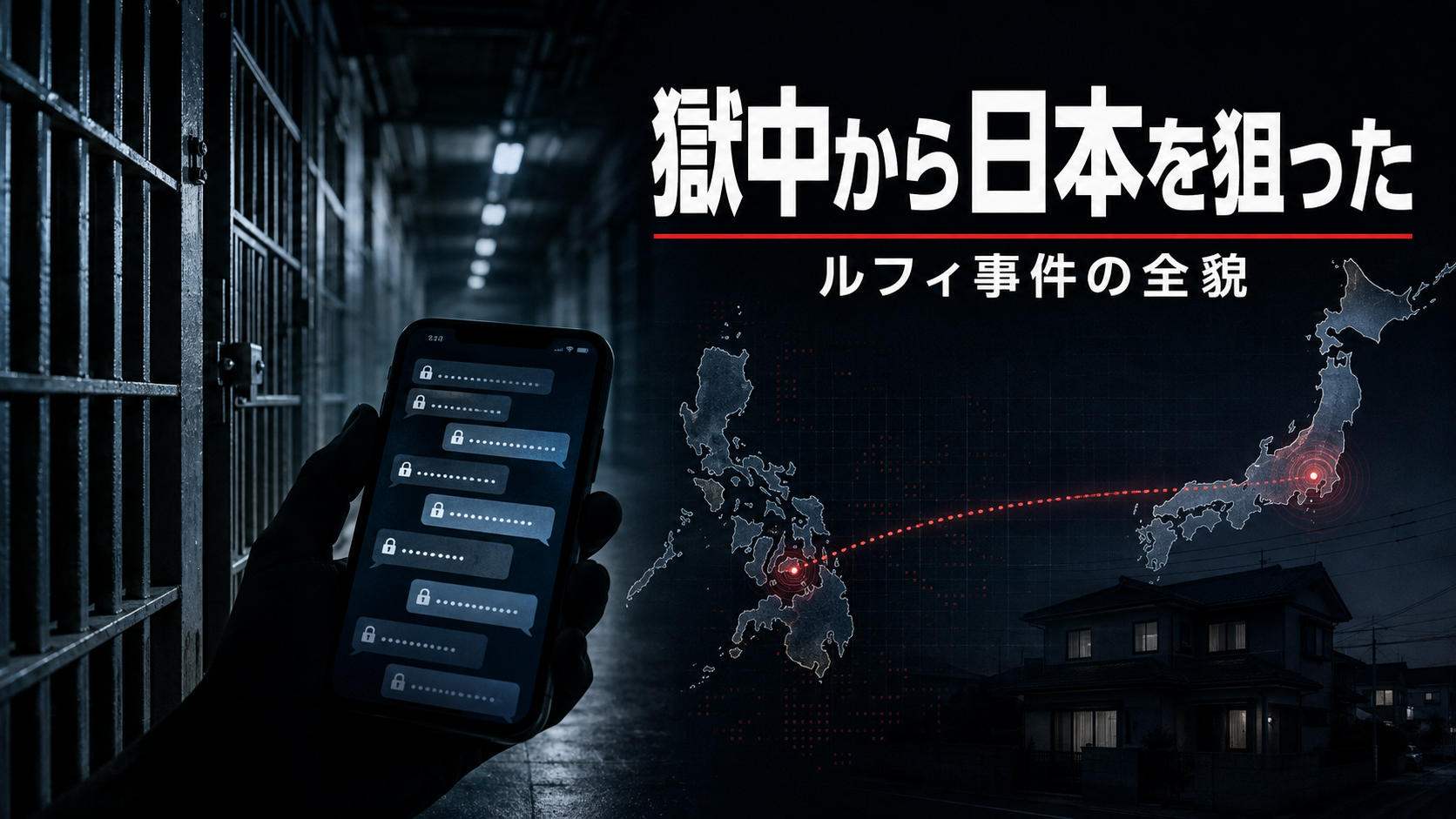
The ‘Luffy Case’
The “Luffy case” was not simply a string of robberies. It was a cross-border organized crime operation in which a Japanese criminal group based in the Philippines remotely directed operatives recruited through social media inside Japan, repurposing infrastructure built for telephone fraud into armed robbery. The men identified as the ring’s leaders continued to issue orders — using mobile phones smuggled into a Philippine immigration detention facility — to young men in Japan whom they had never met. In January 2023, a 90-year-old woman was killed in Komae, Tokyo, and the brutality of the crime shook Japanese society.
This article traces how the case arose, how the Philippines came to be exploited as a criminal base, the structure of crimes carried out through so-called “yami baito” (underground part-time jobs), the deportation of suspects through cooperation between the Japanese and Philippine governments, and the state of the trials as of August 7, 2026.
Who Was ‘Luffy’?
“Luffy” was an anonymous account name borrowed from the protagonist of a popular manga, and it did not necessarily refer to a single fixed individual from the outset. Investigators found that the ring’s leaders used multiple aliases, including “Luffy,” “Kim,” and “Mitsuhashi.”
The four men later deported to Japan as the core of the case were Yuki Watanabe, Toma Imamura, Seiya Fujita, and Tomonobu Kojima. According to reporting and the charges filed against them, the group divided roles among overall coordination, planning, recruiting operatives, and collecting cash. It is more accurate to understand the case as a criminal network centered on anonymous leaders, rather than a single person named “Luffy” acting alone.
Origins: A Telephone Fraud Operation Based in the Philippines
The foundation of the case was a large-scale telephone fraud operation (“tokushu sagi”) that targeted elderly people in Japan. According to Japan’s National Police Agency, the fraud linked to this group is believed to have caused over ¥6 billion in damages. The confirmed period ran mainly from November 2018 to June 2020, during which roughly 70 people were reportedly arrested.
In November 2019, Philippine authorities raided a base in Makati City and detained 36 Japanese nationals. There, so-called “kakeko” — callers who phoned Japan to defraud victims of money — had been operating systematically. Most members were sequentially deported to Japan, but the four men later charged as the leaders behind the wide-area robberies remained in the Philippines, tied up in local criminal proceedings.
The raid did not eliminate the criminal organization entirely. The chain of command, the mechanisms for collecting funds, and the recruitment structure remained intact, and part of it was later repurposed from telephone fraud into robbery.
When a Detention Facility Became a ‘Command Center’
The four men were held at a Philippine Bureau of Immigration detention facility in the Bicutan area of Taguig City — a facility meant to hold foreign nationals while deportation and other procedures are processed. At the time, however, the facility reportedly could not fully prevent detainees from using mobile phones or bringing in other items, and corruption and management failures were also pointed out.
The leaders are said to have exploited this environment. Using the encrypted messaging app Telegram, they relayed targets, routes, methods of entry, and role assignments to operatives inside Japan. Because they themselves were outside the country — and in detention — the structure made it difficult to trace back to the leaders even when operatives in Japan were arrested.
In addition, foreign nationals facing unresolved criminal cases in the Philippines can sometimes not be deported until those proceedings conclude. This loophole gave rise to a tactic known as “demanda me,” in which suspects filed lawsuits against themselves to delay deportation. The Philippine Department of Justice and the Bureau of Immigration later strengthened measures against this abuse of the system.
Responsibility should not be misattributed here, however. It was a criminal group centered on Japanese nationals that planned the crimes and targeted Japanese victims. Philippine society as a whole did not participate in the crimes; rather, certain institutional weaknesses, lapses in facility management, and the presence of corrupt collaborators were exploited by the criminals. Philippine authorities ultimately cooperated with Japan and deported the four key figures.
‘Underground Part-Time Jobs’ Created Disposable Foot Soldiers
Most of the operatives were not longstanding associates with close ties to the ring’s leaders. Young people who responded to social media recruitment posts promising “high pay,” “same-day cash,” and “easy work” were gathered under anonymous handlers.
Applicants were made to submit personal information such as their driver’s license, photographs, family composition, and home address. If they realized partway through that the work was criminal and tried to withdraw, they were threatened with harm to their families or visits to their homes. In this way, operatives — who often did not know each other’s identities or the real names of their handlers — were assigned narrowly divided roles: driving, lookout duty, forced entry, assault, and carrying away stolen goods.
This differs from a traditional organized-crime group with a fixed membership. The core figures stay hidden, recruit people through social media for each crime, and swap out the lower-level participants. This is the form of crime that police now call an “anonymous, fluid criminal group,” or “tokuryu” — and the Luffy case cemented that term in the public consciousness.
Being threatened does not erase the criminal responsibility of those who broke into homes, restrained victims, beat them, and stole property. Courts have handed down lengthy prison terms and life sentences to operatives as well. “Yami baito” is not a part-time job — from the moment someone applies, a criminal organization gains hold of their personal information, and it becomes an entry point that destroys the lives of both victims and perpetrators.
From Fraud to Wide-Area Robbery
The string of robberies occurred between May 2022 and January 2023 across locations including Kyoto, Tokyo, Chiba, Yamaguchi, and Hiroshima. The targets were homes and businesses believed to hold cash, luxury watches, and other valuables.
Ahead of each crime, so-called “apo-den” calls — phone calls used to probe a target’s assets and when they would be home — were made. It appears that the same methods built up through telephone fraud — victim lists, information gathered by phone, division of roles, and remote management of personnel — were transplanted into more directly violent crimes.
The major incidents included:
- May 2022, Kyoto City: A jewelry store was robbed of numerous luxury watches.
- October 2022, Inagi, Tokyo: Men posing as delivery workers broke into a home, assaulted the residents, and stole cash and jewelry.
- November 2022, Iwakuni, Yamaguchi Prefecture: An attempted robbery of a home failed.
- December 2022, Nakano, Tokyo: Intruders broke into a home, injured the residents, and stole cash.
- January 2023, Oamishirasato, Chiba Prefecture: The owner of a recycling shop was severely beaten and seriously injured.
- January 2023, Komae, Tokyo: A 90-year-old woman was assaulted and died.
Because the number of cases handled in investigations and trials, and the scope of each defendant’s involvement, differ, it is not appropriate to reduce the “Luffy case” to a single number of incidents. What matters is that incidents across multiple prefectures were connected by the same remotely directed criminal network.
A Life Taken in Komae
What made the brutality of the case unmistakable was the robbery-homicide in Komae, Tokyo, on January 19, 2023. A 90-year-old woman was restrained with cable ties in her own home, beaten severely with a crowbar and other implements, and killed. Luxury watches, rings, and other valuables were stolen.
Police traced the address in Komae from a mobile phone seized during the investigation into an earlier robbery in Oamishirasato, Chiba Prefecture. By the time officers reached the victim’s home, she had already died.
A remote handler, operatives recruited through social media, leaked and gathered personal information, and highly secure communication tools combined to turn a plan to steal valuables into a crime that took the life of an ordinary citizen.
Deportation Pursued by the Japanese and Philippine Governments
Following the Komae case, reports widely suggested that the ring’s leaders were likely detained at a Philippine immigration facility. The Japanese government requested the prompt deportation of the four men, and the Philippine Department of Justice and Bureau of Immigration moved quickly to resolve the pending local cases and process their deportation.
On February 7, 2023, Toma Imamura and Seiya Fujita were deported to Japan. Yuki Watanabe and Tomonobu Kojima followed by February 9, and both were arrested by Japanese police, including while still in transit. All four were initially arrested on charges related to telephone fraud, such as theft, and were subsequently charged, one by one, in connection with robberies across the country.
This deportation was made possible through investigative and judicial cooperation between Japan and the Philippines. While the case exposed gaps in the Philippines’ facility management, it is also an example of the two countries’ authorities correcting the abuse of the system and handing the suspects over to Japan’s criminal justice system.
How Far Has the Trial Progressed?
As of August 7, 2026, guilty verdicts have continued to be handed down against operatives and intermediaries. One of the operatives involved in the Komae case, among others, was sentenced to life imprisonment.
Among the alleged leaders, the Tokyo District Court sentenced Seiya Fujita to life imprisonment on February 16, 2026, finding that he had played an “essential role” in seven cases, including the robbery-homicide in Komae. In the case of Tomonobu Kojima, a 20-year prison sentence handed down over his involvement in telephone fraud, recruitment of operatives, and the robberies was finalized in August 2026 after the Supreme Court dismissed his appeal.
Meanwhile, Yuki Watanabe and Toma Imamura have been indicted on charges including robbery resulting in death, but no final judicial determination had been reached as of this writing. Under criminal law, a defendant is presumed innocent until a verdict becomes final, and reporting must distinguish between the assessments of investigators and facts established by a court.
Keeping the Philippines From Becoming a ‘Haven for Criminals’
Even after the Luffy case, the Philippine Bureau of Immigration has continued to arrest and deport members of the “Luffy” group and figures associated with a group known as “JP Dragon” who are wanted in Japan. The Bureau has repeatedly stated its position that it will not allow the Philippines to become a hiding place for foreign fugitives.
What is needed is not to condemn any nationality or country. It is to squarely confront the reality that criminals exploit combinations of national borders, communication technology, immigration systems, and the limits of investigative authority — and to strengthen information-sharing between Japan and the Philippines, the swift arrest and deportation of fugitives, communication controls at detention facilities, and anti-corruption measures.
Within Japan as well, efforts must proceed in parallel: removing “yami baito” recruitment posts, lawfully investigating highly secure communication tools, tracing criminal proceeds, preventing the leaking of victim lists, and raising awareness among young people. Arresting only the low-level operatives is not enough — as long as the anonymous core figures and the flow of money remain, the same crime can be reborn under a different name.
Lessons Left by the Case
The essence of the Luffy case does not lie merely in the unusual fact that four Japanese men were detained in the Philippines. It lies in how criminal infrastructure built for telephone fraud transformed — through social media and anonymous communication — into more violent armed robbery.
The leaders issued orders from abroad, the operatives were treated as disposable, and the victims lost not only their assets but, in one case, their life. This case shattered the conventional assumptions that crossing a border puts one beyond the reach of investigators, that detention halts criminal activity, and that arresting the lower ranks stops the organization.
At the same time, the unraveling of the case and the deportations were achieved through cooperation between Japan and the Philippines. The Philippines was not the cause of the case but a place exploited by a Japanese criminal group — and it subsequently worked alongside Japan to dismantle the criminal network. Keeping this distinction in view, and strengthening institutions and investigative cooperation against cross-border crime, is the starting point for preventing a repeat of this case.
Timeline
- November 2018 onward: Telephone fraud operations based in the Philippines expand
- November 2019: 36 Japanese nationals detained in Makati City
- May 2022 – January 2023: A series of robberies and attempted robberies occur across Japan
- January 19, 2023: A 90-year-old woman dies in Komae, Tokyo
- February 7–9, 2023: The four alleged leaders are deported from the Philippines to Japan
- 2024: Japan’s police white paper features measures against anonymous, fluid criminal groups
- February 16, 2026: Tokyo District Court sentences Seiya Fujita to life imprisonment
- August 2026: Tomonobu Kojima’s 20-year sentence becomes final
References
- National Police Agency, “White Paper on Police 2024” — “Police Measures Against Anonymous, Fluid Criminal Groups”
https://www.npa.go.jp/hakusyo/r06/honbun/index.html - Ministry of Justice, “White Paper on Crime 2024,” Part 4, Chapter 3, Section 2
https://hakusyo1.moj.go.jp/jp/71/nfm/n71_2_4_3_2_1.html - Philippine Department of Justice, “DOJ helps BI tackle the ‘Demanda Me’ scheme” (October 17, 2023)
https://www.doj.gov.ph/news_article.html?newsid=adgUUTAXPiOLdpXuGv2Oxgu76wQ0bQn2EHlbWU5DyG0 - Philippine Bureau of Immigration, “BI successfully deports two Japanese members of ‘Luffy’ Gang”
https://immigration.gov.ph/bi-successful-deports-two-japanese-members-of-luffy-gang/ - Philippine Bureau of Immigration, “BI deports another ‘Luffy’ gang member to Japan”
https://immigration.gov.ph/bi-deports-another-luffy-gang-member-to-japan/ - Mainichi Shimbun, “‘Luffy’? Suspect group’s telephone fraud damages exceed ¥6 billion: National Police Agency” (February 2, 2023)
https://mainichi.jp/articles/20230202/k00/00m/040/086000c - Ryukyu Shimpo, “‘Luffy’ ringleader sentenced to life imprisonment: Tokyo District Court” (February 17, 2026)
https://ryukyushimpo.jp/national/entry-5042291.html - Tokyo Hodo Shimbun, “‘Luffy’ Wide-Area Robbery Case: Tomonobu Kojima’s 20-Year Prison Sentence Finalized by Supreme Court” (August 5, 2026)
https://tokyonewsmedia.com/archives/26173
Editor’s note: This article was compiled based on government materials, investigative announcements, news reporting, and trial information published as of August 7, 2026. Descriptions of the defendants, except where a final verdict has been reached, reflect the charges filed or the claims of investigative authorities; defendants are presumed innocent until a guilty verdict becomes final.


コメント