
By Yasotarō Mōri
Chapter 1: The Thorny Path
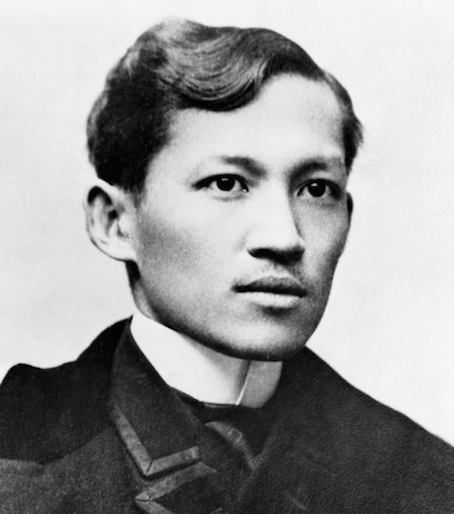
José Rizal was born the seventh child (and second son) into an old family in the town of Calamba, on the shore of Laguna de Bay, in Laguna Province, Luzon. The family appears to have lived a fairly prosperous life, of a standing one might call well-to-do farmers. He had one elder brother, five elder sisters, and three younger sisters. Both sides of his family were of respectable lineage; his family tree shows Chinese blood going back several generations through his grandfather and great-grandfather, and it is said that one of his great-grandfathers was Japanese. Both of his parents had received an education advanced for Filipinos of the time, and they were extremely devoted to their children’s education. It is said that Rizal inherited from his father the brave temperament that would not yield an inch once he believed himself to be right, and from his mother his abundant natural talent.
Looking back now on Rizal’s life, one gets the impression that he never really had an ordinary childhood. Intellectually, he was always three or four years ahead of children his own age — the spark of what is called a child prodigy. Around the age of three, taught by his mother and sisters, he learned the basics — the “ABCs,” so to speak — of the native Tagalog language. He soon began comparative study of Tagalog and Spanish, and by the age of five, it is said, he could easily read the Spanish Bible. There were other men of letters in his day, but it is said that none quoted the Bible in their writing as extensively as Rizal did, a result, no doubt, of his having read it so closely at such a young age. Around this time he also showed artistic talent, drawing pictures and skillfully working in wax.
His mother constantly encouraged his poetry, and at the age of eight he wrote a poem for a town celebration and presented it to the organizers. It was so well made that he received a prize from the governor for it. At nine, he wrote a poem in Tagalog titled “Our Mother Tongue,” extolling love of one’s homeland through respect for the national language — a piece so thoroughly conceived and phrased that it hardly seems the work of a boy. Another poem he wrote that same year, titled “My Mother’s Birthday,” expressed a pure-hearted devotion to his mother, and is counted among the finest of the many poems he composed over his lifetime.
▲ The Spark of a Child Prodigy ▼
When he was nine, his father sent him to a school in the nearby town of Biñan. His uncle, José Alberto, lived there, and Rizal boarded with him — his own name, José, was given in honor of this uncle. In his few months at that school, his grades were outstanding. After a few months, the headmaster sent him home, telling him, “There is nothing more this school can teach you.” His father, thinking Rizal must have done something wrong and been expelled, grew angry — but the headmaster met with his father in person, showed him just how excellent Rizal’s schoolwork was, and demonstrated that there was truly no longer any need for him to remain at the school, at which his father was satisfied. Such was the anecdote that survived to illustrate the almost prodigious sharpness Rizal showed in mastering his lessons.
During this short spell of schooling in Biñan, he learned a great deal about the wider world — not so much from the school itself as from everyday life in his uncle’s household. Four years before Rizal was born, Sir John Bowring, the Governor of Hong Kong, had visited various parts of the Philippines and stayed as a guest in this uncle’s home. Bowring, known in his day in various circles as a linguist, told the uncle at that time about a book written long before by a Spaniard named Morga, titled Sucesos de las Islas Filipinas (An Account of the Philippine Islands) — the uncle himself being a Filipino of considerable education and standing.
Hearing these stories from his uncle, Rizal vowed to himself: first, that he too would become a devoted scholar like Bowring; and second, that he would one day obtain Morga’s Sucesos de las Islas Filipinas and have it read by Filipinos generally. Almost twenty years later, while studying in London, he found this very book in the British Museum, painstakingly transcribed it by hand, had it further copied, and distributed it widely — thereby fulfilling the long-cherished ambition he had carried since boyhood.
Had things gone on this way without incident, Rizal might well have ended his days simply as a respected notable — an admirable gentleman of radiant bearing and exceptional talent, admired by all yet nothing more. But Heaven placed this prodigy upon the stage of trial. When he was eleven, his father decided to enroll him at the Ateneo Municipal de Manila to give him a higher education. It was while he was preparing for this that two incidents occurred which would cast a lifelong shadow over his heart and mind. And so he was set upon the fate of walking the thorny path.

コメント