
Introduction
On April 13, 2026, President Marcos signed Executive Order No. 113, promulgating the 13th Foreign Investment Negative List. The list took formal effect on May 2 of the same year. The revision itself was primarily intended to correctly reflect, within the list, changes already introduced in recent years through amendments to the Retail Trade Liberalization Act and the Public Service Act, and to resolve discrepancies in how those changes were described in practice. Even so, its substance carries major implications for foreign nationals and foreign companies seeking to operate retail businesses in the Philippines. For Japanese nationals and Japanese companies in particular, entry into retail — long regarded as a hurdle too high to clear — has now become a realistic option.
What Changed: Minimum Capital and Foreign Ownership Share
First, a brief look back at the history of foreign ownership restrictions on retail. Under the original Retail Trade Liberalization Act of 2000, foreign entry into retail required paid-in capital of at least US$2.5 million (roughly ¥260 million), with an additional investment of at least US$830,000 required for each physical store. For small and mid-sized businesses, this was, in practice, an insurmountable threshold.
In 2021, an amendment to the Retail Trade Liberalization Act under Republic Act No. 11595 lowered this minimum paid-in capital sharply to 25 million pesos (roughly ¥50–60 million, or about US$500,000), and eased the per-store additional investment requirement to at least 10 million pesos. Requirements related to net worth, number of stores, and retail track record were also eliminated, opening the door to mid-sized retail businesses.
The 13th Foreign Investment Negative List now clarifies, for the first time in explicit terms, how retail businesses below that 25-million-peso threshold are to be treated. It formally establishes that a retail business with paid-in capital below 25 million pesos may still admit foreign nationals or foreign companies, provided the foreign ownership share does not exceed 40%. Previously, it was generally understood that foreign capital was, in practice, entirely excluded from small-scale retail businesses below that capital threshold; this new explicit provision formally recognizes room for entry — through foreign ownership of up to 40% — even for small, low-capital retail stores.
This amendment aligns retail regulation with the general principle applied to domestic-market-oriented companies under the Foreign Investments Act — namely, that companies below a certain paid-in capital threshold serving the domestic market are, in principle, limited to 40% foreign ownership — and can be understood as correcting a situation in which retail alone had been treated less favorably.
What the Wider Opening Means in Practice
The impact of this amendment is not limited to making it easier for major retail chains to enter the market. What matters more in practice is that it has clarified a path for foreign nationals to take an equity stake in retail businesses at the scale of an individual proprietorship or a small storefront.
Until now, a Japanese national looking to run a small retail store in the Philippines often faced a choice between two options: relying entirely on a local partner (in effect, operating under a Filipino national’s name), or raising mid-sized or larger capital sufficient to clear the 25-million-peso threshold. With this amendment now allowing up to 40% equity participation even for small, low-capital stores, it is likely that more Japanese nationals will pursue joint ventures with local partners to enter retail at a scale suited to their means. Food and beverage businesses are already generally permitted 100% foreign ownership, but many operators in categories that include a retail component — select shops, food retail, general merchandise stores, and the like — stand to benefit from this amendment as well.
Why Setting Up in a Mall Is the Default Strategy
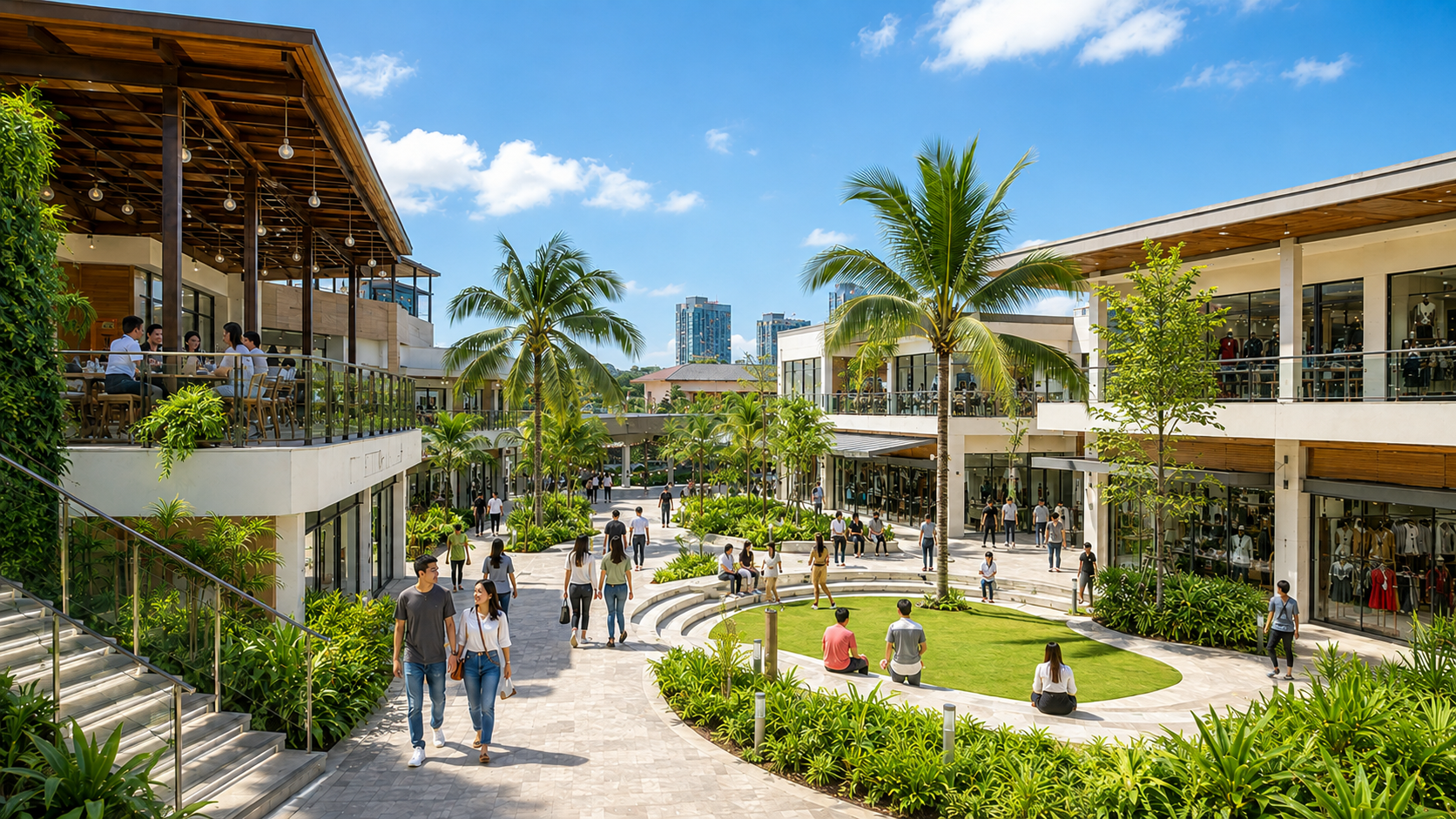
That said, when it comes to running a retail or food-and-beverage business in the Philippines, something matters even more than capital restrictions: location strategy — specifically, where to open. For anyone doing business in the Philippines, there is really only one answer: the mall.
In the Philippines’ tropical climate, standalone street-front shops are constantly exposed to intense midday heat and sudden downpours. Air-conditioned shopping malls, by contrast, function for Filipino consumers as an oasis to escape the heat. It is not unusual for families to spend an entire holiday inside a mall, and malls serve, in effect, as a kind of public space in Philippine urban life — not merely commercial facilities.
Three companies dominate mall development in Metro Manila:
- SM Prime Holdings (SM Supermalls): The country’s largest mall operator, with more than 86 malls nationwide and a target of reaching 100 domestic locations within 2026.
- Robinsons Land (Robinsons Malls): The country’s second-largest mall operator, running 57 malls as of the end of 2025.
- Ayala Malls: A developer with particular strength among affluent consumers, operating around 31 malls concentrated in upscale areas such as Makati and BGC.
While specific terms vary somewhat between operators, the contract conditions tenants face are broadly similar across these malls. It is common practice to pay a percentage-of-sales rent — a fixed base rent plus CUSA (Common Use Service Area) charges, plus a percentage of monthly sales (for food and beverage tenants, typically around 5%) — and virtually all three developers, SM, Robinsons, and Ayala, require substantial upfront funds before opening, including a security deposit equivalent to three months’ rent and three months of rent paid in advance. Contracts also typically include an annual rent escalation clause of roughly 5–10%, and it is not uncommon for tenants whose sales growth fails to keep pace with rising rent to be forced out within a few years.
In other words, in the Philippines, success in retail and food-and-beverage business hinges less on which mall to choose than on how to draw customers under these largely standardized conditions and achieve sales growth that outpaces rising rent.
Success Stories in Multi-Store Expansion: Uniqlo, Ramen Nagi, and Marugame Udon
A leading example of success in multi-store expansion under this mall-centered, standardized-terms market structure is Uniqlo (Fast Retailing). Since opening its first store at SM Mall of Asia in 2012 through a joint venture with the SM Group, Uniqlo has steadily expanded its network across SM, Robinsons, and Ayala malls. It had just 6 stores in 2013 — fourth place within ASEAN — but grew to 43 stores by 2017, overtaking Malaysia to rank first in ASEAN. By the end of May 2024 it had 76 stores, and according to Fast Retailing’s own official figures, it had reached 81 stores as of June 30, 2026. This is the largest store count of any Southeast Asian market for the brand, ahead of Singapore, Malaysia, and Thailand alike, making the Philippines Uniqlo’s largest market in Southeast Asia. Rather than pursuing a standalone street-front strategy, expanding from within malls through a joint venture with the SM Group has been the single biggest factor behind this success.
A similar pattern is clearly visible among Japanese food-and-beverage businesses. Ramen Nagi, for instance, has grown to 41 stores since entering the Philippines in 2013, according to local interviews with staff of its operating company — the largest count among all the countries and regions where the chain operates, including Taiwan, Hong Kong, mainland China, and Singapore. Its stores are concentrated in major malls across Makati, BGC (Taguig), Pasay, Mall of Asia, and the area around SM Aura, and a strong network with major mall developer Robinsons Land is said to have supported this expansion. Ippudo, along with Mendokoro Ramenba — less well known in Japan but well regarded locally, with a location inside Philippine Isetan — have likewise expanded their store networks centered on Metro Manila’s major malls.
The udon chain Marugame Udon offers another good example of mall-centered multi-store expansion. Toridoll Holdings opened its first Philippine location in BGC in August 2017 through a franchise agreement with local company B.V. Cuisine (under Suyen Corporation). The original plan called for a modest 10 stores by 2020, but the chain had already reached 14 stores by the end of February 2021, expanding to 16 with the opening of SM Mall of Asia and Robinsons Galleria locations that May. Growth accelerated from there, reaching around 40 stores by the end of June 2023, and the company officially announced it had reached 50 Philippine stores with the opening of the “Marugame Udon OPUS” location on July 17, 2024 — its 50th in the country. That marks an expansion to roughly 50 stores in about seven years since entry, another clear case of growth driven by concentrated openings in large malls, including SM malls.
What these success stories share is a strategy of expanding across multiple stores through the infrastructure malls provide, building brand recognition and scale simultaneously, rather than settling for a single, popular standalone location. In the Philippines, the model of a single thriving shop on a prime street corner tends to be less reliably successful than opening simultaneously across multiple malls — an approach that spreads the risk of rent increases and fluctuating foot traffic while stabilizing the business as a whole.
Outlook: Will More Japanese Businesses Enter Philippine Retail?
Given all this, this revision to the Negative List will almost certainly accelerate the entry of Japanese nationals and small and mid-sized Japanese companies into Philippine retail. It matters a great deal that a sector long seen as blocked by overly strict capital requirements has now become a realistic option — entry with as little as up to 40% equity participation, even on a small capital base.
That said, a lower barrier to entry does not guarantee success. As with Uniqlo, Ramen Nagi, and Marugame Udon, businesses will increasingly be judged on whether they plan, from the outset, for mall-centered multi-store expansion, and on whether they can build the brand strength and operational capability needed to grow sales faster than the standardized, steadily rising rents malls impose.
Conclusion
The clarification of retail regulations under the 13th Foreign Investment Negative List is a regulatory change Japanese businesspeople exploring opportunities in the Philippines should not overlook. Now that the capital barrier to entry has been lowered, correctly understanding the realities of the Philippines’ mall-centered, standardized business environment — and building a business plan premised on expansion across multiple malls rather than a single street-front shop — is likely the surest path to success.
Sources: Executive Order No. 113 (13th Foreign Investment Negative List); Republic Act No. 11595 (amended Retail Trade Liberalization Act); One Asia Lawyers; Camellia Consulting Co., Ltd.; Nikkei; Fast Retailing official website, “Southeast Asia & Oceania” (data as of June 30, 2026); Toridoll Holdings press release, “Marugame Udon Reaches 50 Stores in the Philippines” (July 2024); Philippine Primer (local reporting); Ryutsu News; Wikipedia (SM Supermalls, Robinsons Malls, Ayala Malls); various industry commentary and local reports.

コメント