
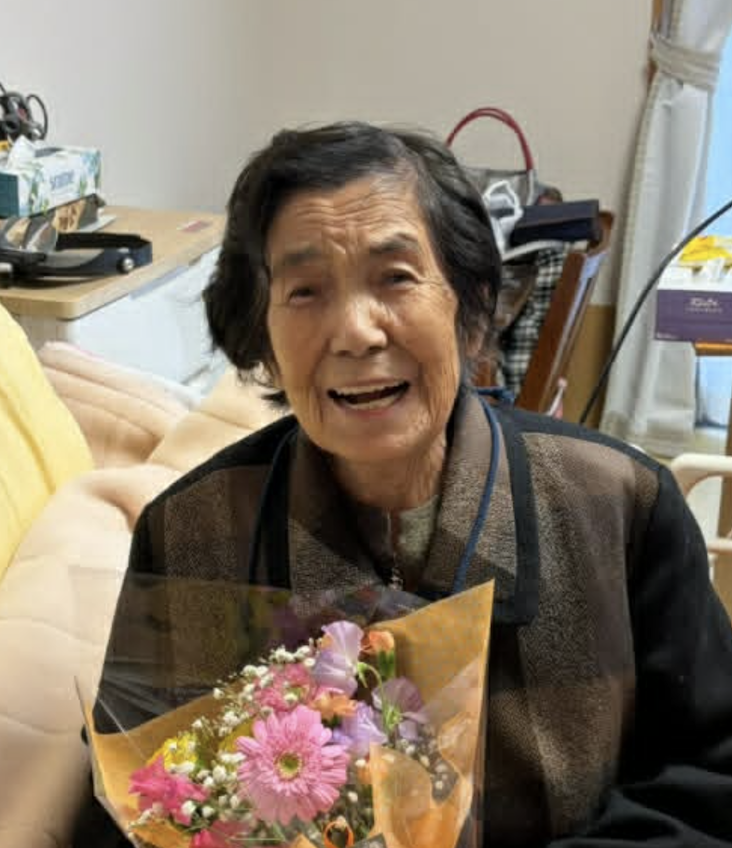
Hisako Kamikita (maiden name: Kimura), born January 8, Shōwa 9 (1934), in Arakawa Ward, Tokyo — a repatriate from Korea. Mother of two daughters and one son. Her father was a craftsman specializing in special glassware. She now leads a two-residence life, dividing her time between her home in Takayama, Gifu Prefecture, and “Pension Krone,” a guesthouse she runs in the town of Samboan, Cebu Province, in the Republic of the Philippines.
Life as Refugees, Heading for Keijō Station
Trains ran from Keijō Station to Busan. Without reaching Busan, there was no way to board a repatriation ship. Hisako’s family decided to make for Keijō Station, moving from one abandoned Japanese home to another over the course of several months. Whenever they moved, her father Suezō and stepmother Matsuyo always carried the heavy luggage on their backs, while Hisako, eleven years old, walked holding the hands of her two still-young brothers, ages seven and five.
Having left Yeongdeungpo, where they had lived, Hisako’s family finally reached the vicinity of Keijō Station in the snows of December. As they drew closer to the station, the number of Japanese around them grew, all of them carrying their belongings — some pushing handcarts — as they made their way toward Keijō Station. Hisako still clearly remembers crossing a large bridge over the Han River along the way.
As it happened, on August 8, just before the war’s end, the Soviet Union suddenly abrogated its neutrality pact and declared war on Japan, invading Manchuria the very next day, August 9. What makes the Soviet Union’s conduct so unforgivable is not merely that it entered the war at the very last moment, but that even after the war had ended, its forces did not stop their violence and looting against Japanese who had already been disarmed.
To Busan by Freight Train
Having finally reached Keijō Station, they found that the train provided for repatriates was a freight train. No small number of the cars had no roof at all, and the Japanese were simply crammed in like cattle and horses and carried off toward Busan.
What Hisako and her family found hardest to bear along the way was that the freight train, which should have reached Busan in a single day, was repeatedly stopped at each station by Korean soldiers on the pretext of inspections, who demanded bribes simply to let the train pass through.
Moreover, since any Korean won they still had on hand would become worthless the moment they boarded the repatriation ship, they had no choice but to exchange it for Japanese yen at whatever rate was demanded by Korean money changers who boarded the freight cars.
Repatriates at the Port of Busan
At last, after many days, they reached Busan, where an astonishing number of Japanese had gathered. They were housed, in order of arrival, in Warehouse No. 1, Warehouse No. 2, and so on, to await the arrival of a repatriation ship. Since each repatriation ship could carry only about two thousand people, even after reaching the port of Busan they still had to wait many more days.
Those who had run out of money would go out into the city and rummage through garbage bins left by jubilant American soldiers and by Koreans reveling in the air of the victors, gathering rotting bread and fruit to fill their stomachs until they could board a ship.
There was a woman at the port who wept without pause. Hisako asked her mother why the woman was crying, but her mother only shook her head and would not tell her the reason. Some time after they had returned to Japan, her mother finally explained: “That woman had been assaulted by a Russian soldier — that’s why she was crying.”
As it happens, at the Futsukaichi Recuperation Center in Chikushino, Fukuoka Prefecture, abortion procedures were performed on roughly 500 Japanese women — women like the one at the port — who had become pregnant after being sexually assaulted by Soviet soldiers, Koreans, or Chinese during their repatriation from Manchuria or Korea.
コメント