
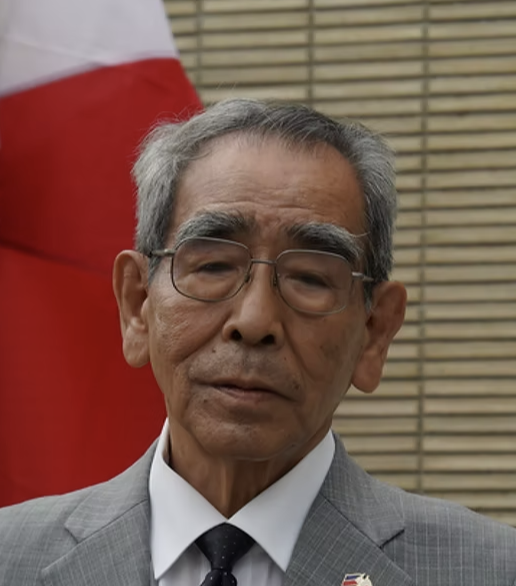
Pinoy-Hapon United Foundation (PHUF), a non-profit organization, Honorary Chairman Takeshi Asanuma
The war we fought, the “Greater East Asia War,” ended in our country’s defeat 81 years ago, on August 15, 1945.
It was a historic fact — the first time in our country’s more than 2,000-year history that we had ever surrendered to a foreign power. More than 3.2 million of our military personnel and civilians lost their lives, and Tokyo, Yokohama, Nagoya, Osaka, Kobe, Hiroshima, Fukuoka, Nagasaki, and other major Japanese cities were utterly destroyed by American air raids, reduced to cities of rubble.
With defeat, a total of more than 6.6 million Japanese overseas — military personnel and civilians alike, from the Korean Peninsula, Taiwan, the Palau Islands, and other territories that had been under Japanese administration — repatriated to a Japan reduced to scorched earth. Roughly 575,000 Japanese military personnel and civilian employees of the military who had been in the former Manchurian Empire were detained by Soviet forces and sent to Siberia and elsewhere for forced labor. The return of these internees stretched on for years, and the last large-scale repatriation, by ship to the port of Maizuru, was only achieved in December 1956 (Shōwa 31).
Here in the Philippines too, Japan and the United States waged fierce fighting for roughly four years, claiming the lives of some 520,000 Japanese military personnel, civilian employees of the military, and some civilians. Manila was reduced to ruins, and it is said that more than a million Filipino lives were lost.
It is likely unimaginable to Japanese people today, living in a peaceful nation and one of the world’s leading advanced economies, respected and trusted by so many countries — but around 1946–47, our country was, in terms of GDP, said to be a “poorest of the poor” nation, even behind the postwar Philippines.
Born in Shōwa 13 (1938)
I was born in Shōwa 13 (1938) in Dōtonbori, Osaka — a “child of the Shōwa era,” now 88 years old. My clear memories begin around the time my brother, two years my senior, entered kindergarten in Shōwa 17 (1942), when I was taken along by my mother to attend his entrance ceremony.
That same October, my younger sister was born, and I was taken to the hospital by my grandmother. I have no memory of the celebrations for the “2,600th year of the Imperial Era” in Shōwa 15 (1940), but the song the adults used to hum — “♬ The Imperial Era is two thousand six hundred years — ah, the hearts of a hundred million beat as one!” — still lingers in my ears. In Shōwa 17 (1942), the whole extended family celebrated my great-grandmother’s 88th birthday at a restaurant in Hamadera Park, and I remember riding in a taxi for the first time on that occasion (with facing rear seats).
In April Shōwa 18 (1943), my brother entered “national school” (present-day elementary school). Fierce fighting between Japan and the United States was apparently already underway out over the Pacific, but Osaka itself was still peaceful and quiet. Even so, our neighborhood would occasionally hold “send-off gatherings” for soldiers departing for the front, and “gatherings to welcome home the spirits of the fallen.” Neighborhood associations (“tonarigumi”) were organized, the wartime firefighting corps was strengthened, fire drills were carried out within the neighborhood association, rice and other staple foods came under a rationing system, and rice ration passbooks were issued. Requests for “thousand-stitch belts” (senninbari) came around from the National Defense Women’s Association. From time to time an air-raid warning siren would sound, but it was always lifted again shortly after.
The Cradle Song
At the time, the adult world hummed along to rousing military songs and morale-boosting anthems, and NHK radio broadcasts were much the same. There were a few gentler, more peaceful tunes too, like “The Little Cedar of the Mountain” or “Tonton Tonkararin to Tonarigumi” (Neighborhood Association song), but far more common were the many military songs and patriotic anthems — “♬ Sugino, where are you!,” “♬ Here, hundreds of leagues from home,” “♬ The noble whiteness of Mount Fuji,” and so on — which still cling to my ears to this day.
Even so, my brother taught me the children’s songs he had learned in kindergarten — “♬ Ame-furi Otsuki-san” (Rainy Moon), “♬ Ame Ame Fure Fure” (Rain, Rain, Fall, Fall), “♬ Kamome no Suihei-san” (The Seagull Sailor), “♬ Donguri Korokoro” (Rolling Acorn) — and these captured my young heart for song. “♬ The canary sings the cradle song…” remains, to this day, the melody of my heart.
コメント