

MANILA NEWS DAILY
That War and Me (7) About My Mother
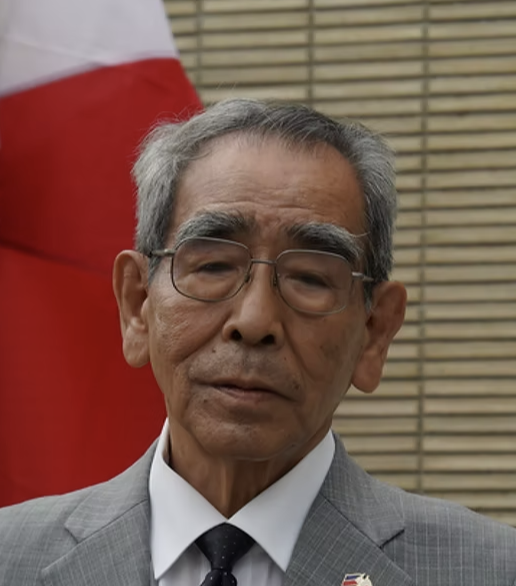
Pinoy-Hapon United Foundation (PHUF), a non-profit organization, Honorary Chairman Takeshi Asanuma
My mother was born in Meiji 44 (1911), the same age as my father.
She came from a farming family near Yamato-Sakurai (present-day Sakurai City, Nara Prefecture, famous for Kusunoki Masashige). Her family were apparently small-scale independent farmers. After completing higher elementary school (a two-year course) — early secondary education at the time — she went to Osaka to work, where she met my father, who ran a radio shop in front of the Kado-za theater in Dōtonbori. Theirs was, unusually for the time, a love marriage (Shōwa 9 / 1934). My mother was gentle-natured but strong-willed at heart, and had an artistic bent — before the war she would occasionally take up oil painting as a hobby, amateur though she was. I remember several of her paintings hanging in our Osaka house, but they were lost in the war.
In Shōwa 19 (1944), my father was called up for military service, and by year’s end the employees he had left behind had also been taken for military duty or conscripted labor at munitions factories. The two maids we had also returned to their hometown (my grandmother’s home region, Wakayama Prefecture), leaving my mother as head of the household, with only my father’s youngest brother — an uncle living nearby, exempted from service due to poor health — to support her. The situation was already far beyond anything resembling ordinary daily life.
Osaka was wartime through and through. My mother had a moving company send our furniture and household goods, piece by piece, to a rented storeroom near my grandparents’ house on the outskirts of Nara. No one knew when Osaka might suffer a great air raid. My mother gave her instructions briskly and efficiently.
I had an older brother, two years my senior, who had been sent to stay with our grandparents under the child-evacuation program. My mother told me, “Your father is in the army, your brother is evacuated — you’re the only man left in this house!” and from then on she called six-year-old me a “man,” and no longer let me be babied.
I had always been a real mama’s boy, spoiled and affectionate. My mother doted on me too and took me everywhere with her, though my brother used to tease me, calling me a “clinging bug.” When my mother told me I was now the “man” of the house, I have a faint memory of thinking, somewhat vaguely, “Hm, I suppose that’s how it is.”
The Great Osaka Air Raid of March 13, Shōwa 20 (1945). Our family fled first to my grandparents’ house outside Nara, but four families of relatives from Osaka poured in as well, and the household fell into chaos. In mid-May we rented an annex from a distant relative in Yata Village, at the southern edge of Osaka City, and my family moved there along with my uncle’s family — only to find ourselves, right next door to “merchant city” Sakai, once again chased by wave after wave of B-29 bombing raids.
On the afternoon of June 15, the great air raid struck Sakai and southern Osaka. The city center of Sakai was destroyed. Incendiary bombs rained down near our own home as well. But because we were some distance from the heart of Sakai, fewer bombs fell in our area compared to the city center, and most of them started fires in fields and roadways rather than buildings. Some incendiaries did punch through roofs, but residents smothered the flames with wet futons before they could spread, and since the area wasn’t densely built up, the fires never grew out of control.
One bomb fell into our own courtyard too, but it failed to detonate. My mother was desperately covering it with a wet futon to prevent fire when suddenly a voice shouted from outside the gate, “Mrs. Asanuma, your son—!” My mother ran out and came back carrying my brother, his stomach torn open. An incendiary bomb had pierced through his back or abdomen, killing him instantly. As she tried to gather him into her arms, my mother was also burned on her left shoulder and arm by napalm that had ignited nearby. Even so, she held on tightly to my brother, covered in blood.
We laid him on an outdoor bench and covered him with a child’s futon. We placed a bucket beneath the bench, and blood continued to drip into it until the next day. My mother, in shock and suffering from her burns, was left dazed and numb. My uncle sent a telegram to my grandfather and reported the death to the village office. He thanked the neighbors for their help and took care to see to my mother’s treatment and to look after my little sister and me.
The next day, a coroner came at the village office’s request, and my aunt stood in for the postmortem examination. My brother was the only casualty of the air raid in that village. The village presented us with a condolence payment of five yen. My brother’s short life came to an end at nine years old.
After the funeral, my mother — wounded in body and in spirit — sent my sister and me back to Nara with our grandparents. She herself passed away at the end of July, as if following my brother.
“Great Men of the Philippines: José Rizal” (Part 21)
Yasotarō Mōri
His Approach to Education
He had long argued that improving the situation in the Philippines required educating the Filipino people, so it is easy to imagine how keenly interested he must have been in this small village school as his first opportunity to put his educational philosophy into practice.
His pupils were seventeen children from the town’s more well-off families, and his guiding principle was to advance moral, intellectual, and physical education in equal measure. He taught moral education through everyday conduct; for intellectual education he focused mainly on arithmetic, geometry, English, and Spanish, while also teaching field excursions, swimming, and gymnastics. In what might be called natural science, his students accompanied Rizal to help collect plants and insects and received hands-on instruction with real specimens — here too, the three strands of moral, intellectual, and physical education were present.
He paid particular attention to teaching his pupils not to be superstitiously afraid of anything: for example, when there was a local legend that climbing a certain tree would bring misfortune, he deliberately had the children climb it. During recess the students would gather together in the shade of a tree called the talisay, so he named his residence Talisay after it, and composed “The Song of the Talisay Tree” to commemorate it.
Because his time in Dapitan was, in the end, so short, this educational undertaking produced no concrete results worth noting — but it holds significance as the first occasion on which he put into practice his long-held belief that improving conditions in the Philippines depended above all on the education of its people.
Two Incidents
Materially, he was in fact rather well provided for, and to outward appearances he was living out his days in genuine contentment — yet inwardly there was something that chafed at him deeply: the cry of a conscience demanding freedom and justice. In February 1894 he finally petitioned the Governor-General to be released from his exile. In his petition he stated plainly that he had committed no crime whatsoever — or if he was guilty of anything, it was the same thing every other Spaniard was guilty of, namely wishing for Spain’s prosperity and strength.
Upon receiving this petition, Governor-General Despujol came in person to inspect Dapitan, but refused to grant it, telling him, “You’d like to make yourself king of this place, wouldn’t you.” Rizal also sought to establish a settlement in the north of Luzon, but this too was denied. And because the Governor-General’s manner in refusing him was so extremely rude, Rizal resolved, reluctantly, to settle permanently in Dapitan. (The Governor-General was later replaced by Blanco, who came to sympathize with Rizal from the heart.)
According to one account, the authorities and the friar faction had conspired to disappoint and discourage Rizal at every turn, hoping thereby to deepen his family’s and relatives’ sense of pity for him and ultimately induce him to abandon his political convictions. In the end, they simply failed to see the true measure of the man.