
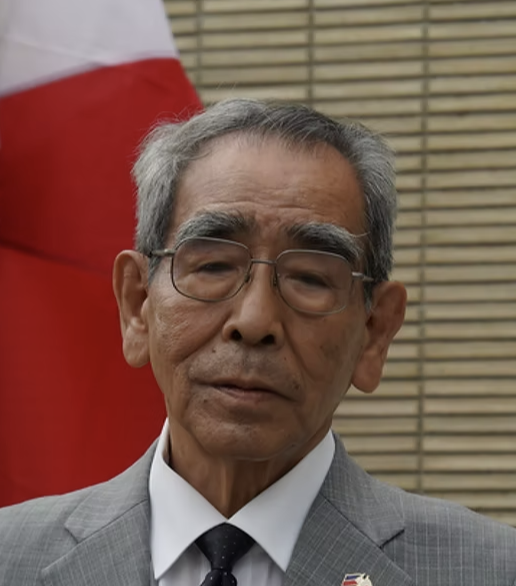
Pinoy-Hapon United Foundation (PHUF), a non-profit organization, Honorary Chairman Takeshi Asanuma
In 1943 (Showa 18), the headquarters of the Naval Landing Force, which was in charge of managing Manila’s port, requested that the Taiwan Governor-General’s Office dispatch a “police corps” to assist with military duties, and it was decided to send a total of 2,000 men to Manila. The advance party of 500 “Taiwanese police corpsmen” was commanded by Police Inspector Hiroeda Otouemon of the Taiwan Governor-General’s police force. Born in Odawara in 1905 (Meiji 38), he completed the preparatory course at Nihon University, entered military service as an officer-candidate in 1928, and was discharged as a sergeant. In 1930 he went to Taiwan, became a police officer, and also served concurrently in local administration. He was known as a sincere man, and it seems he was well liked by the local people.
Under the command of Corps Commander Hiroeda, the Taiwanese police corps landed in Manila in December 1943 and came under the command of the Naval Landing Force, taking up military duties. These ranged widely, including guarding the harbor and the city, maintaining public order, transporting and managing supplies, and guarding prisoners of war under naval jurisdiction. Because of the commander’s order that “prisoners are to be treated with courtesy,” the men under Hiroeda caused no incidents. However, prisoners under army jurisdiction were abused by military employees from the Korean Peninsula, and after the war, at the war crimes trials that were held, several of them were sentenced to death; Lieutenant General Hong Sa-ik of the Imperial Japanese Army, a Korean who was held responsible for the oversight, was also convicted and climbed the “thirteen steps”*.
In February 1945, the American forces launched their all-out assault on Manila, in the fierce fighting known as the Battle of Manila. The police corps appears to have taken up a supporting defensive position in the area of Fort Santiago, where the headquarters was located. As the Japanese forces were driven back, the wounded and the dead mounted steadily. In their desperation, on February 25 the Japanese command took away the police corps’s rifles and ordered them to “strap on explosives and charge the enemy tanks.” Commander Hiroeda refused to accept this order. He gathered his platoon leaders and told them, “You are not Japanese. There is no need for you to die here. Identify yourselves as Taiwanese and surrender to the American forces.” Saying, “I will take responsibility for disobeying the order,” he entrusted his military sword to Platoon Leader Liu Wei-tien, went down to the basement, and took his own life with his pistol. His men then identified themselves as Taiwanese, surrendered, and in March 1946 were sent back to Taiwan.
After the war, Commander Hiroeda’s widow, Fumi, returned to her hometown of Toride in Ibaraki Prefecture, where she had a fine grave built for him at the nearby Kokyoji Temple and prayed for his repose. Yet for more than thirty years she did not know that her husband had saved the lives of as many as 500 Taiwanese men.
The bond between Commander Hiroeda and Platoon Leader Liu Wei-tien and the other men was a strong one. After returning to Taiwan, their position was a delicate one, and for a long time, especially under Kuomintang rule, it remained difficult even to speak of having “cooperated with the Japanese military.” Even so, they would quietly gather from time to time to pray for their commander’s repose. When more than thirty years had passed after the war and Taiwan’s political situation had finally begun to settle, a monument honoring Hiroeda Otouemon was erected in September 1976 at the Quanhuatang Temple near Platoon Leader Liu’s hometown in Nanzhuang Township, Miaoli County, and his memorial tablet was enshrined there. Former corpsmen and their families gathered for a memorial service.
Even now, with almost all of the former corpsmen having passed away, it is said that their bereaved families and others connected to them still gather every year on a Sunday in September for a memorial service.
In 1977, Platoon Leader Liu and several other former corpsmen visited Japan and met Hiroeda’s widow, Fumi, for the first time. Beside Commander Hiroeda’s grave they erected a solemn memorial monument, and an unveiling ceremony was held with the participation of the representative of the Taipei-Japan exchange office in Tokyo (equivalent in rank to an ambassador), Taiwanese residents of Tokyo, former corpsmen, and others. The granite monument bears an inscription of Commander Hiroeda’s achievements and service. Afterward, Mr. Liu visited Fort Santiago in Manila, brought back to Japan a handful of sand from the place where his commander had died, and, together with the widow Fumi, offered it before his grave.
Many years have passed since then, and it is said that even now, descendants of the former corpsmen occasionally still come to pay their respects at Kokyoji Temple. The people of Taiwan are a people who treasure the spirit of “righteousness” and “benevolence.”
*Thirteen steps: a reference to the gallows used for execution by hanging, so called because the scaffold had thirteen steps.

コメント