
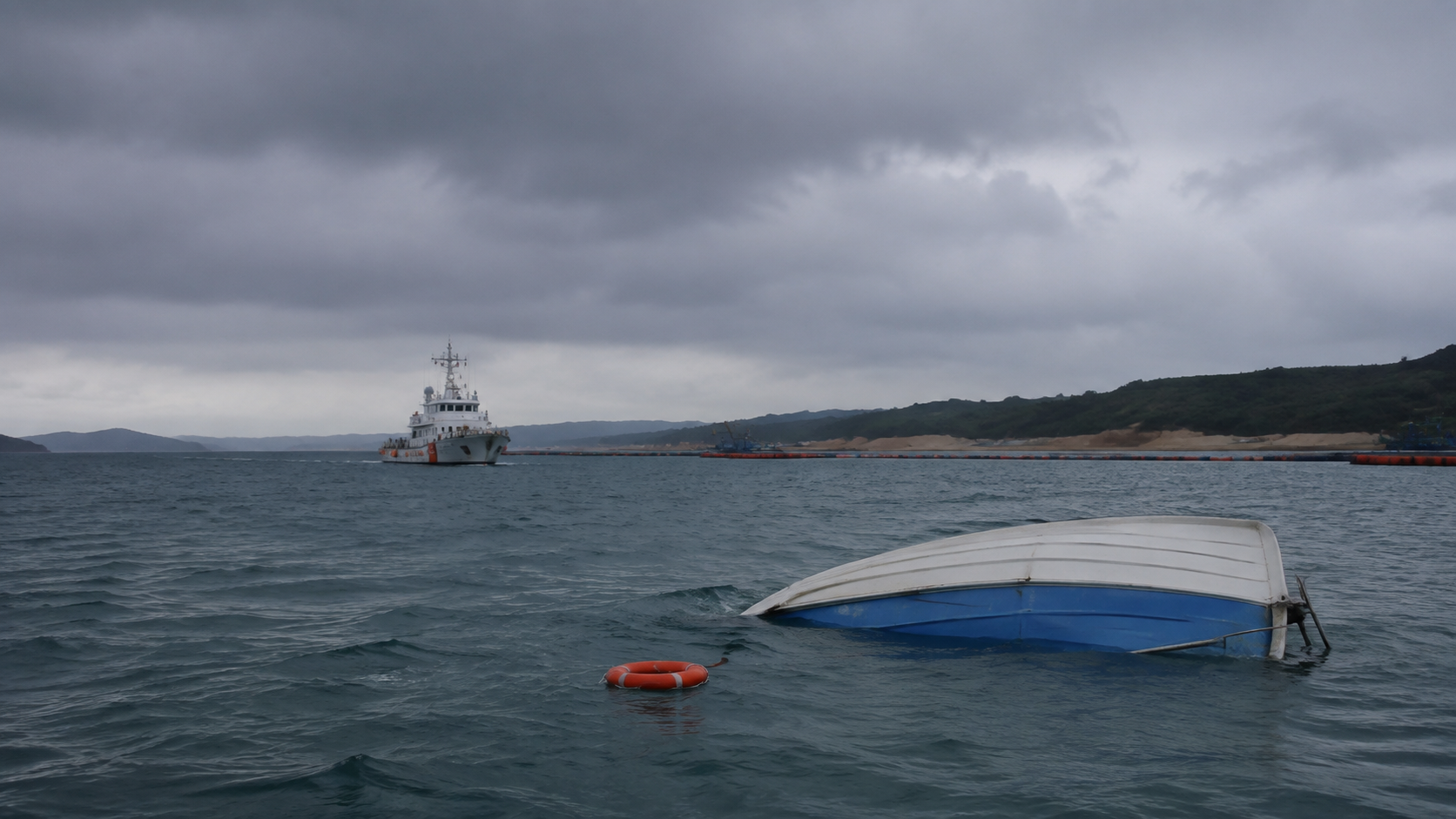
In March 2026, a small-boat capsizing off Henoko in Nago City, Okinawa Prefecture, killed two people, including a high school student on a school trip, and has remained a major focus of Okinawa prefectural politics for nearly six months since. The boats involved were operated by a protest group opposed to the relocation of U.S. Marine Corps Air Station Futenma to Henoko. In July, the bereaved family filed a criminal complaint against a total of 11 people, including school officials and executives of the group. This article looks back at events in chronological order.
The Accident (March 16, 2026)
Two small boats capsized off Henoko in Nago City while second-year students and others from Doshisha International High School in Kyoto Prefecture were on a study trip. The boats were vessels used for protest activities against the construction of the new base at Henoko, and the students were taking part in a course that let them view the base from the sea.
After the first boat, the Fukutsu, capsized, the second boat, the Heiwa Maru, which had gone to help, capsized as well. A second-year student at the school, Ms. Takeishi (17), and the male captain who had been piloting the Fukutsu died. The captain is said to be the person who proposed this sea-viewing course.
The school has conducted visits from the Henoko beach as part of peace education since around 2015, and added a sea course in 2023.
Initial Response and the Question of Responsibility (March–April)
In the Prefectural Assembly immediately after the accident, opposition members, including those of the Okinawa Liberal Democratic Party and Independents caucus, raised doubts about the very nature of citizens’ protest activities. The member organizations of the protest group that operated the boats, the Council Against Helicopter Base Construction (Heli Kichi Hantai Kyogikai), decided in April to disband in the wake of the accident (with more than 500 members).
The Liberal Democratic Party headquarters’ education and science division also received a briefing from the government on the accident on April 2. Attending lawmakers raised not only the question of who was responsible for the accident, but also concerns that the aim may have been to mobilize students for political activity, and called for a thorough investigation of the background to how the students came to board the boats.
In mid-April, the Sankei Shimbun reported remarks on “compensation” by the council’s co-chair, Mr. Nakamura, but the council issued a statement asking for the facts to be corrected, saying that only part of the remarks had been emphasized and that his true meaning had been misunderstood.
The Education Ministry’s Finding and the Governor’s Rebuttal (May 22)
On May 22, the Ministry of Education, Culture, Sports, Science and Technology indicated its judgment that the school’s learning content violated the Basic Act on Education, which stipulates political neutrality. Its point was that students had been put on a protest boat and given education biased toward a particular viewpoint.
In response, Governor Tamaki again criticized the judgment on May 25 as “going too far,” stressing that Okinawa’s peace education as a whole is not biased. He expressed the view that the purpose of peace education is to foster students’ own ability to think from multiple perspectives, on a foundation of respect for life and individual dignity.
Subsequently, reporting by the Sankei Shimbun found that a person registered as a peace-learning advisor on a school-trip website operated under commission from the prefecture had also put students on protest boats at another private school where the person previously worked, in 2017 and 2018 and in 2024 and 2025. The Okinawa General Bureau had earlier stated that there were no other similar cases.
The Bereaved Family’s Appeal and Criticism of the Governor’s Answers (June–July)
After the accident, the bereaved family opened an account on social media called “Henoko Boat Capsizing Bereaved Family Memo” and has continued to post about how those involved have responded to the accident. At the end of May, the family posted a question asking how the governor would recommend that the Henoko relocation issue be handled if it is to be used as material for peace education.
In early June, when reporters asked Governor Tamaki about this post, he answered, “I haven’t seen it, but I have heard that there is such a thing,” which drew criticism. The governor later said he had read the family’s post and, on the question of how peace education should be conducted, said “it is as the bereaved family says,” and expressed the view that there should be an education program in which students themselves think and discuss from various perspectives.
In the general questions in the Prefectural Assembly beginning at the end of June, there were heated exchanges between the Tamaki administration and the opposition. Assembly member Shimabukuro of the Okinawa Liberal Democratic Party and Independents caucus called the very practice of protest activities at sea “nonsense” and argued that they should stop. The governor merely stated his view that various actors, including government bodies and private organizations, are making efforts to convey historical facts, and avoided assessing the protest activities themselves. The assembly member also sharply criticized the governor’s conduct of prefectural administration to date.
In the same session, Assembly member Shimajiri touched on the fact that the bereaved family feels the accident during a school trip is being “used for political activity,” and asked whether it was pitiful that it was being used politically. Governor Tamaki replied that the family’s true feeling is probably that they want “things to be kept as quiet as possible,” and said that, given that an investigation is under way, those involved should keep calm. This answer spread on social media from mid-July, and criticism followed one after another because it conflicted with the fact that the family had in fact repeatedly called for the truth to be uncovered on note, a blogging platform.
In a note post on July 10, the family revealed their anxiety that, four months after the accident, the memories of those involved and the records were being lost as time passed, and public interest was fading.
Criminal Complaint (July 13)
Against this background, the bereaved family filed a criminal complaint for professional negligence resulting in death and injury and other offenses against a total of 11 people: four school officials, including Doshisha International High School Principal Nishida, and seven executives of the Council Against Helicopter Base Construction, which had operated the two capsized boats. The complaint, dated July 13, was accepted by the Nakagusuku Coast Guard Office.
On that same day, July 13, Governor Tamaki told reporters, regarding the onboard security-camera footage from the time of the accident that the family had made public, that he questioned its release, saying, “Is it even appropriate for this to come out? It is evidence for the investigation.” At his regular press conference on the 17th, he again expressed the view that the security-camera footage could become important evidence in the investigation and inquiry.
The family had decided to release the footage in order to uncover the truth, as material for examining how those involved responded after returning to port following the accident and how the injured students’ safety was checked and rescue provided. The mother is said to have expressed the view that the release was of great social significance.
On July 28, the council’s co-chair, Mr. Nakamura, responded to an interview with the Sankei Shimbun and said that, since the complaint came from the bereaved family, he intended to cooperate fully with the investigation.
On July 30, the family held a press conference and explained how they came to file the criminal complaint, seeking to establish the true cause of the accident and to prevent a recurrence. On the same day, the council also released a statement of apology and on its response.
The School’s Third-Party Committee Report and the Governor’s Comment (August 3)
A special investigation committee (a third-party committee) established by the Doshisha educational corporation released a report on the accident. In response, Governor Tamaki said on August 3 that he “keenly felt that this must never happen again,” and indicated that he intends to advance safety and security efforts in cooperation with those concerned.
However, when a reporter asked where the prefecture’s responsibility lies, he avoided giving a clear answer, saying only, “I think the bereaved family has many feelings, so I would like to take those feelings on board firmly.”
Ahead of the Gubernatorial Election (August 1)
With the Okinawa gubernatorial election coming in September, a large rally was held on August 1 in front of Camp Schwab at Henoko by the “All Okinawa Conference,” which works with the protest group, with about 590 participants according to the organizers. While some participants called for the governor’s re-election, the Council Against Helicopter Base Construction itself declined to take part in the rally.
At a policy announcement for the gubernatorial election, when asked about a remark by a Liberal Democratic Party prefectural assembly member that “what supports Mr. Tamaki is an ultra-left violent group,” Governor Tamaki clearly denied that any such people are among his supporters. On the protest movement itself, however, he said only that he would work to prevent a recurrence through exchanges of views with the board of education and tourism-related organizations, and avoided going further.
What to Watch Next
In the Prefectural Assembly, the Liberal Democratic Party side has called for a prefectural investigation of its own and for the establishment of a special committee to examine the accident, but this has not materialized. For now, the focus is likely to be on the investigating authorities’ clarification of criminal responsibility and on whether the Henoko issue and the handling of the accident become election issues in the September gubernatorial race.
コメント