
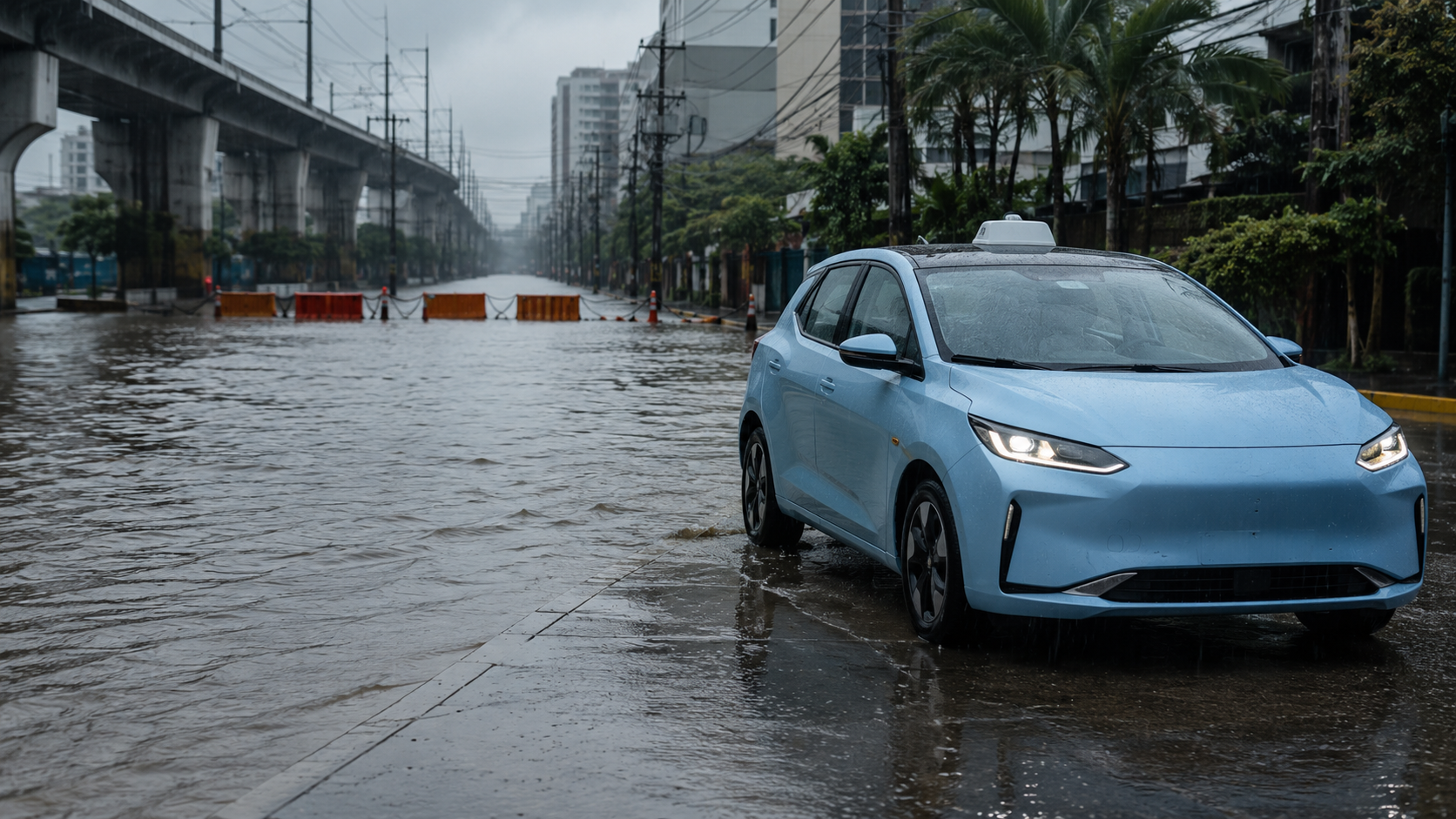
During the rainy season in Metro Manila, downpours flood roads in many places within a short time. When an electric vehicle (EV) drives onto such a road, the problem is not just a breakdown. Several issues that affect the occupants and people nearby are conceivable: the risk of the vehicle being swept away, windows and doors failing to operate after a loss of power, and ignition of the traction battery after submersion.
That said, it is not accurate to assume that “EVs are vulnerable to water and will immediately cause electric shock or fire when flooded.” Today’s EVs are designed on the premise of a waterproofed high-voltage battery, leakage monitoring, and power cutoff in the event of an abnormality.
What matters is to distinguish between the direct dangers while a vehicle is in floodwater and the battery fires that can occur some time after submersion.
The Problem of Doors That Won’t Open Is Not Unique to EVs
The main reason the doors of a flooded car will not open is the water pressure outside the vehicle. This applies not only to EVs but also to gasoline and diesel cars. However, at the depth of ordinary road flooding, water pressure does not need to be considered. Even in a power loss, there is no problem if the car has a safety design that allows the doors to be opened manually.
Check in Advance Whether Your EV Has a Manual Door Release
EVs with electronic doors are generally also equipped with a mechanical manual release. However, its location and operation differ by model.
On the Tesla Model 3, for example, the front doors have a manual release lever near the window switch, while in the rear you remove a cover inside the door pocket and pull a release cable. The structure may differ depending on the model year and specifications.
The problem is that if you look for the release for the first time in an emergency, you may not be in time.
Not only owners of private EVs but also taxi companies, whose vehicles are used by many drivers in shifts, need to train drivers on the following for each model:
- How to release the front and rear doors manually
- The escape procedure while the power windows still work
- Where the on-board escape tools are kept
- Criteria for deciding not to enter flooded roads
- Conditions under which a car must not be restarted or charged after flooding
- The procedure for evacuating passengers safely
Simply leaving a manual in the car is not enough. Every driver who might drive during heavy rain should check the release locations on the actual vehicle.
EV Fires After Submersion Confirmed in Florida
Now, many cases of EVs catching fire after submersion have already been confirmed overseas.
When Hurricane Ian struck the U.S. state of Florida in 2022, EVs affected by seawater from the storm surge caught fire one after another after the water receded.
According to the Associated Press, the batteries of up to about 5,000 EVs were affected, and 36 of them caught fire. Not every flooded EV burned; only some did, but the episode revealed a new problem: fires that break out well after the submersion.
The reported fires included the following:
- Ignition while parked after the water receded
- Ignition while being transported on a tow truck
- Ignition several days after flooding
- Re-ignition of a battery after the fire had once been extinguished
- Ignition inside a garage, spreading to the building
In Hurricane Helene in 2024 as well, there were reports of a flooded Tesla catching fire in a garage and destroying a home. No casualties were reported in that case, but it renewed attention to the danger of keeping flooded vehicles inside a house or near buildings.
Why Do Fires Start After the Water Recedes Rather Than Underwater?
An EV’s traction battery consists of many battery cells and high-voltage components. If the battery case is damaged, or if moisture gets inside past the seals, an internal short circuit can occur as time passes.
Seawater in particular contains salt, which conducts electricity easily. If seawater enters the battery and the salt remains after the moisture evaporates, a path for electricity can form.
As a result, a fire can develop through a sequence like the following:
- Seawater or dirty water enters the battery
- Salt and corrosion cause an internal short circuit
- Some cells overheat abnormally
- The heat spreads to adjacent cells
- Thermal runaway occurs
- Flammable and toxic gases are released and ignite
While submerged, the battery may be cooled by the surrounding water, but its temperature can rise after the water recedes or after the vehicle is pulled out. Because internal corrosion takes time, it cannot be ruled out that a fire may break out suddenly hours or days later.
The U.S. National Transportation Safety Board (NTSB) warns that damaged lithium-ion batteries retain stored energy and pose risks such as thermal runaway, re-ignition, and electric shock to rescue and maintenance personnel.
Freshwater and Seawater Flooding Should Be Distinguished
The Florida cases cannot simply be applied to every flood in Metro Manila.
The problem in Hurricane Ian was mainly submersion in salt water from the storm surge. Compared with freshwater flooding, which is mostly rainwater, salt water conducts electricity more easily and also accelerates corrosion inside the battery.
Even so, it is not appropriate to regard Manila’s floodwater as completely fresh. Water on flooded roads may be mixed with sewage, mud, oil, metal fragments, and chemicals from the road surface. Along the Manila Bay coast, storm surge and salt-laden water may also flow in.
Therefore, even if a car runs normally after flooding, it should not be judged “safe because it did not break down.”
The Possibility of a Fire Inside the Vehicle While Submerged
In theory, an accident in which an EV’s battery ignites immediately after the vehicle enters a flooded road and the occupants are burned to death cannot be ruled out. However, most submerged-EV fires widely confirmed so far occurred after the water had receded, while the vehicle was parked, being transported, or in storage.
The dangers that generally threaten occupants soonest in floodwater are not fire or electric shock but the following:
- The vehicle is swept away by the current
- It falls into a hole in the road, a gutter, or an open manhole
- Water pressure keeps the doors from opening
- A power failure leaves the windows and locks inoperable
- Water enters the cabin and the occupants drown
An EV battery fire is a serious danger, but it is not necessarily the “first danger” that delays the decision to escape during flooding.
Manila’s EV Taxis Need Special Measures
EV taxis are increasingly being introduced in Metro Manila, and some operators now have many drivers sharing the same model in shifts.
EV taxis run for longer hours than ordinary private cars and are more likely to carry passengers even in heavy rain. And because the drivers do not own the vehicles, they may not fully understand the manual door release or what to do after flooding.
Operators should be required to take at least the following measures:
- Show flood-prone areas on the dispatch system
- Stop dispatching to hazardous areas when flood warnings are issued
- Clearly give drivers the authority to detour or suspend service
- Conduct training in manual door release and passenger evacuation
- Equip every vehicle with escape tools and inspect them regularly
- Do not return flooded vehicles to ordinary charging sites
- Isolate flooded vehicles, keeping them away from buildings and other vehicles
- Set up a system for inspection by specialized battery technicians
- Record flood depth and driving history
If drivers’ sales targets or performance evaluations are too strict, they could become an incentive to enter flooded roads despite knowing the danger. A system is also needed so that suspending service for safety does not lead to pay cuts or discipline for drivers.
What to Do When Flooding Begins
If you cannot tell how deep the water ahead is, the rule is not to enter. Even if the car in front got through, that does not mean your own car can pass safely.
If water begins to enter the cabin, you need to move to a safe place at an early stage, while the car still moves and the windows still work. Even if you try to open the doors after the water level has risen, water pressure may keep them shut.
In preparation for an emergency, it is also advisable to check the following about the car you drive in advance:
- The location of the manual door release
- How to escape manually from the rear seats
- The type of window glass
- The location and use of escape tools
- The manufacturer’s instructions for after flooding
Equipment and structure differ by model, so rather than relying on a one-size-fits-all method, be sure to consult the owner’s manual.
Do Not Restart or Charge a Flooded EV
An EV that has been deeply flooded should not be restarted or charged, even if it looks normal on the outside. In particular, if any of the following signs appear, stay away from the vehicle and contact the fire department or a specialist:
- White smoke or steam coming from near the battery
- Hissing or crackling sounds
- A pungent or sweet chemical smell
- Bubbles continuing to come from under the vehicle body
- The area near the battery is abnormally hot
- Smoke that stopped once and then appeared again
Moving a flooded car to a home garage, an underground parking lot, a charging facility, or a spot next to other vehicles is dangerous. Follow the instructions of the manufacturer and rescue agencies, keep the vehicle away from buildings and combustible materials, and have it inspected by specialists. Tesla has also published dedicated guidance for vehicles that may have been submerged.
The Risk of Buying a New EV in Metro Manila: The Fear of Zero Resale Value
Taking all this into account, even buying a new EV carries another risk: the risk that its value on the resale market falls to virtually zero.
With used EVs in Metro Manila, it is hard to judge from the exterior any past flood history or internal battery damage. Even if a car runs normally after flooding, corrosion may be progressing inside the battery or the high-voltage terminals.
The danger of charging problems, insulation degradation, breakdowns, or fires after purchase cannot be ruled out. Before buying, it is necessary to check the battery’s state of health, insulation resistance, and accident history, but in the first place there is no obligation to submit documents on flood history or failure records.
The cost of replacing the battery after the warranty ends can even exceed the market value of the used car. There is also the possibility that, due to technological progress, new-car price cuts, parts shortages, or a manufacturer’s withdrawal, a car can no longer be repaired and ends up scrapped.
When it comes to resale, an EV is no different from a used large household appliance. That being the case, the very decision to buy an EV calls for careful thought.
コメント