
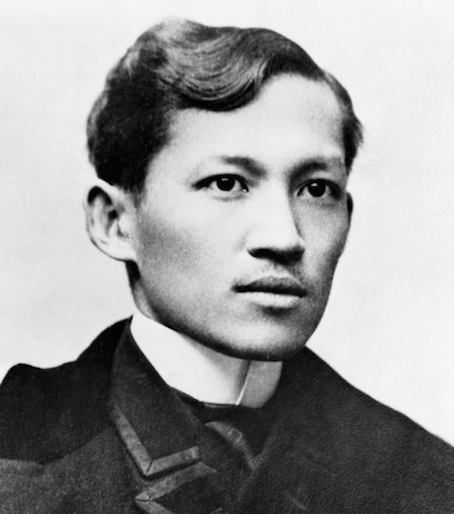
By Yasotarō Mōri
▲ Entering the Ateneo Municipal
Weighed down by the troubles surrounding his mother and brother, Rizal set off for Manila with a leaden heart (in June 1872; his departure had been delayed a month by his mother’s case). He did well on the entrance examination, but because he had taken it a month past the deadline, and because his physique looked slight and frail, the school authorities hesitated to admit him. It was through the intervention of Dr. Manuel Burgos (a nephew of the aforementioned Dr. José Burgos) that he was able to enroll. He was eleven years old at the time.
Within a month of enrolling, he stood first in his class. To encourage diligence, the school divided each class into two groups — “Rome” (the higher-ranked) and “Carthage” (the lower-ranked) — with students moving between the two according to their performance. From the time Rizal enrolled, his group was always “Rome,” and he was celebrated as its chief. Looking now at his academic record over his four years at the school, he was marked “excellent” without exception in Latin, Spanish, Greek, and French, in arithmetic, algebra, and geometry, in philosophy, poetry, and rhetoric, and in mineralogy, chemistry, physics, and natural history.
The first foreign book he ever read, while a student here, was Dumas’s The Count of Monte Cristo. What moved him about it was the parallel between the unjust persecution suffered by the novel’s hero and the plight of his own mother, weeping under similarly unjust persecution, and the powerlessness of his country, the Philippines, to resist such injustice. What moved him even more deeply was a travelogue of the Philippines written by the German scholar Dr. Feodor Jagor. Viewed from the standpoint of colonial policy, the book attacked Spain’s misgovernment of the Philippines quite bluntly, warning outright that if things were left as they were, Spain would follow the same path by which it had lost its colonies in the Americas, and would in the end lose the Philippines as well. To Rizal, who had already felt a vague, ill-defined dread about the future of the Philippines, this book showed him clearly and unmistakably just how real that danger was. His conviction that the Philippines must be saved grew firmer than ever.
In the first two years, whenever he returned home for the end-of-year holidays, he would go straight to the prison in Santa Cruz to visit his mother and comfort her as best he could. By his third Christmas holiday, his mother had already been released and was back home. This was a joy beyond measure for them both, but the one thing that weighed on Rizal’s heart was that his mother’s eyes had been afflicted and she had nearly lost her sight, so that she could not even see the face of the son who had come all this way home to her. In that moment, he resolved that he would one day become a doctor and fully cure his mother’s eyes.
Having thus completed his four years at the Ateneo Municipal with outstanding grades, he went on to enroll at the University of Santo Tomas in Manila (in April 1877, at age sixteen). He entered the medical course — out of his wish to cure his mother’s eyes, but also out of a desire to help the many Filipinos he saw falling ill and dying year after year.
▲ Suddenly Known to Society
He studied diligently at the university, but it was an unexpected turn of events that made him famous. There was in Manila a Liceo Artístico-Literario, which held an open poetry competition with a prize. Rizal entered and won first place, receiving a silver pen for his effort (1879). The poem was titled “To the Filipino Youth,” and its concept broke from the conventional mold of his earlier poetry, while its tone was especially vigorous, carrying an indignation that stirred the blood of the young. Seven years earlier, at the time of Dr. Burgos’s death, there had been a Society of Young Students that was ordered disbanded. Its members quietly spread word — and cheered privately — that Rizal had written this poem to encourage them, the youth. This was, of course, something Rizal himself knew nothing about, but it was later exploited by a faction hostile to him. In any case, this single poem was enough to make his name suddenly and widely known throughout society.
At this university, there were constant clashes between Spanish and Filipino students, caused mainly by the insulting attitude of the Spanish students toward their Filipino classmates. By nature, Rizal was never one to stay silent under insult. On one occasion, even this normally quiet young man flew into a rage and came to blows, getting the better of his opponent, though he himself was injured in the head. He hurried back to the boarding house of his uncle, Antonio Rivera, where he lodged, and his uncle’s daughter Leonor, seeing his wound, tended to it at once. It was on this occasion that the two fell in love, and within a year they were engaged. This was perhaps the happiest period of Rizal’s entire life, a time when he had not yet come to know deeply the darker sides of the world. The poetry he wrote in this period is said to be the most beautiful of all his verse. At the same time, whereas he had previously been whispered about as the ringleader behind clashes with Spanish students, after this major brawl he came to be openly talked about as the very instigator of the fighting on the Filipino students’ side. It is easy to imagine that this rumor was spread by those who felt no goodwill toward Rizal.
Even after enrolling at the University of Santo Tomas, Rizal continued to visit his old school, the Ateneo Municipal, to pursue a few specialized subjects. Because of this connection, when the Ateneo students held a literary gathering (in December 1880), he wrote a play for the students. In one scene of this play, a devil appears and delivers an attack on Spain. Among its lines was this:
“The Philippines now has no comfort left; it groans under foreign tyranny. And under Spain’s despotic rule, it is wasting away, slowly dying.”
So the line went. The Jesuit priests who taught at the Ateneo Municipal, regarding Rizal as the brilliant student they themselves had trained and took pride in, greeted the play with applause. But the Dominican friars who taught at the University of Santo Tomas — who held ill feeling toward the Jesuits — took this as Rizal using the play as a vehicle to speak ill of Spain, and from then on, whenever Rizal appeared in class, the faculty’s attitude toward him grew noticeably cold, even hostile.

コメント