
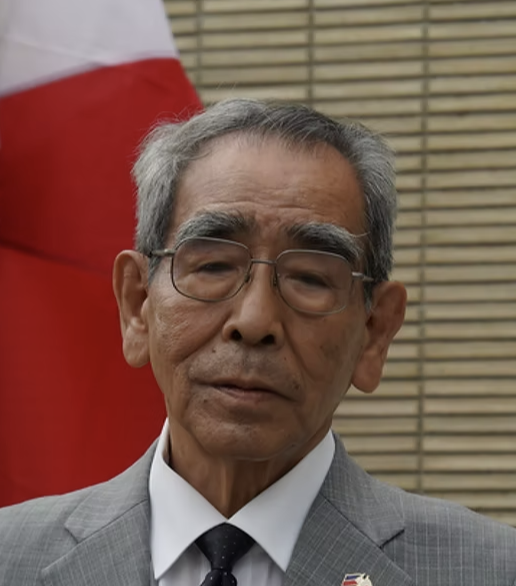
Pinoy-Hapon United Foundation (PHUF), a non-profit organization, Honorary Chairman Takeshi Asanuma
”Emilio Aguinaldo” came from a family of local notables in Cavite on the island of Luzon. He awoke to politics in his youth and built a record of achievement, serving as “mayor” at the age of 26. Strongly influenced by “Dr. José Rizal” and the anti-establishment revolutionary “Bonifacio,” he took part in the “revolution and independence movement.”
In 1896 he joined the “Katipunan’s” “armed uprising against Spain,” which “Bonifacio” had organized, and for a time overwhelmed the “Spanish forces”; but owing to differences in political line, in May 1897 he came into political conflict with “Bonifacio,” had him killed, and seized leadership of the “revolutionary organization.”
However, strong reinforcements were sent from Spain itself, and “Aguinaldo,” driven into a corner despite fierce resistance, succeeded in reaching a “peace accord” with the Spanish authorities, received a certain “settlement payment,” and went into exile in “Hong Kong” with a few close aides at the end of 1897.
In April 1898, the “Spanish-American War” began over a dispute about interests in “Cuba,” and the United States gained the upper hand. The United States promised “Aguinaldo,” then in exile in Hong Kong, that if he returned to “Luzon” and fought “Spain,” it would provide weapons and funds and guarantee “independence” after victory, and it transported them to “Luzon” aboard an American warship. Once ashore, they gathered their own troops, advanced north defeating the Spanish forces guarding “Manila,” set up their base at “Malolos,” and pacified north-central Luzon.
On June 12, 1898, “Aguinaldo” declared “independence” and the “establishment of a republic.” This was the “Malolos Republic.” Historically regarded as the “First Republic,” it had him as its first “President” and adopted a “constitution and flag.” “Part of the flag and constitution” are carried on in the “present-day Republic.”
In August the “Spanish-American War” ended, but the United States betrayed him. Far from granting “independence,” it purchased sovereignty over this colony for “$20 million,” had the Spanish forces withdraw, set up a system of direct rule, and moved to “drive Aguinaldo out.”
And this despite the fact that even the “Spanish Empire” had not politically “betrayed” him.
Enraged, he entered into a thoroughgoing armed struggle against the United States in 1899 as “President of the Republic.” This was the “Philippine-American War.” The American commander, “Major General Arthur MacArthur Jr. (father of General Douglas MacArthur),” confronted him with overwhelming troop strength and materiel, gradually driving “President Aguinaldo” into a corner; his strength spent, he surrendered in April 1901, and at that time several generals who had served under him went into exile in Japan. The local lives lost in about two years are said to have reached 400,000, military and civilian combined, and it is said that Filipinos have not forgotten this grievance even today.
”President Aguinaldo” was originally pro-Japanese and had a strong interest in the “Meiji Restoration.” He respected the “wisdom of the Japanese people” for carrying out great reforms while maintaining the “Imperial House,” with its proud historical tradition.
During the war against the United States, too, he asked the “Japanese government” for assistance, and Japan secretly responded, but the “aid ship Nunobiki Maru,” loaded with weapons and ammunition, was caught in a typhoon in the East China Sea and sank, and regrettably the supplies never reached his hands.
In November 1962, the “Crown Prince and Princess (now the Emperor Emeritus and Empress Emerita),” who were making an official visit to this country as representatives of “Emperor Showa,” visited the 92-year-old Aguinaldo at his home, and it is said that he wept with emotion. Two years later, in 1964, he passed away.
”Mr. Aguinaldo” carried to the end the negative legacy of having had “Bonifacio” killed, but he is remembered in political history as a forerunner who laid the foundation of “Philippine independence.”
コメント