
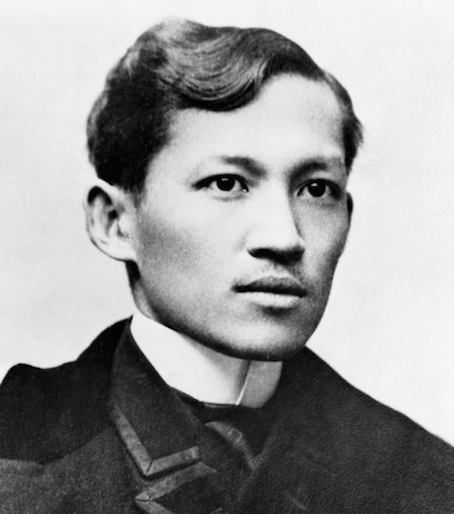
Yasotarō Mōri
The End of a Valiant Man
A few minutes before seven o’clock on the morning of December 30, Rizal was led out from Fort Santiago to Bagumbayan Field, the place of execution. He wore a dark suit and a black top hat — clothes newly made for his intended voyage to Cuba, but a fitting color for the occasion of a funeral as well.
With his hands bound behind him, he walked to the execution ground accompanied by priests. “His head was held high and resolute, his spirit calm and composed, and there was even the trace of a smile about his lips,” the record states. Lieutenant Andrade, who had defended him, walked at his side, with a guard of soldiers before and behind. “Rizal’s composure was a thing to marvel at,” one of the priests later recounted.
“So we are walking the road to Calvary,” he said. “Christ was nailed to a cross, but I shall make my own cross of my spine, and be nailed to it by bullets.”
He said this, and then said to the priest,
“What splendid weather it is. Could there be a more tranquil morning than this? You can see Corregidor and the hills of Cavite so clearly. On a morning just like this, I once walked around here with the one dear to my heart.”
So he said. The one dear to his heart was his sweetheart, Leonor. Beyond the fortress walls, the two towers of the Ateneo could be seen rising in the distance — towers that had not yet been built when he himself studied there. He gazed at them with evident fondness, and it was said that only in this one moment did any flicker of emotion cross his brow.
During his years at the Ateneo, he had often walked in this same area with friends, and on one occasion, for reasons known only to himself, he had remarked to a friend, “I cannot shake the feeling that someday, on some fine morning, I shall be shot to death on this very field” — a premonition that, tragically, came true. Both the one who spoke those words and the one who heard them must have been overwhelmed with emotion, recalling that day. The hand of fate moves in mysterious ways.
A vast crowd had gathered at the execution ground. But it was a crowd of two very different kinds. One was made up of Filipinos, who watched in reverent silence and tears as Rizal — whom they looked up to almost as their savior — met his end by firing squad. The other was made up of Spanish officials, friars, and ladies, who had come merely out of idle curiosity to watch the punishment of a disloyal traitor to Spain, laughing and carrying on without a shred of restraint, as though out on some pleasure outing.
When Rizal reached the execution ground, he shook Lieutenant Andrade’s hand firmly, and asked the officer in charge to let him face the firing squad rather than have his back turned to it (to be shot with one’s back to the squad was the manner reserved for traitors to the nation). The officer refused, saying he could not grant this request, as it went against orders. Rizal then said that, if so, there was nothing to be done, but asked instead, “Please do not shoot me in the head — shoot me in the heart,” and this request was granted.
He refused a blindfold, and when the officer told him to kneel, he refused that too, standing upright and facing the sea. The army doctor in attendance asked specifically to check Rizal’s pulse, and found it entirely normal. Bound as he was, Rizal used his fingers to indicate the spot over his heart, telling them, “This is where it is — shoot here.”
The firing squad consisted of eight Filipino soldiers, with Spanish soldiers lined up behind them. The plan was that, should the Filipino soldiers refuse to fire, the Spanish soldiers would shoot them down as well.
The guns rang out with a thunderous crash. One might have expected Rizal to crumple limply to the ground, but instead, by sheer force of a will stronger than iron, he twisted his upper body sharply around and fell to the earth facing the sky. To the very end, he carried through his unbending resolve: that he would never fall face-down upon the ground, but would die looking up at the heavens.
It was three minutes past seven in the morning. Rizal was thirty-five years, six months, and eleven days old. It was not a long life as years go — and yet what a rich, varied, and profoundly meaningful thirty-five years it had been!
Cheers rose up from the crowd of Spaniards, and the military band struck up the Spanish national anthem. The troops marched once around Rizal’s body, as though they were passing in review before this great man. One officer, mindful of the respect owed to the dead, took a handkerchief from Rizal’s pocket and used it to cover his face.
Howard Bray, who witnessed the scene, later recalled: “The shock I felt when Rizal fell, amid the crack of the guns and the jeers of the Spaniards and friars, and that ghastly morning itself, I shall never forget as long as I live. It was one of the most coldblooded crimes recorded in history since the tragedy of Golgotha.”
Another witness, the Englishman Sir Hugh Clifford, contributed an article about Rizal to a British magazine, in which he offered his thoughts on the scene, writing:
“Setting aside for a moment our melancholy reflections on this wretched tragedy, we cannot help but feel a certain grim satisfaction in recalling that, less than eighteen months after this event, the Battle of Manila Bay was fought, and the roar of mightier guns once again rang out over this very field — guns that brought victory to the United States.”
× × ×
Today, at what was once Bagumbayan Field and is now Luneta Park, a towering monument to Rizal stands in majestic solitude. It was built with contributions from the general public, and its designer was the same artist who had earlier designed the national monument to the Swiss patriot William Tell. (Schiller’s poem celebrating William Tell was translated into Tagalog by Rizal himself, and is known among the Filipino people through that translation.)
And so, on the sixteenth anniversary of Rizal’s execution (December 30, 1912), his remains were solemnly interred beneath this monument, which thereby became his tomb as well. Later, around Shōwa 9 (1934), students of the University of the Philippines raised 600 pesos among themselves to erect a marker at the exact spot, some 100 meters from the monument, where Rizal actually fell. (End of “Chapter Six: Toward a Tragic End”)

コメント