
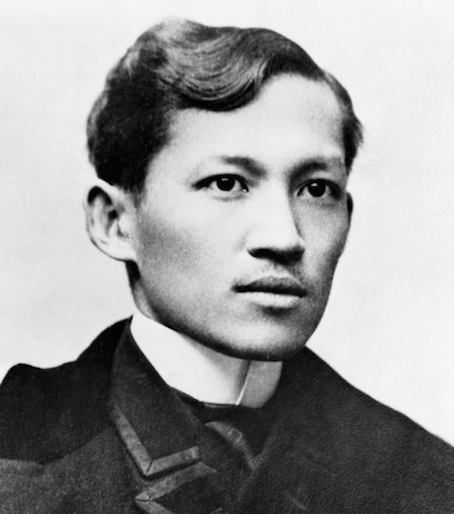
Yasotarō Mōri
An English engineer named Kipping came to the town of Dagupan, where Leonor’s family lived, to supervise the construction of a railway. He fell in love with Leonor at first sight, and eventually proposed marriage. Her mother was overjoyed and worked hard to see the match realized, going so far as to spread the false rumor that Rizal was already engaged to Dr. Blumentritt’s daughter, in an attempt to sway Leonor’s heart. When Leonor still stubbornly refused, her mother finally resorted to tearful pleading, begging her, if she loved her mother, to help her by consenting to the marriage — to think of it as helping her mother. Leonor at last consented, but declared that she did not intend to live long, and that she would neither sing nor play the piano again until she died; she locked the piano shut.
Then one day, while her mother was away on business in Manila, a letter from Rizal happened to arrive. In it, he reproached her for never once having answered any of his previous letters. Since Leonor had been writing much the same complaint to Rizal, it became clear, for the first time, that their correspondence had been intercepted along the way, and she flew into a mad rage. When her mother returned from Manila, she confessed everything. But by then, according to custom, the engagement to Kipping could not simply be called off, and the wedding was held on June 17 (1891). It must truly have felt like a princess sent off to marry into a foreign land — Leonor gathered up the seven years of correspondence from Rizal that her mother had confiscated, burned it to ash, and placed the ashes in a silver box. She made a cover for it from a piece of the very dress she had worn eleven years before, when, at the age of thirteen, she had become betrothed to Rizal, embroidered it with the letters J and L, and draped it over the silver box, which she kept on her dressing table for the rest of her life.
Rizal left Spain for Hong Kong (October 18, 1891). He carried eight hundred copies of the sequel with him and, through various connections, sent them on into the Philippines, but the authorities did everything they could to oppose the distribution of the book, and it is said that no small number of copies were confiscated. Upon reaching Hong Kong, he set up practice as an eye doctor, and there became close with a Portuguese physician, Lorenzo Marques, who came to hold him in deep respect and trust. Had he simply continued his practice as an eye doctor, he might have lived out peaceful days. But news from home kept reporting that the Spanish authorities’ persecution of the town of Calamba, and their lawlessness, grew worse by the day, so much so that he is said to have spent sleepless nights in anguish over it.
▲ The Plan to Emigrate to Borneo
As one means of saving the people of his homeland, he drew up, in strict secrecy, a certain plan. It was to establish a colony in British North Borneo and have some three hundred households — his own family among them, along with others from Calamba and elsewhere who had suffered the confiscation of their property and expulsion from their land — emigrate there en masse. He himself traveled from Hong Kong to Borneo to inspect the land, and the British governor stationed there was thoroughly in favor of the plan, promising to provide, free of charge, one hundred thousand hectares of land for a term of nine hundred and ninety-nine years. His close friends in Europe supported the plan with great enthusiasm, leaping at the idea, and hoped it might be realized as soon as possible.
Amid this anguish, what brought him a measure of relief was the arrival in Hong Kong of his father and brother, who had fled the Philippines. His mother and sister followed soon after. There he performed a second operation on his mother’s eyes, and her eyesight was fully restored. Hoping to see the Borneo plan realized as soon as possible, he urged the relatives still remaining in the Philippines to come quickly to Hong Kong, but his brother-in-law Hidalgo opposed the plan. Hidalgo insisted that they ought to remain in the Philippines to the very last. As Rizal saw it, every other avenue had by now been closed off. This Borneo plan was the one remaining course left to them.
If he were to force himself to seek some other course, setting aside whether it would succeed or fail, it would mean returning to the Philippines himself and throwing himself into the thick of the movement. But this was a course for which he would have had to be prepared, nine times out of ten, to be killed. Of course, he did not fear death. If he could be confident that his own presence in the Philippines would genuinely contribute, even a little, to the salvation of his countrymen, he would gladly have thrown himself into the jaws of death. But would it truly be so? He wavered. And Hidalgo’s letter only deepened his uncertainty.
The hand of fate is always moving in subtle ways. Around this time, Governor-General Weyler of the Philippines returned to Spain, and a man named Eulogio Despujol took up the post in his place. Rizal sent the new governor-general a courteous letter of greeting, offering to serve, in whatever capacity he could, toward improving conditions in the Philippines — for the new governor-general had, upon taking office, announced a set of reform measures for the Philippines. No reply came to this letter. At the same time, the persecution of the town of Calamba continued. Borneo was also, geographically, a convenient base for the Filipino enlightenment movement he had long aspired to. Meanwhile, the new governor-general did carry out some of his reform measures, pardoning thirteen of those who had been exiled from Calamba to Jolo and allowing them to return home.
Seeing this, Rizal judged that the moment had come for the Borneo plan, and sent the new governor-general a second letter. In it, he stressed that settling in Borneo had no purpose other than to resolve, peacefully, the dispute between landlords and tenants, and he petitioned for the permissions necessary for Filipinos to leave the country and become naturalized British subjects, among other things. The governor-general, through the Spanish consul-general resident in Hong Kong, sent back word to this effect: “At a time when the Philippines already suffers a shortage of labor, it is not desirable for people to emigrate in order to develop foreign lands. So long as Filipinos act within the law, they are free to work anywhere within the islands to promote the prosperity of the Philippines.”


コメント