
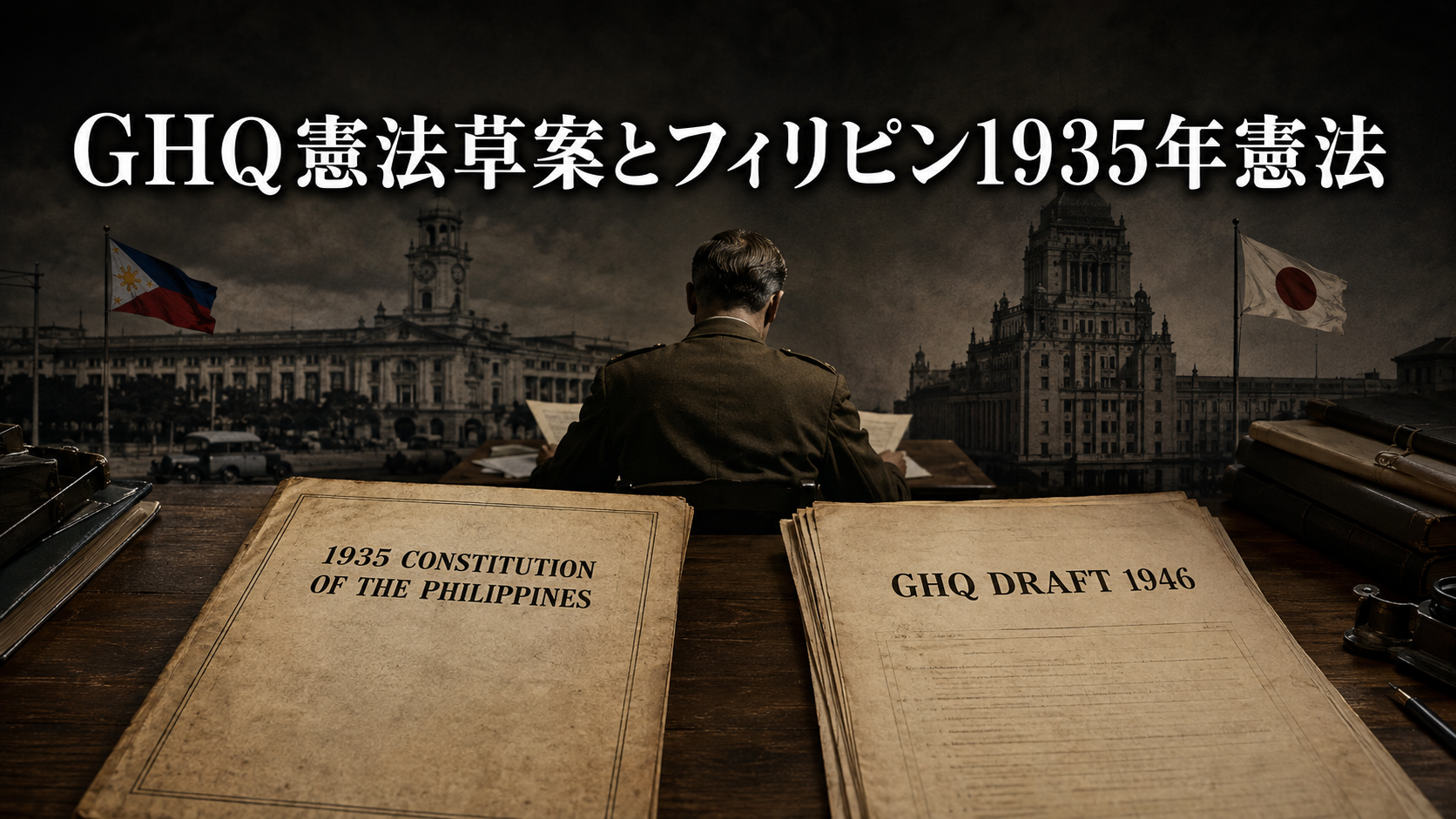
The GHQ draft that formed the basis of Japan’s Constitution was completed in a remarkably short time. On February 3, 1946, General Douglas MacArthur, Supreme Commander for the Allied Powers, presented the “MacArthur Three Principles,” centered on retaining the Emperor system, renouncing war, and abolishing the feudal system. The following day, February 4, the GHQ Government Section began drafting the constitution, and by the night of February 10 had submitted a draft to MacArthur. After revisions, it was completed on the 12th and handed to the Japanese government on the 13th. The actual drafting took six days, and including final adjustments, the whole process took just eight days.
Who Was Brigadier General Courtney Whitney, Chief of the GHQ Government Section?
Brigadier General Whitney had a background deeply connected to the Philippines before the occupation of Japan. After leaving the Army in 1927, he practiced law in Manila for about 13 years, and experienced firsthand the process by which the 1935 Philippine Constitution was drafted and enacted. In 1940 he returned to active duty as a major, and in 1943 joined MacArthur’s Southwest Pacific Area headquarters as a colonel. As chief of the Philippine Regional Section of the Allied Intelligence Bureau, he oversaw support for anti-Japanese guerrillas and intelligence operations, and after the recapture of the Philippines he was responsible for civil affairs administration. He was promoted to brigadier general in January 1945, and in December of that year, after the occupation of Japan began, he became Chief of the GHQ Government Section.
Similarities Between the Philippine 1935 Constitution and the GHQ Draft
What stands out is that the Philippine 1935 Constitution already explicitly stated the renunciation of war. Article II, Section 3 of that constitution provided as follows:
The Philippines renounces war as an instrument of national policy.
By contrast, Article VIII, “Renunciation of War,” in Chapter II of the GHQ draft reads as follows:
Renunciation of War
Article VIII. War as a sovereign right of nation is abolished. The threat or use of force is forever renounced as a means for settling disputes with any other nation.
No army, navy, air force, or other war potential will ever be authorized and no rights of belligerency will ever be conferred upon the State.
While the Philippine 1935 Constitution renounced “war as an instrument of national policy,” the GHQ draft of Japan’s Constitution abolished “war as a sovereign right of the nation.” The term “sovereign right” refers to an absolute right, to sovereignty itself — the GHQ draft sought to restrict a right that, for an independent state, should never be subject to restriction. Moreover, by also disallowing the maintenance of armed forces to guarantee the renunciation of war, the draft carries a strong character of an occupying power’s constitution.
Conclusion
For this reason, although the Philippine 1935 Constitution and the GHQ draft of Japan’s Constitution are not worded identically, the structure of enshrining “renunciation of war” as a constitutional principle shows a clear commonality between them.
There is, moreover, the fact that Whitney — who lived in Manila as a lawyer at the time the Philippine 1935 Constitution was enacted, and who during the war, as a colonel and later brigadier general under MacArthur, was in charge of intelligence and civil affairs in the Philippines — went on to oversee the drafting of Japan’s Constitution as Chief of the GHQ Government Section.
Behind GHQ’s ability to produce a systematic constitutional draft in just over a week lay the precedent of the Philippine 1935 Constitution, in which the United States had been deeply involved.
Given Whitney’s career background and the textual similarities between the two, the possibility that GHQ drew heavily on the 1935 Constitution cannot be ruled out.
Source: National Diet Library, “Constitution of Japan,” February 12, 1946
Source: National Diet Library, “Nihonkoku Kenpō” (GHQ Draft, provisional)
コメント