

MANILA NEWS DAILY
That War and Me (3) B-29 Air Raids on Osaka
Pinoy-Hapon United Foundation (PHUF), a non-profit organization, Honorary Chairman Takeshi Asanuma
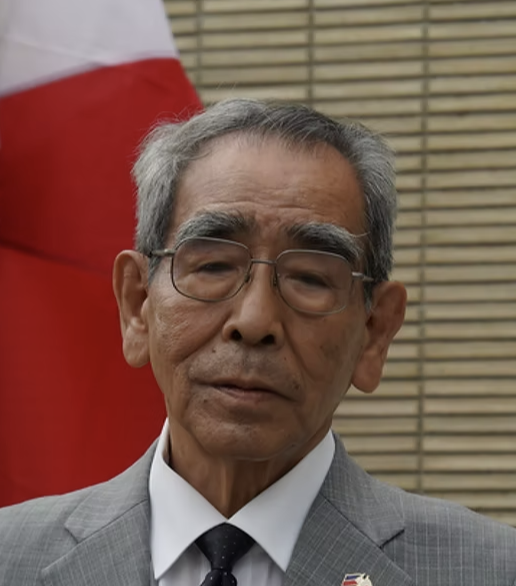
Those who served in the previous war, the Greater East Asia War, who actually took part in combat, survived, and returned home, must by now be well past the age of 100, and opportunities to hear their experiences directly are fast disappearing. Even those who fought as boy soldiers at the age of 17 or 18 at the time are already well into their nineties. The chance to hear firsthand accounts of that horrific wartime experience is steadily slipping away.
I was born in Shōwa 13 (1938), and by the time I became aware of the world around me, the country was already in the midst of war. When Japan surrendered unconditionally in August of Shōwa 20 (1945), I was on summer vacation as a first-grader at national school. The wartime experiences I underwent just as my sense of self was awakening burned themselves into my mind as a kind of PTSD, a formative experience I have never been able to forget, and I have carried that harrowing memory in a corner of my heart all the way to this, my eighty-eighth year.
It is my earnest wish to pass on even a small part of the “war” I experienced to younger generations, and to have them keep the Greater East Asia War — now a matter of history — in their memory. In Shōwa 19 (1944), my father went off to war, to Aomori; my great-grandmother and grandparents moved outside Nara City; and the six or seven household staff we had were each taken off for military service or labor conscription. My father’s youngest brother (26 years old, exempted from military service due to poor health) and his wife (with a one-year-old son) lived nearby and helped with the family business, but my mother looked after them as well.
From around the end of Shōwa 19, B-29s began coming to bomb the skies over Osaka with some frequency. From time to time, I was able to witness what looked like aerial combat with intercepting fighter planes. Anti-aircraft guns on the ground also opened fire, and B-29s were shot down over the city of Osaka as well; the adults in our neighborhood would go to see the wreckage and come back with accounts of the gruesome scenes. It seems that large crowds subjected the American airmen killed there to public humiliation.
Once the new year came, the air raids centered mainly on nighttime, and an air-raid warning was issued almost every night. Nighttime air raids are truly terrifying.
My younger sister and I would be carried by our mother as we fled into the air-raid shelter. Formations of B-29s, illuminated by searchlights from the ground, scattered one-ton bombs across the city of Osaka, destroying every kind of structure and gouging craters some seven or eight meters across into the roads.
I would shiver inside the air-raid shelter, listening to the whistling sound of falling bombs — from the pitch of the sound, you could guess how close it would land. When I thought, “this one’s close,” a tremendous BOOM would echo nearby and the shelter itself would shake. This kind of terror would go on for more than an hour at a stretch. NHK kept broadcasting the air-raid warning throughout, and once it was lifted, it would air the Central Military District’s report: “Enemy aircraft have withdrawn to the west of the Kii Peninsula.”
The day after an air raid, I went to see the bombed site in our neighborhood. Four or five wooden houses had been blown apart, and a large crater had opened in the nearby road. The civil defense corps was clearing the site, and I was told that in the courtyard of one of the bombed houses there had been an air-raid shelter, inside which two people had died. There was no telling when or where death by bombing might strike.
To prevent fires from spreading during bombing raids, the forced clearance and demolition of densely packed wooden housing began in various parts of the city. In my own neighborhood, too, the densely built wooden housing near Kintetsu Uehonmachi Station was forcibly torn down, creating an open plaza in front of the station — but after the war ended, a black market sprang up there, lined with restaurants and food stalls. It was redeveloped in Shōwa 54 (1979), and that redevelopment became what is known as “Uehonmachi Hai Hai Town.”
Next after the B-29 bombing raids, the most terrifying thing was strafing by carrier-based aircraft and fighter planes.
These began appearing all across Japan from around the time Japan’s control of the air had weakened, in Shōwa 20 (1945). There were the square-winged Grummans and the twin-boomed Lockheed P-38s. They attacked indiscriminately — not only military targets but civilian trains, vehicles, buildings, and people alike — strafing at such low altitude that you could make out the pilots’ faces.
I will talk about the strafing attacks in the next installment.
“Great Men of the Philippines: José Rizal” (Part 14)
Yasotarō Mōri
An English engineer named Kipping came to the town of Dagupan, where Leonor’s family lived, to supervise the construction of a railway. He fell in love with Leonor at first sight, and eventually proposed marriage. Her mother was overjoyed and worked hard to see the match realized, going so far as to spread the false rumor that Rizal was already engaged to Dr. Blumentritt’s daughter, in an attempt to sway Leonor’s heart. When Leonor still stubbornly refused, her mother finally resorted to tearful pleading, begging her, if she loved her mother, to help her by consenting to the marriage — to think of it as helping her mother. Leonor at last consented, but declared that she did not intend to live long, and that she would neither sing nor play the piano again until she died; she locked the piano shut.
Then one day, while her mother was away on business in Manila, a letter from Rizal happened to arrive. In it, he reproached her for never once having answered any of his previous letters. Since Leonor had been writing much the same complaint to Rizal, it became clear, for the first time, that their correspondence had been intercepted along the way, and she flew into a mad rage. When her mother returned from Manila, she confessed everything. But by then, according to custom, the engagement to Kipping could not simply be called off, and the wedding was held on June 17 (1891). It must truly have felt like a princess sent off to marry into a foreign land — Leonor gathered up the seven years of correspondence from Rizal that her mother had confiscated, burned it to ash, and placed the ashes in a silver box. She made a cover for it from a piece of the very dress she had worn eleven years before, when, at the age of thirteen, she had become betrothed to Rizal, embroidered it with the letters J and L, and draped it over the silver box, which she kept on her dressing table for the rest of her life.
Rizal left Spain for Hong Kong (October 18, 1891). He carried eight hundred copies of the sequel with him and, through various connections, sent them on into the Philippines, but the authorities did everything they could to oppose the distribution of the book, and it is said that no small number of copies were confiscated. Upon reaching Hong Kong, he set up practice as an eye doctor, and there became close with a Portuguese physician, Lorenzo Marques, who came to hold him in deep respect and trust. Had he simply continued his practice as an eye doctor, he might have lived out peaceful days. But news from home kept reporting that the Spanish authorities’ persecution of the town of Calamba, and their lawlessness, grew worse by the day, so much so that he is said to have spent sleepless nights in anguish over it.
▲ The Plan to Emigrate to Borneo
As one means of saving the people of his homeland, he drew up, in strict secrecy, a certain plan. It was to establish a colony in British North Borneo and have some three hundred households — his own family among them, along with others from Calamba and elsewhere who had suffered the confiscation of their property and expulsion from their land — emigrate there en masse. He himself traveled from Hong Kong to Borneo to inspect the land, and the British governor stationed there was thoroughly in favor of the plan, promising to provide, free of charge, one hundred thousand hectares of land for a term of nine hundred and ninety-nine years. His close friends in Europe supported the plan with great enthusiasm, leaping at the idea, and hoped it might be realized as soon as possible.
Amid this anguish, what brought him a measure of relief was the arrival in Hong Kong of his father and brother, who had fled the Philippines. His mother and sister followed soon after. There he performed a second operation on his mother’s eyes, and her eyesight was fully restored. Hoping to see the Borneo plan realized as soon as possible, he urged the relatives still remaining in the Philippines to come quickly to Hong Kong, but his brother-in-law Hidalgo opposed the plan. Hidalgo insisted that they ought to remain in the Philippines to the very last. As Rizal saw it, every other avenue had by now been closed off. This Borneo plan was the one remaining course left to them.
If he were to force himself to seek some other course, setting aside whether it would succeed or fail, it would mean returning to the Philippines himself and throwing himself into the thick of the movement. But this was a course for which he would have had to be prepared, nine times out of ten, to be killed. Of course, he did not fear death. If he could be confident that his own presence in the Philippines would genuinely contribute, even a little, to the salvation of his countrymen, he would gladly have thrown himself into the jaws of death. But would it truly be so? He wavered. And Hidalgo’s letter only deepened his uncertainty.
The hand of fate is always moving in subtle ways. Around this time, Governor-General Weyler of the Philippines returned to Spain, and a man named Eulogio Despujol took up the post in his place. Rizal sent the new governor-general a courteous letter of greeting, offering to serve, in whatever capacity he could, toward improving conditions in the Philippines — for the new governor-general had, upon taking office, announced a set of reform measures for the Philippines. No reply came to this letter. At the same time, the persecution of the town of Calamba continued. Borneo was also, geographically, a convenient base for the Filipino enlightenment movement he had long aspired to. Meanwhile, the new governor-general did carry out some of his reform measures, pardoning thirteen of those who had been exiled from Calamba to Jolo and allowing them to return home.
Seeing this, Rizal judged that the moment had come for the Borneo plan, and sent the new governor-general a second letter. In it, he stressed that settling in Borneo had no purpose other than to resolve, peacefully, the dispute between landlords and tenants, and he petitioned for the permissions necessary for Filipinos to leave the country and become naturalized British subjects, among other things. The governor-general, through the Spanish consul-general resident in Hong Kong, sent back word to this effect: “At a time when the Philippines already suffers a shortage of labor, it is not desirable for people to emigrate in order to develop foreign lands. So long as Filipinos act within the law, they are free to work anywhere within the islands to promote the prosperity of the Philippines.”