

MANILA NEWS DAILY
History of Japan-Philippines Relations (4)
Chronology
| 1941 | About nine hours after Pearl Harbor (December 8 local time), Japanese forces bomb Clark Field; most of the U.S. Far East Air Force is destroyed on the ground; the Pacific War begins |
| 1942 | The Hukbalahap anti-Japanese resistance army is formed (March 29); Manuel Roxas narrowly escapes a death sentence |
| 1943 | Jose P. Laurel becomes President of the Japanese-sponsored “Second Republic” (October 14) |
| 1944 | The Kamikaze Special Attack Force is formed at Mabalacat, Pampanga, and flies its first mission (October 20–25) |
| 1944 | The pro-Japanese collaborationist organization Makapili is formed (December 8) |
| 1945 | Laurel’s “Second Republic” collapses with Japan’s surrender (August) |
| 1948 | Laurel is granted amnesty by President Manuel Roxas |
| 1974 | Filipino artist Daniel Dizon builds a memorial to the kamikaze pilots on the former Mabalacat airfield site |
The Same-Day Bombing of Clark Field as Pearl Harbor
For the Philippines too, the outbreak of the Pacific War came almost simultaneously with the attack on Pearl Harbor in Hawaii. Because of the time difference, the local date was December 8, but just a few hours after the Pearl Harbor attack, Japanese aircraft struck Clark Field, the main American air base in the Philippines.
General MacArthur is said to have gone nearly eight hours after receiving news of the Pearl Harbor attack without issuing clear orders for interception or a preemptive strike, and during that time most of the crucial bombers and fighters remained lined up on the ground. As a result, when roughly 200 Japanese aircraft arrived shortly after noon, the bulk of the U.S. Far East Air Force’s air power was destroyed on the ground — a devastating blow. This failure — allowing a similar surprise attack to succeed in the Philippines on the very same day, despite already knowing of the Pearl Harbor attack — has since come to be known as a “second Pearl Harbor,” and remains a major point of controversy regarding MacArthur’s initial response.
President Jose P. Laurel
Following the Japanese invasion of the Philippines in December 1941, the country became one of the fiercest battlegrounds of the Pacific War. On October 14, 1943, during the Japanese occupation, Jose P. Laurel became President of the Japanese-backed “Second Republic of the Philippines.”
While Laurel is often described as having headed a “puppet government,” he was also a leader forced to navigate a difficult course between pressure from the Japanese military and the protection of his people. His government collapsed in August 1945 with Japan’s surrender, and Laurel himself was indicted for treason after the war on charges related to collaboration (including cooperation on maintaining public order), but before being brought to trial he was granted amnesty in 1948 by President Manuel Roxas. This war exacted an enormous human toll on the Philippines: on the Japanese side alone, 518,000 lives were lost, and more than 1.11 million Filipinos died. Of the roughly 300,000 American troops committed to the campaign to retake the Philippines, an estimated 15,000 were killed and more than 48,000 wounded — and the toll grows further when the deaths from the Bataan Death March and in POW camps (numbering in the thousands) are added.
Filipinos Who Collaborated with Japan: The Makapili
Beyond the kind of governing collaboration represented by the Laurel administration, occupied Philippines also saw the emergence of Filipino organizations that more directly supported Japanese military operations. The foremost of these was the “Makapili” (short for Makabayang Katipunan ng mga Pilipino, or “Alliance of Filipino Patriots”), formed on December 8, 1944.
At the request of Japanese Commander Shigenori Kuroda, it was organized under the leadership of figures including General Artemio Ricarte — a former revolutionary-army leader who had gone into exile in Japan during the Meiji era and lived for many years in Yokohama — along with Benigno Ramos and Pio Duran.
The Makapili was organized as a military body with a rank structure equivalent to that of the Japanese army, and at its peak is said to have numbered around 6,000 members. Most were landless, impoverished farmers, and many are said to have joined drawn by postwar promises of land reform.
The Makapili not only supported Japanese military operations but is also said to have taken part in hunting down and informing on anti-Japanese guerrillas. Its members, who hid their faces behind woven baskets while informing on their countrymen, were feared by many Filipinos, and the organization is remembered in postwar Philippine history as the most reviled of the pro-Japanese collaborationist groups.
Anti-Japanese Guerrillas: The Hukbalahap
In sharp contrast to the Makapili, the most organized resistance movement against the Japanese occupation was the “Hukbalahap” (formally Hukbong Bayan Laban sa Hapon, meaning “People’s Army Against Japan”). It was formed on March 29, 1942, at the foot of Mount Arayat in central Luzon, through the merger of the Communist Party of the Philippines with socialist and peasant movement organizations from across Luzon.
Led by Luis Taruc, the organization began as an armed force of roughly 500 fighters organized into five companies, but rapidly expanded its influence among the impoverished peasantry of central Luzon, growing at its height into a guerrilla force of around 20,000. The Hukbalahap achieved considerable success in guerrilla warfare and sabotage against Japanese forces, inflicting damage on many Japanese troops. After the war, however, it clashed with the new, pro-American government, and from 1946 turned to an anti-government armed insurgency (the Huk Rebellion) that followed a complicated course before finally being suppressed in 1954.
That, within the same occupied Philippines, a faction that collaborated with Japan (the Makapili) and a faction that resisted it to the end (the Hukbalahap) existed simultaneously speaks to the depth of the division and hardship that Filipino society endured at the time.
Pampanga, Birthplace of the Kamikaze, and the Filipino Who Kept Its Memorial Alive
Mabalacat, in Pampanga Province on Luzon, is also the birthplace of Japan’s first organized “kamikaze” attacks. On October 20, 1944, Vice Admiral Takijiro Onishi organized the Kamikaze Special Attack Force here at Mabalacat, dividing 23 pilots under the command of Lieutenant Commander Asaichi Tamai into four units: the Shikishima, Yamato, Asahi, and Yamazakura squadrons.
On the morning of the 25th of that same month, the Shikishima unit, led by Lieutenant Yukio Seki, took off from Mabalacat East Airfield carrying only enough fuel for a one-way flight, and crashed into the U.S. escort carrier St. Lo off Leyte, sinking it. From then on, this tactic of one-way suicide attacks spread across the Philippines and, in the war’s final stages, to the defense of the Japanese home islands as well.
After the war, at a time when Filipinos who had been friendly to the Japanese — and their children — often faced cold treatment from those around them, the Filipino painter Daniel Dizon, who as a boy had come into direct contact with Japanese soldiers at Mabalacat and had been deeply moved by the discipline and patriotism of the kamikaze pilots, built a memorial to them in 1974 on the site of the former Mabalacat airfield.
Despite considerable opposition, he gathered like-minded supporters to found the “Kamikaze Memorial Society,” and later opened a “Kamikaze Museum” at his home, devoting his life to preserving both the memorial and the museum. After Dizon’s death, his family carried on his wishes, and in November 2022 Japanese Ambassador Kazuhiko Koshikawa honored Dizon and his eldest son, Liberato Guedeon Dizon, with a Consul-General’s commendation for their efforts in maintaining and supporting the memorial.
(Asahiko Yara, Chairman, Japanese Business Club, Philippines, Inc.)
“Great Men of the Philippines: José Rizal” (Part 6)
Yasotarō Mōri
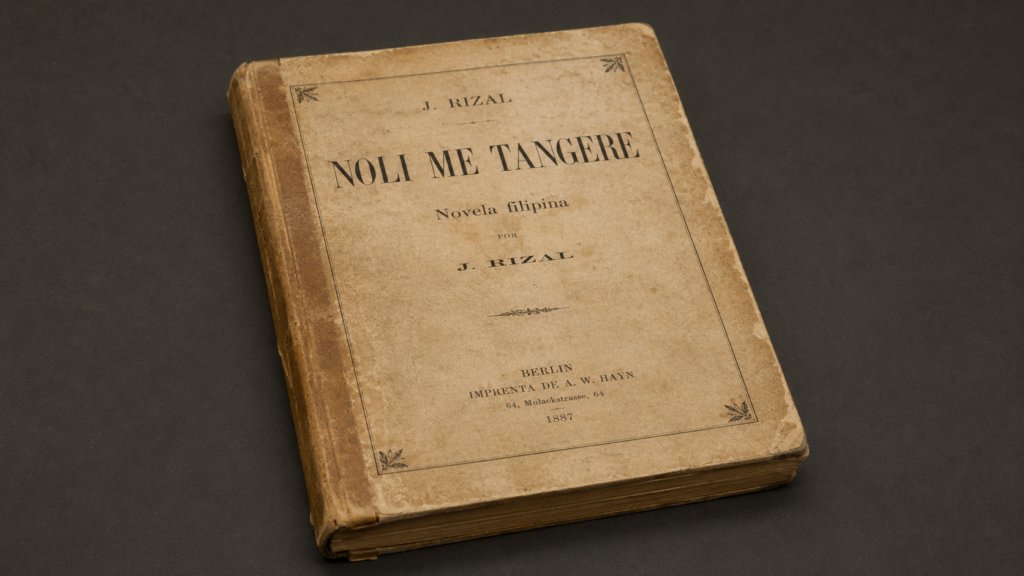
▲ Completing His First Novel
He finished writing the novel while staying in Berlin (February 22, 1887), but he lacked the financial means to publish it. Hearing of this, however, Dr. Maximo Viola, a Filipino residing in Madrid, came forward of his own accord to bear the cost of publication, and so the book was, happily, brought to print. This novel was titled Noli Me Tángere (this was later published in an English translation by the Englishman Charles Derbyshire under the title The Social Cancer, presumably because the author, in this book’s dedication, likens the malignancy of the Philippines to a cancer. There is also another rendering, “Touch Me Not,” which is closer to the original meaning).
The author dedicated this book “To My Fatherland,” and the dedication reads, in substance, as follows:
“Recorded in the history of human suffering is a cancer of so malignant a character that the least touch inflames it and causes agonizing pain. Thus, in the midst of modern civilization, whenever I have wished to summon you before my eyes, to recall the past together with you, or to compare you with other nations, your beloved image has again and again appeared before me, laying bare this cancer of society.
Desiring your welfare, which is our own welfare, and seeking the best remedy for this cancer, I intend to do unto you what the ancients did with their sick: expose you upon the steps of the temple, that all who come to worship may propose a remedy.
To this end, I shall strive to depict your condition faithfully and without partiality. As your child, conscious that I too suffer from your defects and weaknesses, I shall, for the sake of truth, sacrifice everything — vanity itself included — and lift a corner of the veil that conceals this unsightly state.”
This dedication struck a raw nerve with the Spanish authorities and the friars alike. It declared that the misgovernment of the Philippines could no longer be cured by a mere plaster, and that there was no way forward but major surgery and a thoroughgoing cure. This was the first concrete act to display the fierce, fearless spirit he now carried. He sent the completed work to friends in Barcelona and Madrid, who disguised it in various packages to avoid detection and shipped it on to the Philippines.
▲ The Novel Is Warmly Received
It is not hard to imagine that this novel was received with acclaim by the more discerning among the Filipino people, and that it filled those who hated Rizal with equal dismay. Although the characters in the novel had names and positions changed from their real-life counterparts, everything was plain enough that anyone with even a little knowledge of the true situation could clearly identify who was who. This was Rizal’s challenge to Spain’s misgovernment in the Philippines, and to those who were his enemies it was a scathing exposé. It could well be said that, by the same token, Rizal had handed his enemies a convenient pretext for persecution. What we should take note of, however, is this: Rizal already knew that a powerful faction of Spaniards held him as their enemy, and he foresaw that publishing this novel would only further inflame their hostility toward him — even that unforeseen harm might come to him as a result. Yet he still, boldly and fearlessly, sent the novel out into the world, showing true courage in not shrinking from staking his life for the path he believed in. Never bending himself for the sake of his convictions was the noble spirit that ran through his entire life, and the publication of this novel was one expression of that spirit.
After this, at Dr. Viola’s invitation, the two of them toured various places in Germany, Switzerland, and Austria, and visited Dr. Blumentritt at his private residence in Bohemia. The doctor had long been on friendly terms with Rizal through correspondence, and was overjoyed to receive this visit; their friendship grew warmer still, and the doctor, praising Rizal’s greatness in the highest terms, remarked of him, “A man such as he is a gift Heaven sends to the world but once a century.”
He then toured Vienna, Rome, and other cities before sailing from Marseille bound for his homeland (July 5, 1887). Confident in his ability to restore his mother’s lost sight — as he approached his return to his homeland, what filled his mind were the reunion with his beloved family, the painful state of his homeland, and the image of his sweetheart Leonor, whom he could never forget for a single moment.
Looking back, throughout his five years of hard study in Europe, everything he learned of his homeland’s present state through news from home — whether public or private, large or small — was a source of heartache. Soon after he arrived in Spain, a violent cholera epidemic was reported in and around Manila, and he thought of throwing himself into relief efforts there. His father never wrote letters, but was said to always be proud of Rizal and praying for his success. His mother had at first grieved over Rizal’s flight, but later came to wish only that he continue living a devout life. Having been cautioned by his brother, Rizal wrote nothing in his letters to his family except things that would reassure and please his parents and the rest of the household.
▲ Persecution of the Rizal Family
This was indeed a wise policy. Distressing events continued to occur one after another in his home village. The Dominican friars’ persecution of the Rizal family grew ever more blatant, the price of sugar fell, and it was even feared that, if left unchecked, the family might be ruined altogether. His brother, however, advised him it would be best not to return for the time being; one friend counseled that if he insisted on returning, he should first change his nationality to German, British, or American, so as to arrange things such that the Spanish authorities could not lay a hand on him; and others urged him to wait a year and observe the effect that The Social Cancer, already smuggled into the Philippines, was having on society before going home.
Above all, what troubled him most was that, since 1884 (two years after he left for Europe), all word from his sweetheart Leonor had abruptly ceased. That year, a friend had privately informed him that Leonor’s mother opposed her daughter’s marriage to Rizal. He had no way of learning anything about his sweetheart except through third parties. That Leonor might have had a change of heart was something he had not even imagined. Convinced that everything would be resolved the moment they met and spoke, he hurried home by way of the Suez Canal and arrived back in beloved Manila (August 3, 1887).
X X X — Needless to say, his family welcomed him home with great joy. Finding the right opportunity, he performed surgery on his mother’s diseased eyes and succeeded brilliantly, restoring the sight she had lost — a long-cherished wish of his for years. This was the first such surgical operation performed in the Philippines. He had been dexterous with his hands since boyhood, often astonishing those around him with skillful carvings made with an ordinary knife, but the Filipino people, seeing the success of this operation and the fact that a blind woman had regained her sight, felt something akin to mystical wonder at his skill. In addition, seeing his brilliant intellect and his readiness, without the slightest hesitation, to sacrifice himself for the public good, people came to believe that there was nothing Rizal could not do. His reputation as an excellent ophthalmologist spread at once in every direction, and people from near and far flocked in crowds, each eager to be treated by him before the rest.
▲ Tragedy with His Sweetheart
Concerning Leonor, who had been so much on his mind, he discovered a tragic and heartbreaking matter. He had found it strange that word from his sweetheart had ceased, but she too had found it strange that all letters from him had stopped reaching her. After he left for Europe (1882), Leonor’s family had moved to Dagupan, Pangasinan. Her mother had never been pleased about her daughter’s engagement to Rizal and had already expressed her opposition; after the move to Dagupan, she bribed the town’s postal clerk so that any letters from Leonor to Rizal, and from Rizal to Leonor, would all be secretly gathered and handed over to her instead. This was why all communication between the two had ceased. One suspects that, while the mother recognized Rizal’s extraordinary talent, she also saw that he was a marked man in the eyes of the Spanish authorities and that some misfortune might befall him at any moment — and so, for her daughter’s future, she felt it would be safer for her to marry someone other than Rizal. Viewed as a parent’s motive, there may be some reason in this, but for two people bound by a pure and beautiful first love, who had looked forward to their future together with burning passion, this was a tragedy beyond that of merely splitting green wood apart.
Upon his return, he wished at once to visit his sweetheart in Dagupan. Whatever feelings her mother might harbor toward him, he and his sweetheart were openly and formally engaged, and there was no impropriety at all in their meeting. His own parents, however, would not permit it. Respecting his parents’ wishes, he abandoned the trip to Dagupan cleanly, without a single word of complaint.
At the time, it was a long-standing custom among Filipinos that, in matters of this kind, a parent’s will was absolute. Years later, when his own sister grew anxious over a similar matter, Rizal counseled her by recounting his own experience, urging her not to burden their aging parents with worry. Six months before his return home, his work Noli Me Tángere had been sent into the Philippines and was already being read privately in various circles, and its reputation had spread beyond all containing. This was, as touched on earlier, because both the good and bad characters appearing in the story were real people; the matters they were involved in were the raw, lived experience of Filipinos themselves; and above all, it fearlessly pointed out the misgovernment that everyone had until then hesitated even to speak of, out of fear of the Spanish authorities and the friars’ resentment — a bitterness so keen that Filipinos are said to have secretly cheered it in private.