
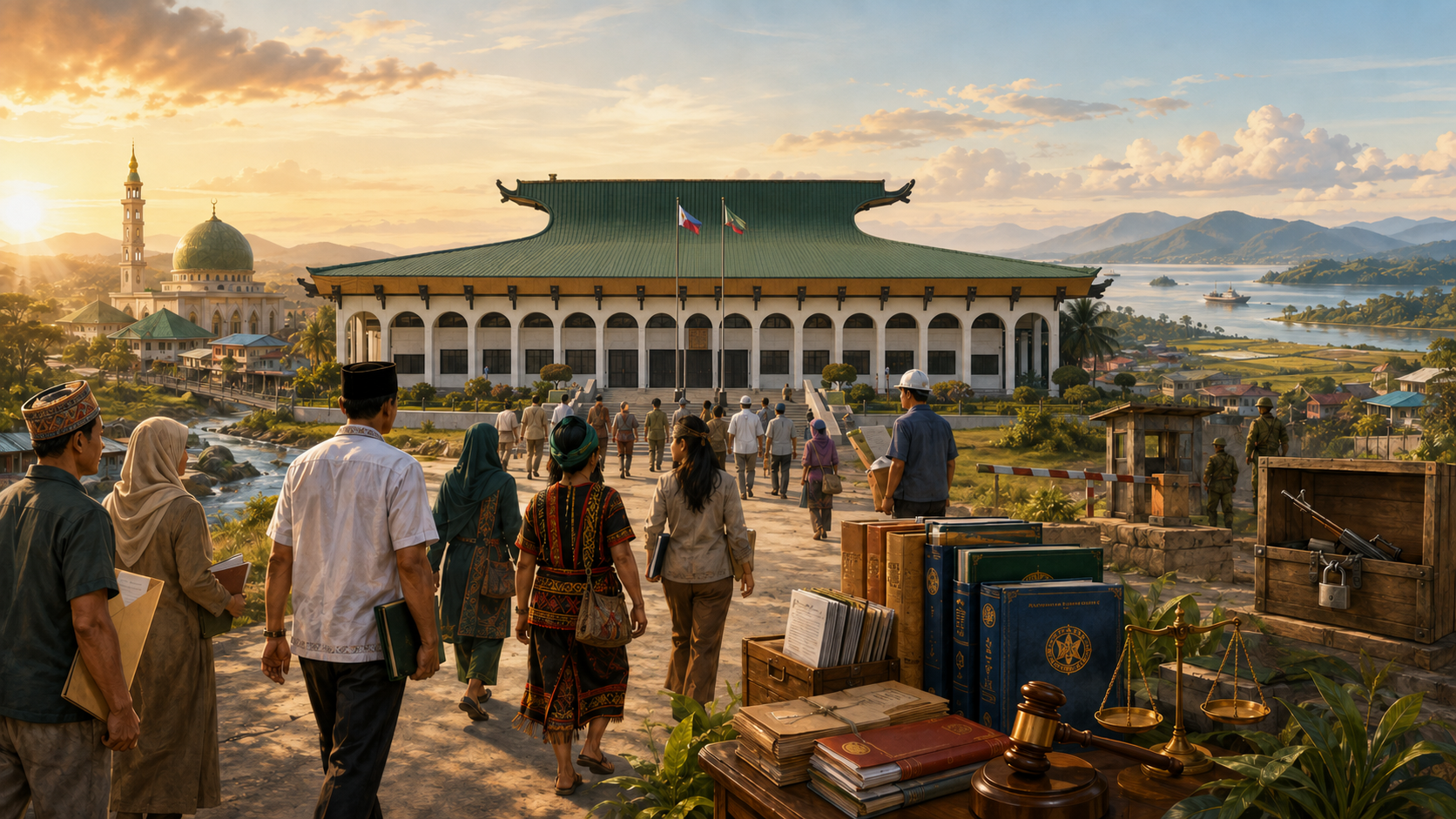
MNLF, MILF, BIFF, Abu Sayyaf, Maute — Decommissioning, Amnesty, and Can Former Combatants Run for Office?
Armed groups in the southern Philippines are often referred to by a string of English-letter acronyms, and are frequently discussed as if they were all the same kind of organization.
But the MNLF, MILF, BIFF, Abu Sayyaf, and the Maute Group differ in when they were formed, their political goals, and their relationship with the government.
The most important thing for understanding today’s Bangsamoro Autonomous Region in Muslim Mindanao (BARMM) is distinguishing between groups that joined the peace process and moved into legal political activity, and groups that rejected peace and continue armed struggle or terrorism.
There are also questions of how far amnesty absolves former combatants of past crimes, and whether their voting rights and eligibility to run for office are restored.
This final installment sorts out the differences among these armed groups and their subsequent political participation.
What Is the MNLF?
The largest Moro armed group in the southern Philippines used to be the MNLF (Moro National Liberation Front).
The MNLF began its armed struggle in the early 1970s, seeking autonomy or independence for the Moro people of the southern Philippines. Its founding leader was Nur Misuari.
The MILF later split off amid internal disagreements over strategy, and the BIFF later split off from the MILF. The rough lineage is as follows.
MNLF
→ the MILF splits off
→ the BIFF splits off from the MILF
Abu Sayyaf and the Maute Group, on the other hand, cannot be explained solely by this lineage of political-organization splits. They are groups formed through a complex mix of international extremist ideology, local crime, foreign fighters, and allegiance to the Islamic State (IS).
Key Differences Among the Main Groups
| Group | Full Name | Main Goal/Character | Relationship with the Government |
|---|---|---|---|
| MNLF | Moro National Liberation Front | Sought autonomy and political rights for the Moro people | Final peace agreement in 1996 |
| MILF | Moro Islamic Liberation Front | Sought stronger autonomy and an Islamic political community | Comprehensive peace agreement in 2014 |
| BIFF | Bangsamoro Islamic Freedom Fighters | Armed faction that rejected the MILF’s peace track | Not covered by the peace agreement |
| Abu Sayyaf Group | Abu Sayyaf Group | Extremism, kidnapping, ransom demands, terrorism | Target of security operations |
| Maute Group | Maute Group | Extremist armed faction claiming allegiance to IS | Target of security operations |
Although all are called Islamic armed groups, the MNLF and MILF accepted peace with the government and have moved to transform themselves into political organizations.
The BIFF, Abu Sayyaf, and the Maute Group, by contrast, are not legal political forces that make up the BARMM government.
MNLF — The First Large-Scale Moro National Movement
The MNLF was the central organization of the Moro national movement that expanded across the southern Philippines in the 1970s.
After fierce fighting under the Marcos administration, it signed the Tripoli Agreement in 1976, brokered by Libya. But disputes over the scope and implementation of autonomy went unresolved, and armed clashes continued.
In 1996, the Ramos administration and the MNLF signed a final peace agreement. This brought the MNLF, in principle, into legal political participation.
Founder Nur Misuari once served as governor of the former Autonomous Region in Muslim Mindanao (ARMM). At the same time, disputes with the government over implementation of the peace agreement recurred, and the MNLF itself split into multiple factions.
Today’s MNLF is divided among a faction led by founding chairman Misuari and another led by Muslimin Sema, among others. Both factions, however, remain within the government’s peace framework.
Muslimin Sema, who once served as mayor of Cotabato City, has held posts such as BARMM’s labor and employment minister and a seat in the interim parliament — moving toward administrative and political activity rather than armed struggle.
Nur Misuari, too, continues to be active as the MNLF’s founding leader, taking part in talks with the government.
It is therefore inaccurate to view the MNLF today as a single, monolithic anti-government force. Although the organization has split, its main factions have chosen the path of peace and political participation.
MILF — The Organization That Achieved BARMM’s Establishment
The MILF is an organization that split off from the MNLF.
Its founding leader was Salamat Hashim, who pushed a stronger Islamic character than the MNLF while continuing armed struggle against the Philippine government.
After Salamat Hashim’s death, Ahod “Al Haj Murad” Ebrahim became chairman.
After long peace negotiations, the MILF signed the “Comprehensive Agreement on the Bangsamoro” with the Philippine government in 2014. This peace agreement was translated into law through the Bangsamoro Organic Law enacted in 2018.
In 2019, BARMM was formally established, and Murad Ebrahim led the regional government as its first interim Chief Minister. He stepped down as interim Chief Minister in 2025, but continues his political activity as MILF chairman and leader of the United Bangsamoro Justice Party.
The MILF is in the process of transforming itself from an armed group into a legal social and political movement. That said, its decommissioning is not fully complete.
How Far Has MILF Decommissioning Progressed?
MILF decommissioning is not simply a matter of taking guns away from soldiers.
Under the peace agreement, it is carried out as part of “Normalization”: combatants and weapons are verified and removed from the military organization, and former combatants and their families are provided education, vocational training, healthcare, and cash assistance to transition to civilian life.
Decommissioning is handled by a third-party body called the Independent Decommissioning Body.
According to the Philippine government, from 2015 through the third phase, roughly 26,000 MILF combatants and 4,625 weapons had been processed for decommissioning.
| Phase | Combatants Covered | Weapons Covered |
|---|---|---|
| Phase 1 | 145 | 75 |
| Phase 2 | 12,000 | 2,100 |
| Phase 3 | Approx. 13,987 | 2,450 |
| Phase 4 (planned) | 14,000 | 2,575 |
Phase 4 is meant to be the final phase, but the MILF decided to postpone it, arguing that the government had not sufficiently fulfilled its obligations, such as socioeconomic support for former combatants.
In July 2025, the government announced that decommissioning of the 14,000 combatants and 2,575 weapons planned for the final phase had been postponed.
In other words, MILF decommissioning has advanced significantly but is not complete.
The number of decommissioned combatants and the number of weapons are also not the same figure. This is not a system where each combatant surrenders exactly one gun — rather, combatants and weapons that the organization declares are verified and processed in stages.
Looking at these numbers alone, it is not possible to precisely calculate how many weapons remain unsurrendered.
BIFF — Split From the MILF in Opposition to Peace
The BIFF (Bangsamoro Islamic Freedom Fighters) was founded by Ameril Umbra Kato, who opposed the MILF’s peace negotiations.
Kato broke away from the MILF, opposing the abandonment of independence demands through peace with the Philippine government. After his death in 2015, the BIFF split into multiple factions.
The BIFF is not a party to the comprehensive peace agreement between the government and the MILF. It is therefore not automatically absorbed into the MILF’s decommissioning system either.
Some members have surrendered to the government, handed over weapons, and joined reintegration programs. But the remaining forces are targets of military and police security operations, and are not a formal part of the BARMM government.
BIFF members are not entitled to MILF-directed amnesty simply because they once belonged to the MILF. It is judged case by case which period, which organization, and which crime is involved.
Abu Sayyaf — On the Border Between Political Movement and Criminal Organization
The Abu Sayyaf Group was founded in the early 1990s by Abdurajak Janjalani.
Janjalani died in 1998, and the group was subsequently led by figures including his brother Khadaffy Janjalani. Khadaffy also died, in 2006.
Abu Sayyaf later split into multiple factions operating in areas such as Basilan and Sulu.
While claiming to seek the establishment of an Islamic state, it repeatedly carried out kidnappings of foreigners and local residents, ransom demands, bombings, and killings — meaning it has been treated both as a political anti-government group and as a terrorist/criminal organization.
In recent years it is said to have been significantly weakened by military and police operations, the deaths of leaders, and the surrender of members. However, it cannot be stated with certainty that small remaining factions or affiliates have disappeared entirely.
Unlike the MNLF or MILF, Abu Sayyaf today has no single representative leader whom the government recognizes as a peace-negotiation counterpart. It is more accurate to understand it as a set of regionally fragmented remnant factions.
The Maute Group — the IS-Affiliated Force That Seized Marawi
The Maute Group formed in Lanao del Sur province, centered on the brothers Abdullah and Omar Maute.
The group declared allegiance to the Islamic State, and in 2017, together with Abu Sayyaf’s Isnilon Hapilon and others, seized Marawi city.
The fighting lasted roughly five months, and urban warfare with the Philippine military left many dead and displaced. Both Maute brothers and Hapilon died in the fighting.
After the Battle of Marawi, the group’s core was destroyed, but there remains a possibility that surviving members or support networks continue operating under different names or as small cells.
The Maute Group is not a party to the peace process that established BARMM. It is therefore not guaranteed political participation as a “former rebel group” in the same way as the MILF or MNLF.
Amnesty Is Not a System That “Unconditionally Absolves Everyone”
The Philippine government has established an amnesty program for MILF and MNLF members.
The current legal basis is Presidential Proclamations No. 405 and No. 406, issued in November 2023.
- Proclamation No. 405 covers MILF members
- Proclamation No. 406 covers MNLF members
Eligible for amnesty are acts such as rebellion, incitement, illegal assembly, and resistance to authorities carried out in connection with the pursuit of political beliefs.
Illegal possession of firearms, ammunition, and explosives incidental to rebellion or unrest can also be covered, under certain conditions.
But simply having belonged to an organization does not mean automatic amnesty.
Applicants must swear to and acknowledge their involvement in the covered crimes, and must surrender any firearms, weapons, or explosives in their possession. The National Amnesty Commission reviews applications, and a certificate of amnesty is issued to those ultimately approved.
Applying alone does not establish amnesty.
Some Crimes Are Not Covered by Amnesty
Amnesty for MILF and MNLF members is not a system that erases all past crimes.
The following crimes are, in principle, excluded from amnesty.
- Kidnapping for ransom
- Massacre
- Rape
- Acts of terrorism
- Crimes committed for personal gain
- Illegal drug offenses
- Grave breaches of the Geneva Conventions
- Genocide
- Crimes against humanity
- War crimes
- Torture
- Enforced disappearance
- Other serious human rights violations
It is therefore incorrect to assume that “joining the peace process absolves all crimes, including murder or kidnapping.”
The system distinguishes between crimes that can be pardoned as political rebellion and crimes punished as acts committed for personal gain or as atrocities.
Also, even when amnesty extinguishes criminal liability, civil liability — such as damages owed to victims — remains.
Are Amnesty Applicants Protected From Arrest?
In April 2025, the government established a system to issue Safe Conduct Passes to certain amnesty applicants.
This is meant to let former members who might otherwise avoid applying out of fear of arrest come forward safely and undergo review.
However, the pass has its limits.
- It does not release someone already detained under a valid arrest warrant
- It does not authorize possession of unregistered firearms
- Holding the pass alone does not finalize amnesty
- It does not protect against crimes not covered by amnesty
In other words, a Safe Conduct Pass is not a “certificate that you can do anything without being arrested.”
Can Former Combatants Run for Elected Office?
Having been a former MILF or MNLF member is not, in itself, a reason to lose eligibility to run for office.
Transitioning from an armed group to a legal party or social movement, and pursuing political goals through elections, is a central purpose of the peace agreement.
In practice, some former MILF and MNLF leaders have served as members of the BARMM interim parliament, cabinet ministers in the autonomous government, and heads of local government units.
The MILF organized the United Bangsamoro Justice Party, and various MNLF factions are also moving into electoral politics.
This does not mean, however, that any former combatant can run for office unconditionally.
Under Philippine election law, those with the following final criminal convictions may lose eligibility to run for office.
- Crimes related to rebellion, insurrection, or subversion
- Crimes punished with a sentence exceeding 18 months
- Crimes involving moral turpitude, i.e. serious moral depravity
- Election offenses
- Crimes carrying permanent disqualification from public office
For local elections, separate disqualification provisions under the Local Government Code also apply.
On the other hand, if someone formally receives a full or appropriate amnesty, civil and political rights suspended or lost due to the crime may be restored, potentially reviving eligibility to run for office.
Presidential Proclamations No. 405 and No. 406 likewise provide that formal amnesty restores civil and political rights suspended or lost due to conviction.
That said, actual eligibility is judged case by case, based on the content of the amnesty certificate, the type of crime, the sentence, any accessory penalties, and the office being sought.
Do Many Former Members Lose Their Voting Rights?
Under Philippine law, those convicted of certain crimes may have their voting rights suspended or forfeited.
But there is no reliable public statistic that tallies the number of people who have lost voting rights broken down by former affiliation — MILF, MNLF, BIFF, and so on.
It is therefore not possible to assert that “most former armed-group members have been stripped of their voting rights.”
In reality, a mix of the following types of people exists.
| Status of Former Member | Approach to Voting Rights/Eligibility to Run |
|---|---|
| No criminal record | In principle, treated the same as any ordinary citizen |
| Charged, but no conviction | Being charged alone does not uniformly strip rights |
| Final criminal conviction | May be restricted depending on the sentence and type of crime |
| Received formal amnesty | Political rights related to the covered crime may be restored |
| Amnesty application pending | Rights restoration is not confirmed by application alone |
| Convicted of a serious crime excluded from amnesty | Subject to ordinary criminal and election-law restrictions |
What matters is not which organization someone belonged to in the past, but whether there is a final criminal conviction, what crime they were punished for, and whether amnesty was formally granted.
Where Are the Former Leaders Now?
A summary of the main organizations, their leaders, and their status to date is as follows.
| Group | Key Leader | Status to Date |
|---|---|---|
| MNLF | Nur Misuari | Involved in peace talks with the government as founding chairman |
| Main MNLF faction | Muslimin Sema | Moved into political/administrative activity; held public office in BARMM |
| MILF | Murad Ebrahim | MILF chairman; served as BARMM’s first interim Chief Minister, now in party politics |
| BIFF | Ameril Umbra Kato | Died 2015; organization split into multiple factions |
| Abu Sayyaf | Abdurajak Janjalani | Died 1998 |
| Abu Sayyaf | Khadaffy Janjalani | Died 2006 |
| Maute Group | Abdullah and Omar Maute (brothers) | Died in the 2017 Battle of Marawi |
| Joint IS-affiliated force | Isnilon Hapilon | Died in the 2017 Battle of Marawi |
The main leaders of the MNLF and MILF moved from armed struggle into political negotiation, administration, and electoral activity.
Meanwhile, most of the prominent leaders of the BIFF, Abu Sayyaf, and the Maute Group died in security operations or fighting, and their organizations fragmented and weakened. That said, a leader’s death does not automatically mean the disappearance of remaining members, illegal weapons, financing networks, or family/community ties.
Peace Is Not a Story of “an Armed Group Taking Over the Government”
In BARMM, leaders and former members of the MILF, who once fought the state, now take part in running the government.
Viewing this simply as “an armed group whose past crimes were absolved and that then became the government as-is” fails to capture the actual structure of the peace system.
What the peace agreement aimed for was building a system in which pursuing political demands through elections, parliament, political parties, and administration is more effective than continuing armed struggle.
To that end, the establishment of the autonomous government, fiscal authority, the parliamentary system, the reintegration of former combatants, decommissioning, and amnesty are combined into a single framework.
But much of the peace process remains unfinished.
- The MILF’s final phase of decommissioning has not been completed
- Illegal weapons remain within communities
- Private armed groups have not been fully dismantled
- The MNLF remains split into multiple factions
- The BIFF and other extremist remnants still exist
- Livelihood and employment support for former combatants is behind schedule
- Local domination by politicians and powerful clans continues
Whether BARMM succeeds cannot be judged simply by whether former armed-group leaders have taken public office.
What is being tested is whether power can change hands without weapons, whether opposition groups are guaranteed the chance to take part in elections, whether former combatants can rebuild their lives, whether victims of serious crimes are not left behind, and whether the law is enforced equally regardless of political affiliation.
What Four Installments Have Shown
This series examined the following questions by comparing BARMM to an ordinary Philippine local government.
Part 1 covered BARMM’s autonomous powers, fiscal system, tax revenue, natural resources, transfers from the central government, and the possibility of territorial expansion.
Part 2 sorted out police authority, the military, land registration, public and private land, state land, and the currency system.
Part 3 examined unregistered firearms, security companies, the private armies of politicians and clans, vigilante groups, and the legal status of the JPST.
And this fourth part has explained the differences among the MNLF, MILF, BIFF, Abu Sayyaf, and the Maute Group, along with decommissioning, amnesty, and voting/candidacy eligibility.
BARMM is neither an independent country nor a special zone exempt from Philippine law.
At the same time, it holds broader legislative, fiscal, and administrative powers than an ordinary province or municipality, and carries the special role of converting decades of armed conflict into a political system.
BARMM receives an annual block grant and a special development fund from the central government, and has been given strong authority over certain tax revenues and natural-resource income. In that sense, it may hold conditions more favorable for economic development than surrounding areas.
But funding and autonomy alone do not automatically produce development.
Unless BARMM can resolve decommissioning, the rule of law, anti-corruption, administrative capacity, protection of religious and ethnic minorities, fair elections, and the security problems that deter private investment, its institutional advantages will not translate into real development.
BARMM is a large-scale political experiment in which, rather than militarily crushing an anti-government force, the Philippine government sought to bring it into the framework of the state by granting autonomy, fiscal power, a parliament, and elections.
Whether it succeeds will serve as a touchstone not only for the Bangsamoro people, but for the peace and governing capacity of the Philippines as a whole.
※This article is a general explainer based on laws and government materials available as of August 2026. Because armed groups have splintered into multiple factions, the leadership and numbers of remaining forces are subject to change, and figures or names may differ across government statements. Questions of an individual’s amnesty, criminal liability, or eligibility to run for office are determined case by case based on the relevant conviction, amnesty certificate, election law, and other circumstances.
Main References:
- Presidential Proclamation No. 405 — Amnesty for MILF Members
- Presidential Proclamation No. 406 — Amnesty for MNLF Members
- Memorandum Order No. 36 — Safe Conduct Pass for Amnesty Applicants
- Philippine Government Peace Process Office — Statement on MILF Decommissioning Deferral
- Philippine Government Peace Process Office — Progress on MILF Decommissioning
- Philippine Government Peace Process Office — MNLF and Government Peace Cooperation
- Republic Act No. 11054 — The Bangsamoro Organic Law
- Philippine Supreme Court Ruling on Candidacy Disqualification Under the Omnibus Election Code
コメント